Industrial Utility Efficiency

ISO and CAGI

To further support transparency and confidence in compressed air system equipment performance, CAGI established the Performance Verification Program. This third-party testing initiative verifies that participating manufacturers’ published performance data, such as energy consumption, flow rate and efficiency, are accurate and consistent with industry standards.
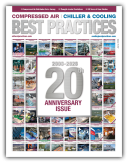
CAGI Releases Compressed Air Purity Guide

The Compressed Air and Gas Institute has released a Compressed Air Purity Guide to help industries achieve clean, dry compressed air and improve system reliability. The guide applies ISO 8573-1 to classify contaminants such as particles, water and oil, and defines purity levels for plant, instrument and process air. It also outlines key technologies like dryers and filtration systems to ensure optimal air quality and equipment protection.

Pressure Dew Point Monitoring: The Key to ISO 8573-1 Compliance

The ISO 8573-1 standard defines clear limits for various compressed air quality parameters. This helps users classify their systems consistently, compare results across applications and set the right requirements for specific processes. This article explains the key points of the ISO 8573 standard and guides you through the correct way to measure and classify pressure dew point for compliance.

Meeting ISO 8573-1 Compressed Air Quality Specifications

The ISO 8573-1 was developed to provide standardized classes for compressed air purity in terms of particles, water and oil to drive the planning and design of compressed air systems in order to deliver the quality desired or required. This article explores why testing compressed air quality is as essential as choosing the right filtration, discusses real-world experiences, illustrates the risks of assuming things are right and explains the value of compressed air measurement. 

The Case For Low Horsepower, Two-Stage Rotary Screw Air Compressors

The isentropic efficiency of single-stage rotary screw air compressors, as reported by CAGI data, typically falls between 65% and 75%. Since isentropic efficiency is the ratio of ideal work to actual work, this range suggests these air compressors consume roughly 33% to 54% more power than the theoretical minimum for the given air pressure output. Much of the discussion in this article is theoretical since low-horsepower two-stage air compressors are new to the U.S. market. 

CAGI Personnel Certification: How to Have Your Own Personal Performance Verification Program

CAGI sponsors and oversees a performance verification program for some types of equipment. In this program, which is expanding to include additional types of products, a third-party verifies performance data that is stated by manufacturers. Participants in these programs are able to use a standardized CAGI datasheet to state performance. The datasheets and verification process provide customers with assurance that they are getting what they pay for in terms of performance.

Isentropic Efficiency of Rotary Screw Air Compressors

Many astute air compressor users have noticed the Compressed Air and Gas Institute (CAGI) air compressor data sheets, dated after June 2020, have a new term listed; isentropic efficiency. Isentropic Efficiency will be the new standard of reference for a true comparison of the overall efficiency of air compressors at any rated discharge pressure. Now users can see which company produces the most efficient product with an easy reference percentage number. The compressed air industry, in conjunction with CAGI, has been trying to make fair comparisons between air compressors for years. 

Achieving “Technically Oil-Free” Compressed Air

In this article we will discuss how to achieve actual oil-free air from your air compressor, no matter what type of air compressor it is. Air compressors of all designs turn mechanical power into pneumatic power by successively concentrating air across compression stages. A rotary screw air compressor, for example, utilizes rotating helical screws to drive air forward, increasing its pressure by reducing the volume of space the air mass takes up. Mechanical compression of this nature takes quite the force and energy to accomplish, which equates to heat generation and physical wear inside of the compressor. 

ISO 50001: How Manufacturers Can Achieve a Low-cost and Low-carbon Future

For an organization to prove that it meets the standard it has to undergo a management system audit, either internal or external. The question, therefore, is how can those utilizing compressed air effectively evaluate their assets’ performance as part of an ISO 50001 energy management system and, in doing so, grow their bottom line and minimize their negative environmental footprint.

How to Implement Aseptic Technique in Microbiological Compressed Air Testing

In modern and industrial work settings, people spend more than 90% of their time in enclosed spaces, such as warehouses, office buildings and factories. In most indoor environments, the air contains a variety of chemical and microbial particles, commonly defined as indoor pollutants, which can severely affect human health and product quality (1). Industries like food and beverage, medical devices and pharmaceutical manufacturers rely on their scheduled compliance testing to confirm the presence or absence of issues in workflow pipelines that are detrimental to the daily output and safety of the product.

Compressed Air and Energy Management Systems Based on ISO 50001: What You Need to Know

An Energy Management System (EnMS) according to ISO 50001:2018 provides companies with a strategic tool to help manage the performance of energy-consuming equipment, including compressed air systems. Improved performance of a compressed air system, in turn, can go a long way toward lowering energy costs and improving system uptime, both of which provide the ability to reduce the company’s carbon footprint. Here’s a look at the standard and important considerations involved in the implementation of an EnMS for a compressed air system according to ISO 50001.