Industries
Pneumatic air cylinders play a major role in allowing a modern sawmill to produce at the high-speed production rates required. Stable air pressure is critical to allow the air cylinders to respond in a timely manner and avoid any production delays.
Auto
There are three main segments in Visteon's climate group are climate systems, powertrain cooling and engine induction. Climate systems include refrigeration compressors, fluid transport, heat exchangers, battery cooling modules, climate controls, auto defog/demist systems, and multi-zone HVAC systems. Powertrain cooling systems include heat exchangers (radiators, condensers, charge-air, exhaust-gas), airflow management, and diesel and hybrid thermal management. Engine induction includes air induction systems and intake manifolds.
Bulk
In thermal power stations, nuclear plants, and chemical and industrial plants, different types of bulk materials are used. The materials exist in different forms including lump, powder, granules, chips, and pallets. These bulk materials, in their different forms, require efficient and reliable material handling systems.
Food
This Midwestern prepared food company now spends $131,011 annually on energy to operate their compressed air system. This figure will increase as electric rates are raised from their current average of 6.0 cents per kWh. The set of projects recommended below will reduce these energy costs by $38,736 or 29%.
Medical
In the U.S. as an example, the NFPA has taken the view that if your compressor draws in good clean ambient air, the air stays clean through the compressor, is then dried and filtered, when you deliver it to the patient it will be entirely satisfactory. After all, when you went into the hospital that’s what you were breathing and when you leave you will breathe it again!
Metals
This aluminum mill spends $369,000 annually in energy costs to operate their compressed air system. This system assessment recommends actions reducing annual energy costs by $120,000 and improving productivity and quality by delivering clean, dry compressed air.
Paper
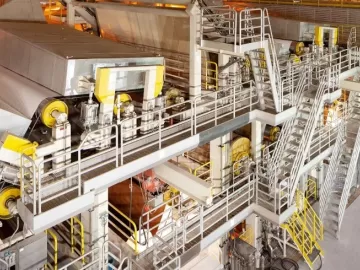
Pneumatic air cylinders play a major role in allowing a modern sawmill to produce at the high-speed production rates required. Stable air pressure is critical to allow the air cylinders to respond in a timely manner and avoid any production delays.
Pharmaceutical
The United States accounts for roughly half of the global pharmaceutical market. This certainly keeps the Food and Drug Administration (FDA) busy in its oversight of pharmaceutical safety and effectiveness, including with the production processes. As the pharmaceutical industry has grown, so too has its utilization of compressed air for breathing air, operation of equipment and instrument air.
Plastics
Most P.E.T. bottle-blowing machines require anywhere from 550 psig (38 barg) to 580 psig (40 barg) and an air flow of 247 cfm FAD (420 m3/hr) to 3700 cfm FAD (6290 m3/hr). The air compressor technology used most prevalently for this application is the double-acting, oil-free, water-cooled, reciprocating air compressor. With the higher pressures and air flows that are required, the P.E.T. bottle blowing market is a strong niche market for the double-acting oil-free reciprocating (piston) compressors.
Power
Nuclear power plants produce electricity for people, business and industry. Electricity is produced in a similar fashion as fossil fuel (i.e., coal, oil, etc.) power plants, using steam to drive a turbines which spin an electrical generator, producing the electricity.
Printing
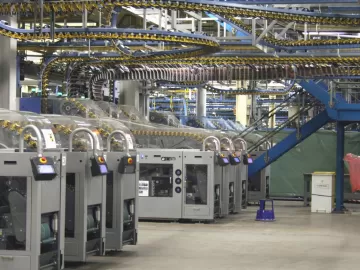
Compressed Air Best Practices interviewed Michael D. Manzella. Mr. Manzella is a Senior Vice President, Environmental, Health, Safety and Quality (EH&S), and also the Chief Sustainability Officer for RR Donnelley (RRD).
Transit
How do you test a 747 engine to ensure reliability once it’s airborne at 600 miles an hour?
Wastewater
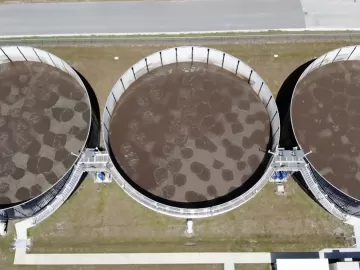
The Focus on Energy Water and Wastewater Program was developed to support the industry because of the enormous potential to reduce energy use without compromising water quality standards. Through the program, numerous water and wastewater personnel have learned that energy use can be managed, with no adverse effects on water quality. Most locations that have saved energy have found improved control and treatment.
The PET industry is in a state of flux right now. A number of new bottle blowing facilities are being brought on-line. They are in the “discovery” phase right now as they realize how challenging the required compressed air systems are to manage – from an energy efficiency standpoint. The average high-volume stretch blow molder (SBM) working with PET usually has 2,000 to 4,000 horsepower of installed air compressors with the related energy costs running between $1 to $4 million per year. This typically represents 35-40% of the facilities’ total energy bill.
[ Read Full Story ]
Bottling companies and breweries, in California, are benefiting from a three-step system assessment process aimed at reducing the electrical consumption of their compressed air systems. The three-step process reduces compressed air demand in bottling lines by focusing on open blowing and idle equipment, and then improves the specic power (reducing the energy consumption) of the air compressors.
[ Read Full Story ]
Many passenger cars on roads in Germany contain efficiency concepts that make a considerable contribution to lowering emissions. Automotive manufacturers such as VW have gone even further than this, by applying efficiency strategies in their own value added chain. Because the benefits of pneumatics in automotive industry production processes have seen pneumatic actuation win over other drive technologies, efficient use of compressed air plays a key role in increasing energy efficiency.
[ Read Full Story ]
The United States accounts for roughly half of the global pharmaceutical market. This certainly keeps the Food and Drug Administration (FDA) busy in its oversight of pharmaceutical safety and effectiveness, including with the production processes. As the pharmaceutical industry has grown, so too has its utilization of compressed air for breathing air, operation of equipment and instrument air.
[ Read Full Story ]
This Midwestern prepared food company now spends $131,011 annually on energy to operate their compressed air system. This figure will increase as electric rates are raised from their current average of 6.0 cents per kWh. The set of projects recommended below will reduce these energy costs by $38,736 or 29%.
[ Read Full Story ]
Nitrogen, an inert gas comprising 79% of the atmosphere, can be distilled from ordinary air. However, companies that use this product in their everyday operations know that it’s not quite that simple and much more expensive than the stuff we breathe. The primary means of obtaining nitrogen for industrial use is to transport it onsite in liquid form, which must be shipped stored at cryogenic temperatures. But, really, what’s the point of turning nitrogen into liquid for shipping, transporting it to where it’s used, and then turning it back into gas?
[ Read Full Story ]
Drinking water and wastewater systems account for approximately 3-4 percent, equivalent to approximately 56 billion kilowatts (kW), or $4 billion, of energy use in the United States, adding over 45 million tons of greenhouse gases annually. Further, drinking water and wastewater plants are typically the largest energy consumers of municipal governments, accounting for 30-40 percent of total energy consumed.
[ Read Full Story ]
The Focus on Energy Water and Wastewater Program was developed to support the industry because of the enormous potential to reduce energy use without compromising water quality standards. Through the program, numerous water and wastewater personnel have learned that energy use can be managed, with no adverse effects on water quality. Most locations that have saved energy have found improved control and treatment.
[ Read Full Story ]
The concept offers new possibilities for generating positive pressure or vacuum in a variety of applications. “By applying screw compressor technology to low-pressure air compression, we’ve greatly improved efficiency,” said Pierre Noack, President and CEO of Aerzen USA. The Delta Hybrid has seven patents or patent applications, making it one of the most innovative products in compression technology.
[ Read Full Story ]
The object of this article is to look at some very typical industrial water treatment processes and various compressed air and energy savings projects that have worked well for our clients over the years. The basic fundamentals with regard to compressed air usage are similar to municipal water treatment – a good starting point.
[ Read Full Story ]
- 1 of 16
- ››


.jpg?1264532069)