System Assessment
This facility is part of a major corporation with dozens of manufacturing facilities where consumer good food products are processed and packaged for shipment to retail outlets. The factory was spending $210,000 annually on energy to operate their compressed air system. This system assessment detailed four (4) project areas where yearly energy savings totaling $100,855 could be found with an investment of $100,000.
Compressor Controls
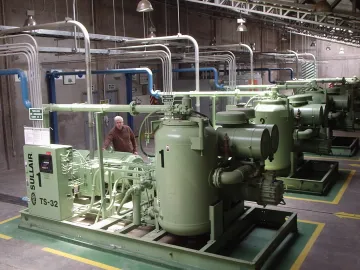
The facility generates compressed air with six (6) air compressors of various sizes located in three different compressor rooms. In recent years, the entire system converted to desiccant air dryers. Available equipment from other facilities has been utilized. The following is the layout of the facility showing the locations of the compressor rooms.
Piping Storage
The Compressed Air Challenge® Fundamentals and Advanced training discuss the benefits of using central controllers to efficiently control system compressors. These systems are called “System Master” controls. Modern day System Master Controls use advanced technologies to network air compressors in a preprogrammed sequence. A properly configured network with the right size and type of trim compressor can typically hold the supply air pressure in a tight band of +/- 2 psi. Because of this capability, many users feel the application of System Master Control negates the benefit of applying Pressure-Flow Control to stabilize the plant air pressure.
End Uses
Stretch blow molding equipment requires a significant amount of energy—both compressed air and electrical—to produce bottles. Creating an effective and efficient process, as well as monitoring and maintaining optimal process settings, can result in significant energy cost reduction. These efforts will also help produce containers that meet all of the required quality standards.
Pressure
International Wire Group, Inc. (IWG) headquartered in Camden, NY is the largest bare copper wire and copper wire products manufacturer in the United States with expanding operations in Europe. Products include a broad line of copper wire configurations and gauges with a variety of electrical and conductive characteristics , which are utilized by a wide variety of customers primarily in the industrial and energy, electronics, data communications, aerospace and defense, medical electronics and devices, automotive, and consumer and appliance industries.
Air Treatment/N2
This northeastern U.S. automotive manufacturing facility spends $269,046 annually on energy to operate their compressed air system. This figure will increase as electric rates are raised from their current average of .019 cents per kWh. The set of projects, in this system assessment, reduce these energy costs by $110,166 or forty percent. Reliability of compressed air quality, however, is the main concern in this plant and the primary focus of this system assessment.
Leaks
“Instead of adding supply equipment, we fix air leaks and incorporate high-efficiency air nozzles, blower packages and point-of-use receivers.” These demand-side actions stabilize compressed air system pressure and this ultimately increases production output, reduces production down-time and spoilage costs, and decreases the power costs of the compressed air system.
Pneumatics
Currently, and for good reason, much attention is being focused on the conservation of energy. Compressed air, like electricity and gas, is an energy resource. It has often been referred to as the third utility. As with all energy sources, our global environment demands that it be conserved and used wisely.
Vacuum Blowers
Every municipality and utility is facing the reality of rising energy costs. In 2010, the Town of Billerica, MA, which is located 22 miles northwest of Boston with a population of just under 40,000 residents, engaged Process Energy Services and Woodard & Curran to conduct an energy evaluation of the Town’s Wastewater Treatment Facility (WWTF) and pump station systems sponsored by National Grid. The objective of the evaluation was to provide an overview of each facility system to determine how electrical energy and natural gas were being used at the facility and to identify and develop potential costsaving projects.
This factory, located in the U.S. northeast, spent an estimated $120,000 annually on energy to operate the compressed air system. The group of projects recommended below reduced these energy costs by $73,700 or 61% of current use. These estimates are based upon a blended electric rate of $0.114/kWh.
[ Read Full Story ]
Currently, and for good reason, much attention is being focused on the conservation of energy. Compressed air, like electricity and gas, is an energy resource. It has often been referred to as the third utility. As with all energy sources, our global environment demands that it be conserved and used wisely.
[ Read Full Story ]
Every municipality and utility is facing the reality of rising energy costs. In 2010, the Town of Billerica, MA, which is located 22 miles northwest of Boston with a population of just under 40,000 residents, engaged Process Energy Services and Woodard & Curran to conduct an energy evaluation of the Town’s Wastewater Treatment Facility (WWTF) and pump station systems sponsored by National Grid. The objective of the evaluation was to provide an overview of each facility system to determine how electrical energy and natural gas were being used at the facility and to identify and develop potential costsaving projects.
[ Read Full Story ]
Stretch blow molding equipment requires a significant amount of energy—both compressed air and electrical—to produce bottles. Creating an effective and efficient process, as well as monitoring and maintaining optimal process settings, can result in significant energy cost reduction. These efforts will also help produce containers that meet all of the required quality standards.
[ Read Full Story ]
The facility generates compressed air with six (6) air compressors of various sizes located in three different compressor rooms. In recent years, the entire system converted to desiccant air dryers. Available equipment from other facilities has been utilized. The following is the layout of the facility showing the locations of the compressor rooms.
[ Read Full Story ]
This plastic extrusion factory spent an estimated $180,711 annually on energy to operate the compressed air system at their Midwestern facility. Based on the air system operating 8,760 hours per year, the group of projects recommended below could reduce these energy costs by an estimated $116,520 or 67% of current use. Estimated costs for completing the recommended projects total $20,100. This figure represents a simple payback period of 2 months.
[ Read Full Story ]
This meat processing and packaging factory spent an estimated $203,640 annually on energy to operate the compressed air system at their Midwestern facility. Based on the air system operating 8,760 hours per year, the group of projects recommended below could reduce these energy costs by an estimated $107,522 or 47% of current use. In addition, these projects will decrease compressor maintenance costs. Estimated costs for completing the recommended projects total $21,900. This figure represents a simple payback period of 2 months.
[ Read Full Story ]
How does one become a top notch compressed air auditor? There is very little in the way of formal schooling available to help interested persons become competent in the art of assessing compressed air systems or recommending improvement measures. As we will read in the following interview, having an excellent attitude a good aptitude, applying continuous learning techniques, using the Compressed Air Challenge’s excellent training seminars and materials, and seeking out mentorship opportunities have allowed one compressed air auditor to progress from a ”dumb kid” parts clerk to the Vice-President of Business Development for Industrial Air Centers.
[ Read Full Story ]
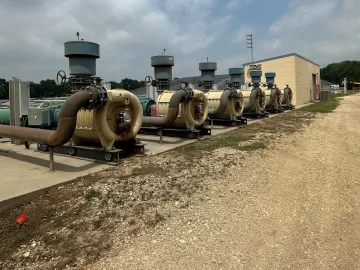
This facility operates one of the largest compressed air installations in industry, with 21 4000 hp process air and five 750 hp instrument air centrifugal compressors to support large-scale aerobic fermentation and related processes that require large volumes of oxygen.
[ Read Full Story ]
Energy management requires accurate and repeatable measurement of critical data, which is easily monitored and analyzed as required to stimulate required action. When a compressed air system assessment is implemented, the basic minimum measurement protocol to establish the baseline (pre‐measurement) and qualify and quantify the results (post‐measurement)
[ Read Full Story ]
- 1 of 15
- ››