Industrial Energy Savings    

Technology

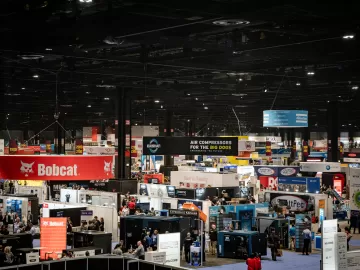
I spent four full days walking the COMVAC (Compressed Air & Vacuum) Halle and was very impressed by the innovations in compressed air system technologies. It is clear our sector is investing in true product enhancements. The goal of this article is to highlight new technologies that caught my eye.

Air Compressors

Compressed air quality is measured by the amount of solid particulates, water and oil content in one cubic foot (cu. ft.) of compressed air. Many of these contaminants are introduced from the air surrounding the installation site that is drawn into the system at the beginning of the compression process. The relative humidity, type of compressor and air treatment and filtration system can also affect air quality. Minimum air quality requirements vary by industrial application; the most stringent standards apply to manufacturers whose end products, packaging or critical instrumentation come in direct contact with compressed air.

Air Treatment

  In an ideal world, industrial air or gas supply lines would be free of particulate, water, oil and other contaminants. In the real world, however, supply lines typically deliver some contaminants along with the air or gas they were designed to carry. Left unchecked, these contaminants will cause efficiency losses, maintenance headaches and the premature failure of pneumatic components.

Blowers

We have industrial accounts where we mix chemicals and acids. Our favorite is blending wine and spirits using compressed nitrogen. The old way to blend was to use “air rousing.” This was done by installing rows of perforated pipes in the bottom of the tank and attaching an air pipe to this grid. Since the typical mixing cycle was 45 minutes, copious amounts of air and energy were used.

Compressor Controls

Air Demand Increase of 43% Results in Only a 5% Energy Cost Increase Compressed air is an expensive medium; yet, many compressed air systems are wastefully managed with minimal system transparency. Capturing essential system performance data and monitoring critical air quality data is not only eye opening, it enables future investments in compressed air systems to be fact-based and traceable.

Instrumentation

One of the strategies discussed in Compressed Air Challenge® seminars is to use remote sensing to better control multiple air compressors.  The use of a pressure signal from a common location downstream of air dryers and filters allows air compressor controls to “see” the downstream pressure better and provide more accurate pressure control. A characteristic of this strategy that is often missed is that remote sensing can also provide better pressure control for single compressor systems, where only one compressor normally runs to feed the plant loads, and can result in lower average compressor discharge pressure and lower more accurate plant pressure regulation, which saves energy.

Pneumatics

Back when gasoline was 35 cents a gallon, the term “environmental technology” was not well known. Engineers did not often promote the benefits of building low-energy consumption pneumatic valves among their peers. Recycling or conservation of resources was seldom discussed with any seriousness. In reality, the conversation was more likely to have turned to the muscle cars of the day and how much horsepower they would generate.

Vacuum

Two years ago, sales were picking up and we began operating six extrusion lines on most days. We had to bring in some portable chillers, to keep up, and we started looking at buying a larger cooling system. We wanted to get rid of the portable chillers and have room to grow into four more extrusion lines. The new system we looked at was a 100-ton system that would have cost us around $150,000 in capital and installation and with a larger monthly electricity bill. We were about to buy the new 100-ton chiller when our President, Abe Gaskins said, “Hold-on, can we replace the Liquid Ring pumps with something that doesn’t consume water”? That was our “Eureka!” moment.

Cooling Systems

Temperature control of the musts during the fermentation process is required for the production of high quality wines. Alcoholic fermentation is the chemical reaction in which yeast is used to transform the natural sugars of the fruit into alcohol. The heat generated by this exothermic reaction has to be managed. If must temperatures are allowed to reach the 85°F to 105°F range the reaction will be stopped. This results in high sugar content and an unstable product that requires the addition of sulphur dioxide (SO2) to allow it to be stored without spoiling. In general, optimal fermentation temperatures are 65°F - 68°F for white wines and 77°F for red wines.
Currently, and for good reason, much attention is being focused on the conservation of energy. Compressed air, like electricity and gas, is an energy resource. It has often been referred to as the third utility. As with all energy sources, our global environment demands that it be conserved and used wisely.
Every municipality and utility is facing the reality of rising energy costs. In 2010, the Town of Billerica, MA, which is located 22 miles northwest of Boston with a population of just under 40,000 residents, engaged Process Energy Services and Woodard & Curran to conduct an energy evaluation of the Town’s Wastewater Treatment Facility (WWTF) and pump station systems sponsored by National Grid. The objective of the evaluation was to provide an overview of each facility system to determine how electrical energy and natural gas were being used at the facility and to identify and develop potential costsaving projects.
The story of Atlas Copco’s 140-year commitment to innovation. When thinking about innovation during the past century, the mind immediately wanders to consumer-facing brands that make products that are experienced by users – like a mobile computer and videophone that fits in our hands or the technology applications through which almost all modern business is conducted.
The right ingredients and processes are essential for manufacturing flavorful beverages that contribute to the company’s bottom line. But what happens to all those other “ingredients” that aren’t part of the recipe? Cleaning up those unwanted ingredients from bottling plant wastewater can consume large amounts energy, time and money—and become a distraction from the company’s primary goal of manufacturing beverages.
Using suction cups and air-driven vacuum pumps is a preferable gripping and handling method of corrugated cardboard materials and boxes in carton-machines like case/carton erectors and rotary cartoners. Robot based applications, like palletizing and de-palletizing, are other examples where the best practice technology for gripping and handling is by suction cups and air-driven vacuum pumps.  
When the Environmental Protection Agency was formed, in1970, it used its congressional mandate to issue all sorts of regulations regarding the discharge of contaminants into the land, water and air of this country. Over the years, air pollution has been one of the key areas where the Agency has put in place stringent requirements to control the emission of VOCs or Volatile Organic Compounds. Today the mandates of this government agency require extensive steps be taken to curtail their release by all operators of tank farms, chemical plants, refineries, fermentation plants and landfill operations. As a result of these regulations the Bio-Mass utilization industry was born.
(Revised Article) Energy efficiency and sustainability solutions are often associated with more obvious initiatives--such as installing compact fluorescent bulbs—but those solutions fail to dig deeper for the “hidden gems” that can have a much greater impact. For manufacturing and building engineers or anyone else dealing with high potential energy consumption and inrush current demands, compressed air systems are one of the first places to look for significant energy savings and greater sustainability.
Variable speed control for all types of industrial equipment is now readily available on the market with competitive pricing to non-variable speed controlled alternatives, including in the air compressor industry. With the advent of prescriptive rebate programs for variable speed compressors and other equipment, the demand for these types of controls has increased. General wisdom would recommend a variable speed compressor for all applications, or multiple variable speed compressors within each system.
A recently completed energy efficiency improvement programme at the Britvic Beckton bottling plant has resulted in substantial energy savings and a positive impact on the company’s carbon emissions allocation.
With the recent and future increases of the cost of energy, operating a wastewater treatment plant (WWTP) as efficiently as possible has become one of the most important factors that operators and managers are facing today. The implementation of a properly designed aeration control system has been reported by the United Sates Environmental Protection Agency to reduce aeration energy by 25 to 40 percent.