Industrial Energy Savings    

Metals

The primary focuses of this show, claiming to be the largest of its’ kind in North America, are metal forming, fabricating, welding, and finishing. The compressed air industry was well represented at the show displaying all types of air compressors, dryers, controls, and piping systems. Here are the highlights:
The IMTS 2012 International Manufacturing Technology Show was held at the McCormick Convention Center in Chicago, Illinois, September 10-15. More than 1,909 companies exhibited - including Compressed Air Best Practices® Magazine, as a part of the Industrial Automation North America Pavillion - organized by Deutsche Messe, the owners of the Hannover Fair. Over 1.24 million square feet of exhibition space was contracted and total registration for the six-day event was for 100,200 people, a 22% increase over 2010.
International Wire Group, Inc. (IWG) headquartered in Camden, NY is the largest bare copper wire and copper wire products manufacturer in the United States with expanding operations in Europe. Products include a broad line of copper wire configurations and gauges with a variety of electrical and conductive characteristics , which are utilized by a wide variety of customers primarily in the industrial and energy, electronics, data communications, aerospace and defense, medical electronics and devices, automotive, and consumer and appliance industries.
Compressed Air Best Practices interviewed Doug Barndt (Manager, Demand Side Energy-Sustainability), Joseph Gress (Principal Engineer, Demand Side Energy) from Ball Corporation and Chris Gordon (Compressed Air System Specialist) from Blackhawk Equipment.  
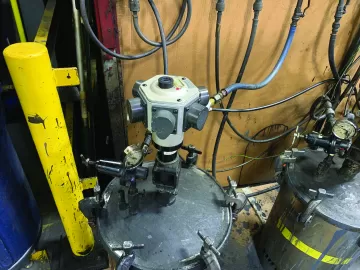
“Sandblasting” is one of the oldest and most used methods of metal treatment. Various abrasive materials may be loaded manually or by a vacuum system pulling the “grit” from a storage tank. A control valve then operates with the compressed air (bypassing the vacuum pump), being forced into the tank pressurizing the receiver. When the high pressure compressed air goes out the discharge line, it pulls the appropriate amount of grit with it to effectively impinge against the targeted metal surface.
Industrial plants are major consumers of water. Water is used in many processes. Sustainability projects focus on reducing the consumption of water and the energy-costs associated with cooling water so it may be effectively used.
This aluminum mill spends $369,000 annually in energy costs to operate their compressed air system. This system assessment recommends actions reducing annual energy costs by $120,000 and improving productivity and quality by delivering clean, dry compressed air.
This major mill complex upgraded their compressed air system and thereby eliminated $500,000 in annual rental compressor costs, reduced annual cooling-water costs by $500,000, and reduced electrical energy costs by $135,000 per year.
Congratulations on Saint-Gobain being named a 2010 ENERGY STAR Partner of the Year by the U.S. Environmental Protection Agency. This is the second year in a row you’ve won the award. Why was this award received?
The Compressed Air Challenge® (CAC) is a voluntary collaboration of industrial users; manufacturers, distributors and their associations; consultants; state research and development agencies; energy efficiency organizations; and utilities. This group has one purpose in mind - helping you enjoy the benefits of improved performance of your compressed air system. The mission of the Compressed Air Challenge (CAC) is to provide resources that educate industrial users about optimizing their compressed air systems.
Properly functioning steam traps open to release condensate and automatically close when steam is present.  Failed traps waste fuel, reduce efficiency, increase production costs and compromise the overall integrity of the steam and condensate systems.  Traps should be tested on a regular basis -- or the neglect may be quite costly.