
Standards
Located in the bowels of most hospitals, you will find the source of the Level 1 Medical Air compressed air system. Per the NFPA Section 99 Specification (National Fire Protection Association), Level 1 air compressor systems provide air for human consumption within the hospital facility.
ISO and CAGI
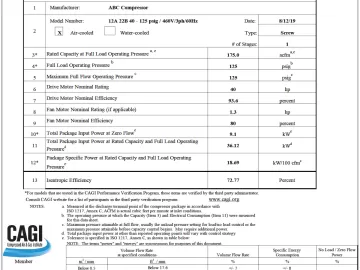
If you have ever looked at the small print of a compressor brochure or a CAGI Data Sheet or a compressor technical information page, you have probably seen some reference to one of the above standards. At one time or another, US compressor manufacturers have used these standards to test and report compressor performance. These are referred to as “Acceptance Test” codes.
NFPA 99 Medical Air
In the U.S. as an example, the NFPA has taken the view that if your compressor draws in good clean ambient air, the air stays clean through the compressor, is then dried and filtered, when you deliver it to the patient it will be entirely satisfactory. After all, when you went into the hospital that’s what you were breathing and when you leave you will breathe it again!
Energy Management
Most readers of this magazine are familiar with the ISO 9000 and 14000 families of standards. The 9000 family pertains to quality management systems and the 14000 family deals with environmental management.
Food Grade Air
The next time you sit down for dinner, take a good look at your food. There’s a very good chance compressed air played an essential role in preparing your meal for consumption.
Large hospitals often use compressed air for important operational related end uses. The systems that produce this air need to supply clean and dry compressed air with a high level of reliability. These systems are not immune to efficiency problems as is the case for any compressed air system.
[ Read Full Story ]
This article will examine in detail four of the five acceptable WAGD implementations under NFPA 99, along with some alternative ways they may be implemented. This article will not deal with passive implementations.
[ Read Full Story ]
BSA LifeStructures is a full service architectural and engineering firm specializing in healthcare, higher education and technology facilities. We employ close to 260 associates and are established in two locations; Indianapolis and Chicago. Our strongest focus is on hospitals and university facilities.
[ Read Full Story ]
Hazardous breathing conditions exist in routine industrial operations, such as hospitals, abrasive blasting, paint spraying, industrial cleaning, and arc welding. In these and other operations that introduce contaminants into the workplace, supplied-air respirators are frequently used for worker protection.
[ Read Full Story ]
A good-size hospital with 200 beds and ten operating rooms can have a medical air system, a laboratory air system, and pneumatic air systems. The medical air systems must all follow the NFPA 99 guidelines. We follow these guidelines, from the beginning, when we assess the demand for air in a hospital.
[ Read Full Story ]
The most abundant contaminant in any compressed air system is water. This can be in either liquid or vapour form. Atmospheric air is already very wet, and becomes saturated when compressed. This water vapour will condense when the temperature drops, after the compressor, and will damage air receivers, pipework and equipment. For this reason coalescing filters and then dryers are used to remove the bulk of this water.
[ Read Full Story ]
Industry standards serve a very important purpose for the end users of compressed air equipment. If the standards are well written, they can help to promote the equipment that they govern, as long as the equipment manufacturers properly apply and promote the standards.
[ Read Full Story ]
Compressors in today’s market must meet a variety of standards written by a wide range of organizations throughout the world. Until recently, most standards were written to deal with safety, both mechanical and electrical, and performance of the individual components of a compressed air system.
[ Read Full Story ]
The NFPA 99 (National Fire Protection Agency) Standard for Healthcare Facilities (2005 Edition) is the current Code by which Healthcare facilities in the U.S. design their compressed air systems. The NFPA 99 Standard covers many requirements for medical gases, with compressed air being just a component of the Standard.
[ Read Full Story ]