Industrial Utility Efficiency

Piping/Storage

Efficient compressed air distribution depends on proper piping design to balance flow, pressure and velocity. This article explains how modular aluminum piping systems improve performance by reducing friction, minimizing pressure drop and maintaining laminar flow. With smooth interiors, full-bore fittings and leak-free connections, these systems help lower energy consumption and extend equipment life. A real-world case study shows how an optimized design reduced material and installation costs while maintaining performance. The result is a more adaptable, efficient and reliable compressed air network for modern industrial facilities.
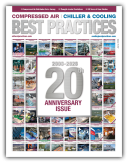
Thought Leaders on System Optimization Past & Future

We asked a hand-selected list of original equipment manufacturers, independent compressed air system sales and service companies, manufacturing plants and independent system auditors to share their thoughts, highlighting the changes they’ve seen over the past 20 years, then predicting what the next 20 years will bring.

Compressed Air at a West Texas Silica Mine

Compressed air system reliability relies on engineering expertise, environmental management and proactive maintenance. This article highlights how Brandon & Clark improved performance in two demanding applications: reducing failures in a dust-heavy silica mining operation through frequent preventive maintenance, and executing a complex disassembly and reassembly of a 300 hp air compressor in a confined university facility while preserving the OEM warranty. These cases show how tailored solutions and long-term service strategies enhance system reliability.

ADG Concepts Solves Years of Piping Problems for Frozen Foods Plant

They got to a point where every time they added a new piece of equipment, it did not eliminate their rental, nor did it eliminate the water problems, the leaks and everything else they were experiencing. The system had issues that adding more equipment simply could not fix.

Kirsh Foundry Drives Energy Efficiency with Compressed Air Optimization

The energy savings amounted to 550,873.5 kWh per year, resulting in a reduction of \$49,579 in energy costs annually. Additionally, nitrogen savings were significant, with annual expenses dropping by \$8,602 due to the installation of the on-site nitrogen generator. Overall, the project achieved total annual savings of \$58,181, with implementation costs of \$74,676 and an impressive payback period of just 1.28 years.

After the Energy Audit, What’s Next?

After an energy audit is performed, how much value has been created? The answer is zero. It's the work done after the audit that makes the difference between a binder on a shelf gathering dust and an executed energy conservation measure creating value. Your management wants results, not reports.

Compressed Air Pressure Loss Solutions for the Last 30 Feet

The significance of material quality used within air compressor rooms and main distribution networks has been increasingly recognized, leading to advancements in energy conservation. However, this focus on material enhancements has not always translated to the last 30 feet of the compressed air system, an area notorious for its loss in efficiency. Here, 30 to 40% of a compressed air system's total energy losses can occur.

The Effect of Increased Storage Capacity on Load/No Load Air Compressors

Fixed speed, lubricated, rotary screw air compressors offer three different part-load control methods: inlet modulation, load/no load and variable displacement. Over the years, load/no load has become the predominant control method offered by fixed-speed air compressor manufacturers. 

Leak Detection Leads to Energy Savings for Cabinet Manufacturing Plant

The plant’s compressed air system consisted of multiple air compressors from different manufacturers, with capacities ranging from 100 to 250-horsepower (hp), for a total system capacity of around 1,100-hp. The plant’s average compressed air demand was 2,300 cfm, with peaks reaching 3,500 cfm. System pressure fluctuated between 105 and 110 psi (7.2-7.6 bar).

For Abundant Air Compressor, Reliability Is a Best Practice

Compressed Air Best Practices® Magazine sat down with Richard Compton, Owner of Abundant Air Compressor of Springfield, MO, and one of his clients, Kenny Schulte, Owner of A-1 Custom Car Care, to talk about why this regional air compressor installation and maintenance company is known for its excellent service.

Plastic Pipe Selection in Industrial Compressed Air Applications

Compressed air piping systems contain high amounts of stored energy, which can be dangerous if released suddenly. Most plastic pipe systems are not suited for this application. The Occupational Safety and Health Administration (OSHA) has issued rulings regarding the use of thermoplastic piping materials for these applications.