Compressed Air Reliability: Two Case Studies in Silica Mining and Confined-Space Installation
In industrial facilities dependent on compressed air systems, the ability to diagnose system problems, engineer practical solutions and maintain equipment over decades becomes as important as the hardware itself. That approach has defined the work of Brandon & Clark, a compressed air system engineering and service company serving industry in West Texas.
Two case studies illustrate the success the company has had in providing reliable compressed air in challenging situations. In the first, the company was called on to reduce maintenance demands for the compressed air system in a silica mine, a harsh environment where ambient air is extremely dusty, even with quality filtration. In the second, the company needed to disassemble and reassemble a 300 hp air compressor in a confined space, while keeping the warranty intact.
A 75-Year History of Mechanical Service in West Texas
Founded in 1950, the company began as a motor repair facility serving the electrical and mechanical needs of regional industry. Over time, the business expanded into multiple technical disciplines, including compressed air systems, electrical services and mechanical infrastructure support. The company’s current structure reflects its multi-disciplinary heritage.
“The company is a multi-division industrial service company with deep roots in Texas industry,” said John Curtis, Compressor Department Manager, Brandon & Clark. “We support our customers across compressed air systems, electrical services and mechanical infrastructure. Within our industrial air compressor services department, we specialize in engineering installations, maintenance programs, system optimization and OEM-supported technical execution.”
The company’s long history of service has shaped its operational philosophy. Rather than treating projects as one-time equipment sales, the organization maintains long-term technical relationships with customers, providing for maintenance, troubleshooting and system upgrades.
“One of the key things setting us apart from everybody else is if we sell something, we also want to be able to service it,” Curtis said. “Everything we sell, we can also service. That might be an electric motor, a power transformer, a VFD or an air compressor. Every one of those things can be supported by our technicians. The goal is to be a single source for our customers. If you bought it from us, you can call us if there’s a problem.”
The company’s service-focused model often places its technicians in environments where compressed air systems operate under demanding conditions. Two recent projects illustrate how the company applies engineering expertise and operational analysis to improve compressed air reliability in complex environments: a silica sand production facility in West Texas and a Texas university infrastructure plant supplying compressed air to research laboratories.
Silica Mining Is a Harsh Environment for Compressed Air Systems
Silica mining operations present one of the most difficult environments for compressed air equipment. The airborne particulates generated during mining, screening and handling processes create a persistent contamination risk for rotating equipment and heat exchange systems. At a silica mine in West Texas, the company works with a mining operator producing silica for oil and gas applications.
“The sand it produces goes primarily into the oil and gas industry for fracking and drilling operations. In geological terms, the material it extracts has to meet specific composition requirements for those uses. It’s not just dirt. It has to meet compaction and material characteristics for hydraulic fracturing,” Curtis said.
The facility extracts sand from a geological formation and processes it for use in oilfield operations. During production, heavy equipment excavates the material, after which the sand moves through a network of conveyors, pneumatic transfer systems and mechanical processing equipment. Compressed air supports several stages of the process.
“In this facility, compressed air helps run some of the pneumatic processes in the mining operations,” Curtis said. “It’s not breathable air. It’s strictly for equipment use. Compressed air is used for drilling equipment, conveyor systems and some pneumatic presses. Some of the conveying equipment is pneumatic conveying tubing, where the material moves through tubes, and some of the transport is traditional conveyor belting.”
Dusty Ambient Air Inside the Compressed Air Enclosure
The compressed air system at the facility consists of four direct-drive, oil-injected rotary screw 100 horsepower (hp) air compressors. The machines operate in parallel. “There are four 100 hp rotary screw compressors,” Curtis said. “Three of them operate on constant load and one acts as a backup unit.”
The compressed air passes through a central air treatment system, including a desiccant compressed air dryer and compressed air storage tanks.
“The system has a wet tank and a dry tank, and there’s a single large desiccant dryer handling the air treatment,” Curtis said. “It’s a PSA desiccant dryer for drying the compressed air before distribution.”
The air compressor installation is located inside an enclosed structure providing partial environmental protection for the equipment. However, the building does not function as a tightly controlled mechanical room.
“The air compressors are inside an enclosed building, but it’s more like a shed,” Curtis said. “It’s not a highly controlled environment. There’s a roll-up door and a standard man door. Even with everything closed, the ambient air is extremely dusty.”
Silica Particulate Infiltration and Mechanical Failures
When Brandon & Clark began servicing the site, the compressed air system was experiencing frequent failures. Those failures weren’t the result of design flaws in the air compressors themselves, but rather the result of the operating environment created by the mining process.
“In a sand production facility, the environment is not mildly dusty. It’s operationally abrasive,” Curtis said. “The silica dust is extremely fine. It’s almost like talcum powder.” That particulate contamination created multiple operational problems. “Heat exchangers were getting clogged, discharge temperatures were increasing and the compressed air dryers cycled more frequently than they should. Filters were failing almost weekly. Fine particulate infiltration was occurring everywhere, even inside the control cabinets. That kind of contamination affects almost every component in the compressed air system.”
The compressed air enclosure was built with ventilation features intended to reduce contamination. “Whoever engineered the original compressor room actually did a pretty good job,” Curtis said. “There’s filtered intake air on one side of the building and exhaust airflow on the other side. The idea is to pull air across the air compressors.”
Despite those design features, however, the sheer volume of airborne silica generated by the mining operation made contamination unavoidable. “Even with all the doors closed, there can be half an inch of silica dust on the floor,” Curtis said. “It’s almost impossible to keep that environment clean.”
Compressed Air System Evaluation Looks for Root Causes
When Brandon & Clark began working with the mining company, the first step was a comprehensive system evaluation.
“We spent about a week on site evaluating the system,” Curtis said. “We looked at compressed air pressures at different times of the day, examined its maintenance program and analyzed where the sand intrusion points were. We evaluated airflow inside the air compressor room, clearances around the machines and whether there was enough space for maintenance and ventilation. We also looked at the airflow path. Was the ventilation actually moving air across the air compressors or was it just circulating at the top of the room?”
Technicians attempted to correlate operational events with air compressor failures. “We looked for patterns,” Curtis said. “For example, does a certain type of activity in the plant create more dust? Does truck traffic stir up more particulate that enters the air compressor building? We tried to identify a root cause.”
Ultimately, the analysis concluded the mining process itself was the dominant source of contamination. “We determined there really wasn’t a single contributing factor,” Curtis said. “It was simply the nature of operating a sand plant.”
Moving to More Frequent Compressed Air System Maintenance
Because environmental conditions could not be significantly improved, the company focused on modifying the maintenance strategy. Initially, the facility followed a conventional maintenance schedule including monthly preventive maintenance visits and quarterly inspections. However, that schedule proved insufficient in the highly abrasive environment.
“We moved from monthly preventive maintenance and quarterly inspections to a bi-weekly service schedule,” Curtis said. “Instead of reacting to failures, we wanted to prevent them. We highlighted a service model shift from being a vendor to being an operational partner. Rather than just responding to problems, we focused on keeping the air compressors operating continuously.”
Technicians began visiting the site every two weeks to perform maintenance, inspect components and clean contamination from the equipment. “In that environment, the only way to keep the air compressors operational is to clean them constantly. Fine particulate accumulation happens quickly.”
Preventive Maintenance Saves \$90,000 in Service Costs in Six Months
The results of the change were immediate. “I don’t believe we’ve had any unplanned downtime since moving to bi-weekly preventive maintenance,” Curtis said. The financial impact of the reliability improvement was substantial. Mining operations operate on continuous production schedules, so air compressor failures quickly affect revenue.
“We calculated that downtime was costing the facility roughly \$4,000 to \$4,500 per hour,” Curtis said. “That was based on its sand production rate and the value of the material it produced.”
In addition to preventing lost production, the new maintenance program reduced service costs. “Just by shifting from emergency repairs to scheduled maintenance, it’s saving around \$90,000 every six months in service and repair costs,” Curtis said. When lost production was included in the analysis, the savings were significantly larger. “When we included the avoided downtime, the estimated savings were about \$1.5 million per year.”
For the company, the project demonstrated the value of forming a partnership with customers. “When we say we want to be an operational partner, what that means is we focus on making sure the customer is operating as efficiently as possible,” Curtis said. “We’re not there just to sell equipment or perform a single service.”
Instead, the company focuses on sustaining the customer’s production systems. “We want the equipment to run as if it were our own facility,” Curtis said. “If our customers are successful, then we’re successful.”
A 300 hp Air Compressor Installation in a University Basement
While the mining project focused on environmental reliability challenges, another Brandon & Clark project will require extensive logistical and engineering planning to solve a different type of problem: installing a large air compressor in a confined facility. The customer is a research university in West Texas operating a central compressed air system serving laboratories and research facilities, and the project was nearing completion at the time of this interview. The company has maintained the university’s compressed air infrastructure for decades.
“They’re an existing customer of ours,” Curtis said. “We’ve worked with them for probably at least 40 years.” Over that time, the company has supported a wide range of maintenance and engineering tasks. “We’ve helped troubleshoot, maintain and install all of its air compressors. We also do electrical work out there, including controls integration, VFDs and PLC work.”
The air compressor installation is located in a campus infrastructure building functioning as a mechanical hub for the university. “The air compressor is located in its infrastructure facility,” Curtis said. “That building handles air and water systems for the campus. It’s like a small city.” The compressed air system supplies multiple types of users in nearby buildings.
“The compressed air feeds research facilities, laboratory equipment, pneumatic controls and the university’s maintenance infrastructure,” Curtis said. Some of the compressed air is distributed to other buildings through underground piping. “There’s a network of compressed air piping branching out from the building. Some nearby research facilities receive compressed air from that central system. The air compressors run 24 hours a day.”
Space Constraints Call for an Open Frame Air Compressor
The air compressor room contains three oil-lubricated rotary screw air compressors, one 300 hp and two 200 hp. Two of those air compressors operate continuously under heavy load.
“The 300 hp air compressor and one of the 200 hp air compressors run fully loaded most of the time,” Curtis said. “The other 200 hp air compressor serves as a backup.” The new installation involves replacing the aging 300 hp air compressor with a new air compressor with a similar capacity.
The original 300 hp air compressor had been in service for decades and experienced repeated failures. “The machine is probably 20 to 30 years old,” Curtis said. “It had gone down numerous times.” Maintenance costs had increased significantly as components wore out. “We were rebuilding airends, replacing coolers and changing parts almost every year. The cost of maintaining the machine had become higher than replacing it.” After analyzing operating costs, the university decided to replace the air compressor with a new unit.
The selected replacement is a 300 hp open-frame, direct-drive, oil-lubricated rotary screw air compressor. “At 125 psi it produces about 3,400 cfm,” Curtis said. The open-frame design is necessary due to space constraints in the mechanical room. “An open-type air compressor has no cabinet. That makes it easier to maneuver components during installation.”
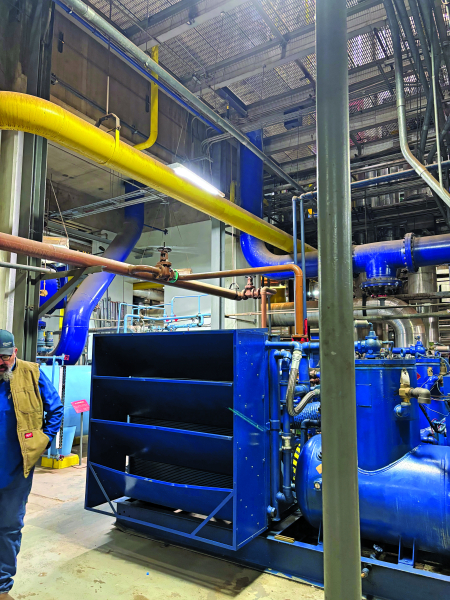
The Texas university’s disassembled 300 hp air compressor was reassembled at this location, replacing an older 300 hp air compressor.
A Four-Foot Opening Presents Installation Challenges
The most difficult part of the project wasn’t selecting the air compressor, but getting it into the building. The air compressor room is located in a basement with limited access.
“The basement has extremely limited entry points,” Curtis said. “The main access opening is roughly the size of a manhole, measuring approximately four feet across.” Historically, equipment had been lowered into the basement using an exterior lift gate. However, that lift system is no longer operational, and repairing it is not financially feasible for the project.
“Fixing the lift gate would have been outside the budget parameters for the project,” Curtis said.
Because the air compressor could not be lowered as a complete unit, Brandon & Clark collaborated with the OEM engineering team to develop a disassembly and reassembly strategy. “From the beginning, we worked directly with the OEM engineers,” Curtis said. “We explained the restrictions and constraints and asked them to help us develop a solution.” The planning process involved months of engineering analysis. “We spent about two weeks initially determining whether the project was even feasible. After that, the full planning process lasted seven to eight months.”
During that time, engineers analyzed the air compressor’s structure and determined how it could be safely disassembled without voiding the manufacturer’s warranty.
“Normally, if you disassemble an air compressor beyond certain components, you risk voiding the warranty,” Curtis said. “In this case, we needed to remove the frame sections and structural components. The OEM engineers developed a plan allowing us to disassemble and reassemble the unit while maintaining the warranty.”
The installation plan involves separating the air compressor into several major components. “The motor, the airend, the cooler, the sump tank and the control cabinet all have to be lowered separately,” Curtis said. The structural frame will also be divided into sections.
“The base frame has two sections,” Curtis said. “There’s the main base and an elevated base that supports the motor and airend.” Each component will be lowered through the manhole using a jib crane. “The components will be lowered into a receiving area in the basement.” From there, technicians will move the parts through a narrow service corridor. “There’s a walkway that’s about five feet wide in some places. That’s the tightest area after the manhole entry.”
On-Site Air Reassembly of 300 HP Air Compressor
Once all air compressor components are delivered to the air compressor room, technicians will reassemble the machine. “The base frame will go in first,” Curtis said. “Then we’ll install the raised base with vibration isolators.” After the frame is assembled, the main mechanical components will be installed. “The airend and motor will be mounted together with the direct drive housing. Next, we’ll install the intake filters, the sump tank and the cooler. The control panel will be installed last.”
Technicians from Brandon & Clark and the OEM will work together during the installation. “It will be a joint effort between our team and the OEM technicians,” Curtis said.
After installation, the air compressor will integrate into the university’s existing compressed air network. The system already includes air treatment equipment and distribution infrastructure. “There are two desiccant compressed air dryers in the compressed air system and multiple receiver tanks,” Curtis said. The company will continue providing maintenance for the entire compressed air installation. “We perform preventive maintenance at least once a month.”
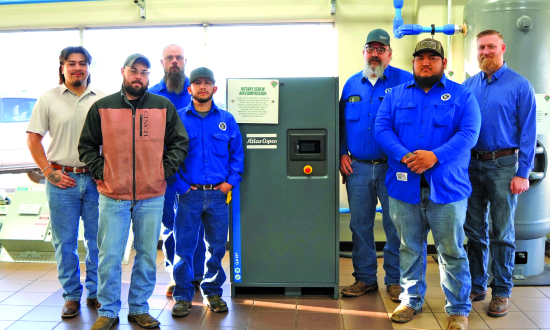
Brandon & Clark team members Nicholas Escobar, Service Coordinator; Tanner Haire, Technician; Brandon Goodwin, Technician; Zackary Estrada, Technician; Chad Carpenter, Lead Supervisor; Israel Rodriguez, Technician, and John Curtis, Compressor Department Manager (left to right).
Long-Term Compressed Air Reliability Objectives
For both the mining project and the university installation, the underlying objective remains the same: providing a reliable compressed air supply in demanding environments.
In the mining facility, that meant adapting maintenance practices to harsh environmental conditions. In the university facility, it means engineering an installation strategy that allows modern equipment to be installed in a confined space. Together, the projects illustrate how compressed air reliability often depends as much on engineering and operational expertise as it does on equipment selection.
As Curtis noted, the company’s approach focuses on long-term operational success. “We’re not there to sell one piece of equipment and walk away,” he said. “We want those compressed air systems running as efficiently and reliably as possible. If the customer’s operation succeeds, then we succeed.”
For more information, visit https://brandonclark.com.
To read more Bulk Industry articles, visit https://www.airbestpractices.com/industries/bulk.
To read more Piping and Storage System Assessments articles, visit https://www.airbestpractices.com/system-assessments/piping-storage.
Visit our Webinar Archives to listen to expert presentations on Air Compressor Technology at https://www.airbestpractices.com/webinars.