Instrumentation

By Simon Gleissner, Managing Director, SUTO iTEC

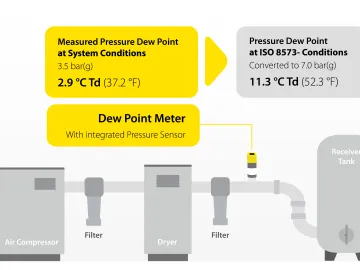
The ISO 8573-1 standard defines clear limits for various compressed air quality parameters. This helps users classify their systems consistently, compare results across applications and set the right requirements for specific processes. This article explains the key points of the ISO 8573 standard and guides you through the correct way to measure and classify pressure dew point for compliance.

OSHA-Compliant Air Guns: Safety, Performance and Industrial Cleaning

By Troy Dreier, Senior Editor, Compressed Air Best Practices® Magazine

Industrial air guns are essential for cleaning manufacturing equipment and production areas, but improper selection or misuse can create serious safety and compliance risks. This article explains OSHA Standard 1910.242(b), the engineering behind OSHA-compliant safety air guns, and how nozzle design, thrust, noise control, and operator training help facilities improve worker safety while maintaining effective industrial cleaning performance.

Designer Furniture Manufacturer Reduces Compressed Air Costs by 20%

By Cynthia Kuiper, Operations Director, VPInstruments

After a sudden air compressor failure exposed hidden inefficiencies, a furniture manufacturer launched a comprehensive compressed air system audit. Using advanced flow, pressure, dew point and energy monitoring, the assessment revealed aging equipment, piping restrictions and costly air leaks across the factory. A full system upgrade combined with continuous compressed air monitoring reduced energy consumption by 20%, improved reliability and delivered a two-year payback.

Tools for Detecting Compressed Air Leaks

By Menno Verbeek, Sales Director, VPInstruments

This article discusses methods and techniques to increase the efficiency of a compressed air installation in both the short and long term. Start by identifying and repairing compressed air leaks, which can result in a decrease in energy use and a savings in operating costs. There are various methods for detecting and quantifying leaks. Simple methods provide a rough indication of the leakage level.

HydroThrift Debuts Advanced Cooling System Control Panel

By Troy Dreier, Compressed Air Best Practices® Magazine

The customers wanted to be able to monitor their system from a control room. They wanted to be able to see the overall view of how the system was running. The bigger thing on the backend – especially for us from an engineering perspective – was being able to do better troubleshooting and helping them without the need to be onsite.

The Critical Role of Data in Compressed Air Systems

By Andrew Smith, SMARTCAir

Compressed air systems are a cornerstone of modern industrial operations, providing essential power for a variety of processes. However, these systems are notoriously energy-intensive, with as much as 90% of the energy input being lost to heat of compression, frictional losses and motor inefficiencies. Due to their dynamic nature, compressed air systems can be challenging to understand well and easy to misinterpret, which is where accurate data measurement and analysis play a key role.

Improve Process Efficiency and Reduce Energy Use with Compressed Air Monitoring

By Hendrik Priemer, Product Manager IIoT Applications, Machine Automation, Emerson 

Without compressed air monitoring, up to 30% of the compressed air generated goes to waste. This waste occurs for several reasons, including leaks caused by failures at joints and tubes, exposure to vibration and normal component wear, and the suboptimization of machines and devices. Continuous monitoring capabilities allow operators to detect leaks and other anomalies in their early stages. By addressing pneumatic issues before they can grow, companies can reduce compressed air use by 20% to 30%.

A Deep Dive into Dew Point Measurement in Compressed Air Systems

By Antti Viitanen, Product Line Manager, Vaisala

In extreme situations, raw battery materials can react with water molecules in the air, causing explosions. In semiconductor development, wafer manufacture requires a highly controlled environment and precise data on the manufacturing environment. Moisture can cause defects in the microelectronic components, impacting their functionality and reliability. For each application, a fast response time allows for quick detection of dew point changes, which can be addressed before they cause damage to the product or equipment.

Smart Pneumatics Play Big Role in Meeting Industrial Sustainability Goals

By Robert Brezni, Global Account Management, EMERSON Discrete Automation

Pneumatics and the generation of compressed air accounts for about 10% of a typical facility's energy consumption. That number could be much lower, but because of leaks and poor air pressure regulation, a surprising amount of energy is wasted in the process. Yet, most manufacturers are not taking full advantage of smart pneumatic technologies or data analytics to improve energy efficiency. By installing connected pneumatic solutions in their plants, manufacturers can continuously collect critical data to understand where energy is being wasted and make informed decisions to optimize energy consumption.

Improving Sustainability Through Compressed Air and Utilities Monitoring


By Dr. Michael Britzger, Senior Manager, IIoT Engineering & Innovation, and Nils Beckmann, Global Director Engineering Intelligent Automation & Solutions for EMERSON Machine Automation 

Utilities monitoring paired with machine learning models can reliably predict anomalies, prompting action that can prevent waste and optimize resource use.

A Case for Using Compressed Air Flow Meters

By Ron Marshall, Marshall Compressed Air Consulting

To accurately assess compressed air systems, it is best to gather as much information as possible, for as long as practical so a clear picture of the operation of the system can be formed. The basic equipment needed includes pressure and amp/power data loggers, but in the past decade some excellent advances in instrumentation design has made very affordable flow meters available. This article discusses using flow meters for an example compressed air assessment.

Moisture: the Assassin in Compressed Air Installations

By Pascal van Putten, CEO, VPInstruments and Frank Moskowitz, Instructor, Compressed Air Challenge

Moisture can freeze in compressed air systems and cause rust and pitting in pipes and components. It can also flush out the lubricant resulting in accelerated tool wear and damage to valves and cylinders. Moist air is also a rewarding breeding ground for bacteria, which especially in the food and pharmaceutical industries can lead to product rejection and costly production downtime. It is therefore strange that many companies limit themselves to measuring only basic quantities such as pressure, flow and (absorbed) power.

Compressed Air Systems and Rocket Science

By Mustafa Uslu, Revindus

Would you believe the same technology used in the launching and controlling of a space rocket is also used in your compressed air system? Yes, in some cases, “rocket science” helps to solve problems in compressed air systems and ensures the performance of the installed units. In this article, we are going to explain the technology called the “Sonic Nozzle”, that combines a space rocket thruster and your compressed air system. Additionally, we are going to walk through a case study, step by step, to show how it works.

Achieving Sustainability Targets by Optimizing Compressed Air Use

By Jan Edler, IIoT Manufacturing Applications Leader, Emerson, and Michael Britzger, Senior Manager IIoT Engineering & Innovation, Emerson

By monitoring compressed air consumption using smart pneumatic sensors, companies can reliably reduce energy use and emissions. The digital transformation of pneumatic systems is one critical way that companies can improve operational sustainability. Advanced airflow-sensing technology provides compressed air monitoring and valuable insights that allow companies to control and significantly reduce the energy used to produce compressed air as well as related carbon emissions.

Sensor Technologies Used in Dew Point Transmitters - Advantages/Disadvantages

By Simon Gleissner, SUTO iTEC

Have you ever had a failing dryer in your compressed air system, ruining your production output, but it was not noticed until it was already too late? Dry compressed air is one of the most important quality parameters when it comes to process safety. When ambient air is compressed, the ratio of the humidity to the air volume will rise drastically. Therefore the higher concentration of humidity in the compressed air leads to a higher dew point temperature and the humidity is more likely to condensate at higher temperatures.

Measurement Principles for Compressed Air System KPIs

By Pascal van Putten, CEO, VPInstruments

In this article we clarify how the main KPIs can be monitored, and we will have a closer look at a few key KPIs: efficiency, pressure loss and leakage. Key Performance Indicators (KPIs) are variables or measures by which the performance of organizations, machines and/or processes can be measured and analysed in a targeted manner. For example, a KPI can be a certain production number per time unit, but also the amount of profit a company makes on a specific product.

Microbiological Testing Considerations for Compressed and High Risk Ambient Air Systems in Food Plants

By Rochester Midland Corporation

Micro-aerosolized droplets are how many members of the microbial world become cross-contaminants via the air mode of transmission. Food borne viral pathogen Hepatitis A and the ubiquitous Norwalk are very often transported via micro- aerosols. It is well known that many viral or bacterial pathogens or spoilers are transmitted via respiratory bursts [coughs/ sneezes] from people or air handling system, condensate, and splash back from floors. Strict cGMPs can limit and control transmission in terms of personal & environmental hygiene.

Smart Monitoring: The Power Behind Pneumatics Productivity

By Emerson and Motion Industries

In manufacturing and packaging facilities that rely on pneumatics, there’s a four-letter word worse than virtually any other: leak. Unidentified air leakage and unexpected maintenance in pneumatic systems are significant sources of revenue and productivity loss but identifying the cause of leakages and preventing unforeseen downtime is typically a challenge.

Troubleshoot Particle Contamination in Compressed Air with Laser Particle Counters

By Jenny Palkowitsh, Trace Analytics, LLC, and Gary Ault, Quality Assurance Management, Inc.

Compressed air contamination can come in various forms, including particles, water, oil, and microorganisms. Non-viable particle contamination is specified in ISO 8573-4:2019 as one of the major contaminants in compressed air to be monitored. Troubleshooting particle contamination with Laser Particle Counters (LPCs) is the focus of this article.

Dew Point Measurement in Compressed Air Systems

By Martin Raab, E+E Elektronik Ges.m.b.H.

Wherever compressed air is used, accurate and continuous monitoring of the dew point temperature is advisable. The dew point provides information about the absolute humidity content of the compressed air. A too high humidity content can have negative effects on the quality of the final product, lead to problems during the manufacturing process, or even result in complete system shutdown. Therefore, operators of compressed air systems should address this issue before it causes serious and costly issues. The following explains the basics of dew point measurement and what is important in practice.

The Fundamentals of Dew Point Measurement in Compressed Air Systems

By Vaisala

Dew point is simply the temperature to which air must be cooled for the water vapor within to condense into dew or frost. At any temperature, there is a maximum amount of water vapor that the air can hold. This maximum amount is called the water vapor saturation pressure. If more water vapor is added beyond this point, it will result in condensation.

Maintaining Compressed Air Filters and the Purpose of Differential Pressure Monitoring Devices

By Mark White, Parker Hannifin

The foundation of any purification system is its filtration and of the ten main contaminants found in a compressed air system, filtration is responsible for the treatment of nine of them. Coalescing filters are the most important piece of purification equipment as they reduce six of the ten contaminants and a look in any air compressor room will find a pair of coalescing filters (backed up with dry particulate and oil vapor removal filters).

Dutch Glass Container Plant Compressed Air System Makeover Increases Uptime and Energy Savings

By Mike Grennier, Compressed Air Best Practices® Magazine

To improve the delivery of compressed air at the plant, which is supplied by low-pressure and high-pressure compressed air systems, the manufacturer took an important first step by using airflow meters to monitor and measure the performance of both systems. Subsequent planning based on actionable data led to a unique compressed air system upgrade that increases the plant’s ability to maintain peak production of high quality glass bottles and containers at all times – while saving $150,000 per year in energy costs. The project also delivered a payback of less than two years.

Is Your Controller a Blast From the Past?

By the Compressed Air & Gas Institute

Advances in phone technology dramatically improve their function and our experience. More storage, faster speeds, enhanced communication options, bigger and brighter display….and so on. As a result, today’s phones are significantly more powerful – improving our productivity and changing our lives. As for the technology laggards, obsolescence eventually prompts change. Repairing or replacing parts and accessories on the old phones is an increasing challenge. Eventually they have to succumb to technology.

SHOW REPORT EXTRA Part 2 – Blower, Vacuum, Measurement, Air Purification and Piping at the 2019 BEST PRACTICES EXPO & Conference

By Bill Smith, Compressed Air Best Practices® Magazine

The Best Practices EXPO & Conference held from October 13-16, 2019 in Nashville, Tennessee, saw a significant increase in attendance growing by 15 percent to 850 attendees from 20 countries. End user (factory personnel) attendance grew by 60 percent! The EXPO was also truly international showcasing 115 exhibitors from 16 countries and EXPO attendance was free for qualified industry personnel. This SHOW REPORT EXTRA Part 2 complements our 2019 Best Practices EXPO & Conference Show Report and the Show Extra Part 1 Report.