Vacuum

By Dr. Fabian Fahlbusch, Head of Content Marketing, Busch Vacuum Solutions

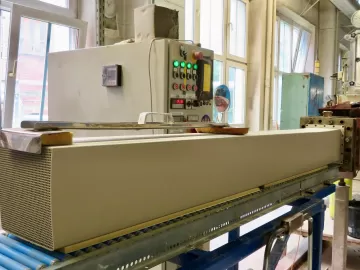
Industrial ceramics have been produced in Hermsdorf, near Jena, since 1890. In the past, high-voltage insulators; now, ceramic honeycomb bodies for heat exchangers, ventilation and emission control systems. They have always kept up with the times, developing innovative materials, products and state-of-the-art production processes to do so.

Magnetic Pickups Reduce Compressed Air Demand at Automotive Plant

By Nasr Alkadi, Ph.D., CEM, CSRM, Strategic Energy Management Consultant and Coach, CLEAResult

This article focuses on a project to replace vacuum cups with spring-return magnetic pickups for handling ferrous metal parts at an automobile assembly plant in Missouri. The application is most familiar in automotive stamping and body shop operations, but the lesson applies to any plant using vacuum cups to grab steel blanks, panels, brackets or formed parts. The original equipment in this case study used vacuum cups served by venturi devices.

The 2026 AICD Show Report

By Bill Smith, Regional Sales Manager, Compressed Air Best Practices® Magazine

The Association of Independent Compressor Distributors (AICD) held its annual trade show in Orlando, FL, in April 2026. Participating distributor members and guests enjoyed the AICD trade show, guest speakers, golf tournament and networking. “Each year, the relationships and synergies keep growing and growing. The AICD is very proud to celebrate our 40th year,” said Sal Calvo, AICD board member and Owner, Compressed AIR USA.

Pneumatics and Vacuum Generators Power Robotics at Automate 2025

By Troy Dreier, Senior Editor, Compressed Air Best Practices® Magazine

Automate 2025, showed attendees how to make their industrial plants more efficient with robotics. Throughout the conference, robotic arms shuttled packages, burgers and even macarons with speed and accuracy. Driving this new technology was a complex network of pneumatic cylinders and pick-and-place automation powered by pneumatic vacuum generation. Innovation makes these proven technologies more efficient than ever.

IWF 2024 Highlights Compressed Air and Vacuum Systems for Woodworkers

By Troy Dreier, Compressed Air Best Practices® Magazine 

In early August, the International Woodworking Fair (IWF) took place in Atlanta, Georgia, bringing together woodworking companies of all sizes to promote new and innovative technologies. In all, 26,000 attendees visited with nearly 1,100 exhibitors. Air compressor system companies were in attendance, as their products are widely used to power hand tools or apply spray finishings. Likewise, the top vacuum pump manufacturers were there to talk to OEMs about integrating their products in CNC router boards, and to talk to business owners about upgrading the vacuum pumps that came with their CNC router boards.

When to Repair vs. Replace Your Vacuum Pump: A Guide

By Mary MacGregor Velhinho, Busch Vacuum Solutions

If your vacuum pump is malfunctioning, you are faced with a choice: repair or replacement. Our guide will take you through both options and provide recommendations on when it makes sense to repair vacuum pumps and when to replace them. We will also take a look at how to spot and diagnose common issues before they lead to system failure. Whatever the path of action, the decision to repair or replace always begins with testing and diagnosis. A factory-trained service technician who specializes in vacuum pump services inspects the equipment and identifies the problem.

Boosting Process Vacuum Performance at a High-Tech Electronics Plant

By Bryan Jensen, Engineered System Solutions Manager, Rogers Machinery Company

Electronics applications typically run their tooling requiring Process Vacuum based on differential pressure from barometric; that is, they control their PVAC pumps to “Inches of Mercury Vacuum”. This is because the parts and pieces being manipulated by vacuum are of certain sizes, shapes, and weights. If the differential pressure across the part is not great enough, then the tooling will fail and result in a loss of product, adverse impact to quality, and production downtime.

From Pharma to Coffee: Pneumatic Conveying Design Basics

By Doan Pendleton, VAC-U-MAX

It’s one thing to move materials during the production process, but when it’s a finished product on the packaging line, choosing the right material handling system is essential. Getting it wrong results in squandered production time when product loss occurs, and wasted raw materials.

Powdered Egg Company Implements Energy-Saving Pneumatic Conveying System

By Doan Pendleton, VAC-U-MAX

Nutriom sets the bar high when it comes to producing its premium quality natural powdered egg products Ova Easy® and Egg Crystals®, that are sold at outdoor retailers such as REI, and online merchants such as Amazon.com; so, when the screw conveyor in their FSIS USDA facility required regular unexpected attention, Leonardo Etcheto, Plant Manager at the Lacey, WA facility knew it was time to look for a better solution.

MGM Industries Reduces Chilled Water Requirements with Dry Vacuum Pumps

Compressed Air Best Practices® Magazine interviewed John MacKorrell (Extrusion Process Engineer, MGM Industries) and Dave Brittain, Steve Gilliam, and Wayne Kemp from Becker Pumps.

Two years ago, sales were picking up and we began operating six extrusion lines on most days. We had to bring in some portable chillers, to keep up, and we started looking at buying a larger cooling system. We wanted to get rid of the portable chillers and have room to grow into four more extrusion lines. The new system we looked at was a 100-ton system that would have cost us around $150,000 in capital and installation and with a larger monthly electricity bill. We were about to buy the new 100-ton chiller when our President, Abe Gaskins said, “Hold-on, can we replace the Liquid Ring pumps with something that doesn’t consume water”? That was our “Eureka!” moment.

Handling Corrugated Cardboard with Optimized Pressure-Regulation of Air-Driven Vacuum Pumps

By Josef Karbassi, Division Manager Automation, PIAB AB

Using suction cups and air-driven vacuum pumps is a preferable gripping and handling method of corrugated cardboard materials and boxes in carton-machines like case/carton erectors and rotary cartoners. Robot based applications, like palletizing and de-palletizing, are other examples where the best practice technology for gripping and handling is by suction cups and air-driven vacuum pumps.

An Introduction to WAGD System Implementations

By Mark Allen, Director of Marketing, BEACONMEDAES

This article will examine in detail four of the five acceptable WAGD implementations under NFPA 99, along with some alternative ways they may be implemented. This article will not deal with passive implementations.

Profile Dekker Vacuum

Compressed Air Best Practices interviewed Rick Dekker (President & CEO) of Dekker Vacuum Technologies.

The roots of our company start with my father, Jan Dekker, who was heavily involved with oil-sealed liquid ring vacuum systems used in the gold mines of South Africa. This was in the mid-1970’s when gold prices were going up. Vacuum systems (in the mines) were optimized by improving vacuum levels using oil instead of water and by adding vacuum boosters.

The Ins and Outs of Vacuum Generators

"Dr. Vacuum" with "Dan Bott"

There is an enormous population of vacuum generators being used successfully by industry. Applications range from pick & place to vapor extraction to bulk material handling and the number of installations is growing. Before proceeding with an installation utilizing these devices, there are two general issues to consider: efficiency and appropriateness.

Printing Facility Vacuum System Upgrades

By Compressed Air Best Practices

Most printing facilities use vacuum for one process or another. I recently spoke with Jesse Krivolavek, (a vacuum system efficiency specialist with IVS, Inc.) about his recent adventures in the world of printing.

Chrysler Finds Vacuum Savings of $400,000 per Plant

By Josef Karbassi, PIAB

A recent comparative vacuum technology study performed by Dr. Kingman Yee, as part of a Chrysler Summer Intern Professors Program, found that air consumption could be reduced by 98% when equipping a robot’s end-of-arm tooling with COAX® technology and a Vacustat™ check valve.

Explosion-Proof Vacuum Systems for Combustible Dust

By Paul R. Miller, Vice President and General Manager, Nilfisk CFM

In February of 2008, a sugar plant near Savannah, Georgia suffered the ultimate tragedy. Fouteen employees were killed and 40 injured when finely ground motes of sugar dust ignited, setting off a violent blast. If the fatalities and a tarnished reputation weren’t enough, the Occupational Safety and Health Administration (OSHA) then fined the company more than 8 million dollars in workplace violations related to combustible dust.

3 Key Factors for Designing Vacuum Pump Inlet Filtration Systems

By Dan Bott

Nearly all vacuum pumping technologies have some degree of sensitivity to inlet particulate contamination. Since everything from a vacuum assisted production process ends up at the inlet of the vacuum pump, it is important to figure out how to best protect the pump in that particular environment. In many cases, the expected service life of a vacuum pump comes down to how well it is protected from incoming contamination.

Vacuum and Compressed Air Systems at IWF 2022

By Roderick Smith, Compressed Air Best Practices® Magazine

The IWF 2022 International Woodworking Fair was held August 23-26 at the Georgia World Congress Center in Atlanta, Georgia. This was the first global woodworking fair since 2018. The Show attracted announced the attendance of thousands of verified buyers of woodworking equipment. IWF is the largest woodworking technology trade show in North America and is held every other year at the Georgia World Congress Center in Atlanta, GA. It is ranked among the largest trade shows in the world.