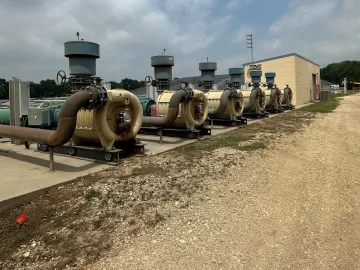
Vacuum/Blowers

There is no single right approach to putting the necessary volume and pressure of air in the pipe to meet production needs. There is a place for purchasing assets, there is a place for renting assets and there is a place for an AOF contract. Just as the business models around these assets change, so do the needs of an industrial plant. This article aims to explore these options and explore some of the pros and cons associated with different methods. 

Thought Leaders on System Optimization Past & Future

We asked a hand-selected list of original equipment manufacturers, independent compressed air system sales and service companies, manufacturing plants and independent system auditors to share their thoughts, highlighting the changes they’ve seen over the past 20 years, then predicting what the next 20 years will bring.

Industrial Blowers Reduce Energy Use in Aluminum Casting Plant

This article explores how a focused engineering intervention driven by data and a clear understanding of process requirements led to a transformative change on a aluminum production plant.  By switching from traditional compressed air systems to low-pressure industrial blowers the plant not only maintained product quality, but also achieved a dramatic reduction in energy use saving nearly \$455,000 annually.

When to Repair vs. Replace Your Vacuum Pump: A Guide

If your vacuum pump is malfunctioning, you are faced with a choice: repair or replacement. Our guide will take you through both options and provide recommendations on when it makes sense to repair vacuum pumps and when to replace them. We will also take a look at how to spot and diagnose common issues before they lead to system failure. Whatever the path of action, the decision to repair or replace always begins with testing and diagnosis. A factory-trained service technician who specializes in vacuum pump services inspects the equipment and identifies the problem.

Advanced Vacuum Generation Reduces Maintenance

Industrial ceramics have been produced in Hermsdorf, near Jena, since 1890. In the past, high-voltage insulators; now, ceramic honeycomb bodies for heat exchangers, ventilation and emission control systems. They have always kept up with the times, developing innovative materials, products and state-of-the-art production processes to do so. 

Vacuum Fundamentals: Process Applications & Oil-Free Technology

A ‘Process’ application, is one where it’s all about controlling the contents of a vessel, pipeline, or chamber.  What is the gas makeup inside the vessel? How much of it is in there? All means to control a chemical and/or thermodynamic reaction so that we add value to some base ingredients to convert them into a marketable product. 

Boosting Process Vacuum Performance at a High-Tech Electronics Plant

Electronics applications typically run their tooling requiring Process Vacuum based on differential pressure from barometric; that is, they control their PVAC pumps to “Inches of Mercury Vacuum”. This is because the parts and pieces being manipulated by vacuum are of certain sizes, shapes, and weights. If the differential pressure across the part is not great enough, then the tooling will fail and result in a loss of product, adverse impact to quality, and production downtime. 

Whiskey Distillery Compressed Air Study Saves Energy

A premium whiskey distillery was seeking to renew their compressed air system and meet their corporate mandate in making their production facility more efficient. The first step on the road to improvement was having their compressed air system assessed. This article discusses some of the findings of the system study, which saved significant energy, improved system reliability, and captured a significant utility incentive to help with the study costs and the cost of a new compressor.

Industrial Central Vacuum System Evaluations: Part 2 Audit Measures

Operating the vacuum system at higher levels (then necessary) affects the needed volumetric flow to compensate for leaks. This required compensation of volume (ACFM) must be added to the nominal production flow demand. The ambient air leak into the system will expand to the highest vacuum level, which is known as the “Expansion Ratio.”

Industrial Central Vacuum System Evaluations: Part 1 Measurement

What is vacuum as used in the manufacturing/industrial sector? The clearest answer is – a contained space with gaseous pressures much less than surrounding atmospheric pressure. Atmospheric pressure (ATM) is expressed in many units of measure. At room temperature a cubic foot of contained air at sea level – the random movement and molecular impact on the walls of the containment vessel equal a force of 14.7 psia for every square inch of the walls.

When Mixing is the Goal, Why Would You Aerate? Compressed Gas Mixing Provides an Alternative Approach

At the beginning of the 20th century, biological wastewater treatment — more specifically, the activated sludge process — was developed and became widely accepted as the treatment method for municipal wastewater, helping to protect our lakes and rivers from pollutants and support public health. In 1947, the Committee on Development of Uniform Standards for Sewage Works was created by the group known as the Great Lakes – Upper Mississippi River Board of State and Provincial Public Health and Environment Managers. 

Low-Pressure Air Compressors Deliver Savings for Lafarge Cement Distribution

The Lafarge Cement Distribution terminal located in Winnipeg, Canada has significantly reduced the site electrical demand and energy charges by changing the way they transport their cement.  Two new low-pressure rotary screw air compressors have replaced two large high-pressure air compressors that previously powered their dense phase transport system.  The resulting power reduction has saved the company 46 percent in transport operating costs.

DO Control System and Turbo Blowers Optimize Energy Use at a WWTF

Every municipality and utility is facing the reality of rising energy costs. In 2010, the Town of Billerica, MA, which is located 22 miles northwest of Boston with a population of just under 40,000 residents, engaged Process Energy Services and Woodard & Curran to conduct an energy evaluation of the Town’s Wastewater Treatment Facility (WWTF) and pump station systems sponsored by National Grid. The objective of the evaluation was to provide an overview of each facility system to determine how electrical energy and natural gas were being used at the facility and to identify and develop potential costsaving projects.

Food Industry Factory Saves $154,000 in Annual Energy Costs

This food industry factory, located in California, was spending \$386,533 annually on energy to operate their compressed air system. This system assessment detailed eleven (11) project areas where yearly energy savings totaling \$154,372 could be found with a investment of \$289,540. A local utility energy incentive, paying 9 cents/kWh, provided the factory with an incentive award of \$159,778. This reduced the investment to \$129,762 and provided a simple ROI of ten months on the project.

Bottler Best Practices in California

Bottling companies and breweries, in California, are benefiting from a three-step system assessment process aimed at reducing the electrical consumption of their compressed air systems. The three-step process reduces compressed air demand in bottling lines by focusing on open blowing and idle equipment, and then improves the specic power (reducing the energy consumption) of the air compressors.

Compressed Air in Wastewater Treatment

The object of this article is to look at some very typical industrial water treatment processes and various compressed air and energy savings projects that have worked well for our clients over the years. The basic fundamentals with regard to compressed air usage are similar to municipal water treatment – a good starting point.

Energy Saving Opportunities in Blowoff Applications

Assessing payback on engineered air nozzle and blower upgrades There are a variety of means factories can use to remove or “blowoff” moisture from a package. Open tubes or drilled pipe are often viewed as simple low-cost methods. However, there are considerable drawbacks to these approaches, most notably – increased operating expense. While they may be convenient and inexpensive in the short term, these approaches often cost 5-7 times more to operate than preferred alternatives.

A Kroger Company Bakery Saves Energy

Recently, The Kroger Company’s Indianapolis bakery identified the use of compressed air in a blow-off and conveyor gap transfer as a major source of energy loss and cost waste. According to the U.S. Department of Energy, “inappropriate use” of compressed air like blow-off produces high pressure atmosphere bleed leading to significant energy loss and unnecessary operational costs. Carrying a 10-15% efficiency return (according to the Department of Energy), compressed air applications can often be achieved more effectively, efficiently and less expensively with alternative solutions using a high flow rate and moderate pressure.

Protection Against Water Hammer Damage

One major problem that causes severe damage or system failure for any water treatment station is water hammer shock waves. “Water Hammer” or “Hydraulic Shock” is a pressure surge or shockwave resulting when a fluid (usually a liquid but sometimes also a gas) in motion is forced to stop or change direction suddenly (momentum change). The reversed momentum then continues to multiply the further it travels before being stopped.

Blower Advancements for the Wastewater Industry

"The Numbers Don’t Lie". It’s a popular saying everyone has heard before, applied to a variety of situations – political statistics, figures backing up an athlete’s performance and budget data. Thirty percent is a big number. Applied to the above scenarios, it could entail a landslide victory or a hitter gaining entry into the Baseball Hall of Fame. But just imagine, if the manager of a wastewater treatment facility were to trim 30 percent from their operating costs, he or she might also consider that a landslide victory of their own.  

Soft Drink Bottler Saves Energy With Blowers

A leading soft drink bottling manufacturer’s compressed air needs were threatening to exceed its Michigan plant’s compressed air capacity. Faced with the cost of buying a new compressor, the soft drink bottling manufacturer re-assessed their compressed air use to identify compressor and energy savings opportunities. In the audit, the soft drink bottling manufacturer identified the use of compressed air in a gap transfer as a source of compressed air and energy inefficiency.

The Ins and Outs of Vacuum Generators

There is an enormous population of vacuum generators being used successfully by industry. Applications range from pick & place to vapor extraction to bulk material handling and the number of installations is growing. Before proceeding with an installation utilizing these devices, there are two general issues to consider: efficiency and appropriateness.

Profile Dekker Vacuum

The roots of our company start with my father, Jan Dekker, who was heavily involved with oil-sealed liquid ring vacuum systems used in the gold mines of South Africa. This was in the mid-1970’s when gold prices were going up. Vacuum systems (in the mines) were optimized by improving vacuum levels using oil instead of water and by adding vacuum boosters.

Savings at the Steel Mill

This major mill complex upgraded their compressed air system and thereby eliminated \$500,000 in annual rental compressor costs, reduced annual cooling-water costs by \$500,000, and reduced electrical energy costs by \$135,000 per year.

Inappropriate-Use Assessment Saves 1,881 scfm

This factory currently spends \$735,757 annually on the electricity required to operate the compressed air system at its plant. The group of projects recommended in the system assessment will reduce these energy costs by an estimated \$364,211 (49% of current use). Estimated costs for completing the recommended projects total \$435,800. This figure represents a simple payback period of 14.4 months.

Printing Facility Vacuum System Upgrades

Most printing facilities use vacuum for one process or another.  I recently spoke with Jesse Krivolavek, (a vacuum system efficiency specialist with IVS, Inc.) about his recent adventures in the world of printing.