Sustainability Projects

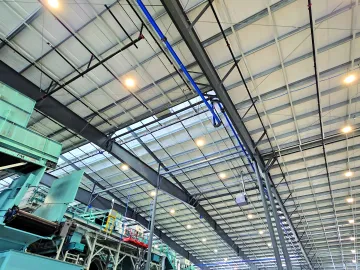
There are multiple compressed air applications in a waste management facility. This new recycling center uses laser-guided optical sorters to divide waste, with no human involvement on the sorting line. Laser optics determine what type of material each scrap is, then compressed air jets maneuver each piece to its collection area. Compressed air also powers handheld blow guns used for cleaning, as well as the bundling and packaging system. 

John Deere Mows Down Energy Costs with Operating Discipline

Discover how John Deere achieved measurable energy savings without major capital investment by optimizing compressed air systems, implementing real-time monitoring and strengthening operational discipline. This case study demonstrates how equipment scheduling, defined ownership, predictive maintenance and data-driven verification reduced electrical demand by more than 1.15 million kWh annually while improving reliability and sustaining long-term manufacturing performance.

Texas Recycling Plant Saves Water with Air-Cooled Air Compressors

There are multiple compressed air applications in a waste management facility. This new recycling center uses laser-guided optical sorters to divide waste, with no human involvement on the sorting line. Laser optics determine what type of material each scrap is, then compressed air jets maneuver each piece to its collection area. Compressed air also powers handheld blow guns used for cleaning, as well as the bundling and packaging system. 

Brewing a More Sustainable Future at Tröegs

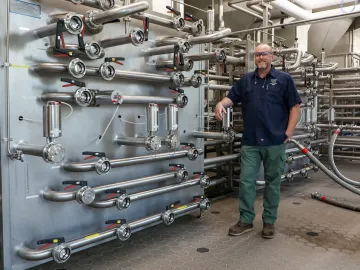
Beer manufacturing creates three byproducts: heat, CO2 and alcohol. The CO2 vents back into the atmosphere, but soon Tröegs will be able to put it into a collection system and reuse it.

Atlas Copco Compressors Enables Sustainability-Based Production

The U.S. air compressor market has a compressed air installed base of at least 15 million horsepower. Further, it evaluated various air audits across different customer types, sizes and segments and determined U.S. manufacturers stand to save around 13 billion kilowatt hours (kWh) annually in electricity associated with compressed air. That translates to a savings of $1 billion in energy costs per year, which would remove nine million metric tons of CO2 annually. That equates to more annual energy usage of more than 1 million homes in the United States.

Don’t Assume Compressed Air Demand Reductions Provide Proportional Energy Savings

The purpose of this article is to show there isn’t always a proportionally linear relationship between what happens with flow reductions on the demand side of a compressed air system - and what happens with the energy consumption in the air compressor room. Optimizing an entire compressed air system requires precise knowledge of the supply side, how compressed air is used in the process itself and how those two relate together.  

Tetra Pak Solutions Conserve Water & Energy for Food & Beverage Sector

“Our view is always from the perspective of the value chain from the raw materials to the end product,” Wellendorph said. “How do we work with our suppliers who supply us? How do we look at our own manufacturing to avoid waste? Then, how can our equipment minimize the amount of energy or water it uses when processing and packaging customers products? It’s more than just focusing on ourselves.”

Air Compressor-Chiller Combination Saves Glassware Manufacturer $9 Million Monthly

A large manufacturer of consumer glassware products in the North East sought a solution for injecting cold compressed air into its refractory furnace. Doing so would minimize the internal corrosion thereby extending the life of the furnace lining and their annual maintenance interval. The manufacturer opted for a unique solution from Aggreko Engineering featuring a rental, oil-free rotary screw air compressor combined with a heat exchanger and chiller. Installed in 2019, the solution is expected to save the company \$9 million monthly given the ability to maintain extend furnace maintenance from one year to two years – and boost plant uptime.

TE Connectivity’s Focus on ROI Drives Sustainability Success and Compressed Air Savings

The company is succeeding with sustainability at many operations, including its manufacturing plant in Lickdale, Pennsylvania. In fall 2019, officials from the Department of Energy’s Better Plants program joined company officials there to celebrate the plant’s energy achievements – including an 11% reduction in compressed air energy costs. Its ability to reduce the cost of compressed air to the tune of \$223,000 per year is a prime example how many TE Connectivity operations have fully embraced sustainability.

Winpak Reduces Demand by 33% and Switches to Oil-Free Air Compressors

By making changes primarily focused on compressed air uses, Winpak, an international plastics products manufacturer based in Winnipeg, Manitoba, Canada, increased compressed air production capacity and reduced annual energy consumption by 33%. These benefits have been accomplished while the company was making the switch to lubricant-free compressed air to support product quality goals. This article discusses some of these changes and addresses measures that could be implemented in any compressed air system.

Sustainability is “Part of Who We Are” at Eastman

By making sustainability a requirement and a core element of its growth strategy, Eastman has improved the energy efficiency of manufacturing operations by 13% since its baseline year of 2008 (the year Eastman became an ENERGY STAR® Partner). By 2018, Eastman had decreased its greenhouse gas intensity by 20%, two years ahead of its goal. Additionally, Eastman received the 2019 ENERGY STAR® Partner of the Year Award for Sustained Excellence, marking the company’s eighth consecutive ENERGY STAR award: two years as Partner of the Year and six years of Sustained Excellence recognition.

Better Plants® Partners Get a Leg up in the Battle for Energy and Water Efficiency

In 2019, more than 230 Better Plants partners took advantage of the program to gain considerable ground in their sustainability efforts. In so doing, they cumulatively saved more than \$6.7 billion in energy costs and more than 1.3 quadrillion British Thermal Units (BTUs). These same companies have more than 3,200 facilities and represent approximately 12% of the U.S. manufacturing energy footprint. In addition to energy, partners are excelling at projects to improve water efficiency.

Stanley Black & Decker Plant in Tennessee: A Beacon of Sustainability

New Britain, Connecticut-based Stanley Black & Decker has gained widespread recognition for its commitment to social responsibility and sustainability – and with good reason: The company has reduced CO2 emissions in 2018 by 8,840 metric tons and in 2019 it was on track to further reduce greenhouse CO2 emissions by another 4,000 metric tons.

Culture Building with ENERGY STAR® Energy Treasure Hunts

There are many reasons why the U.S. Environmental Protection Agency (EPA) ENERGY STAR® Energy Treasure Hunts have proven successful in helping companies save energy and natural resources, but one that rises to the top is their ability to build a culture of energy efficiency throughout an organization.

Technical College Audit Finds Savings of $45,000 in Energy and Water Use

As part of an energy reduction effort, a Canadian technical college hired a compressed air auditor to do a leakage audit of their large campus, which houses over 30 mixed use buildings, including laboratories, research facilities, shops and classrooms. The audit found very few leaks, the reduction of which would achieve minimal savings; however, a few surprising items of interest were noticed during the study that showed very good potential for operating cost savings of 64% with an estimated \$45,000 per year in reduced energy and water costs. This article discusses some of the findings and how savings can be achieved on lightly loaded compressed air systems.

Everyone Wins with Tennessee Tech University Industrial Assessment Center Program

Launched in 2006, the TTU-IAC program provides manufacturers in the state with free energy, productivity, and waste assessments – including best practices for compressed air systems, and blowers and vacuum, as well as cooling towers and chillers. The assessments to date have provided manufacturers in the program with \$27.48 million in recommended cost savings, equaling 3.82 trillion British thermal units of energy savings.

Reducing the Global Warming Potential of Refrigerated Compressed Air Dryers

Long gone are the days when cost and performance could be the only concern for companies manufacturing refrigerated compressed air dryers using refrigerant compressors. In 2019, accelerated governmental (Europe) regulations and a global concern for sustainability have brought new considerations to the table. What is the Global Warming Potential (GWP) of the refrigerants used in dryers and what is their environmental impact?

YoCream and Blount Save with the Energy Trust of Oregon

Since 2002, Energy Trust of Oregon has saved and generated 728 average megawatts of electricity and 52 million annual therms of natural gas. This is enough energy to power Multnomah and Washington counties while heating Deschutes County homes. ETO has saved enough energy equal to the output of a power plant and reduced reliance on fossil fuels. In total, they have invested \$1.5 billion to save customers more than \$6.9 billion on their energy bills over time. They have also added \$5.7 billion to the local economy, including \$1.7 billion in wages, \$312 million in small business income and employment equal to 4,700 full-time jobs lasting a decade.

International Wire Compressed Air System Upgrade Recovers Heat

While late summer may not be the time of year many of us think about heat recovery, the potential for energy savings in compressed air systems should be on our minds year-round. For those involved with the compressed air systems within International Wire Group’s facilities, energy savings is on their minds each day. This culture of continuous improvement has everyone on the lookout for savings wherever possible.

The Compressed Air Challenge: Twenty Years and Moving Forward

As the current president for the Compressed Air Challenge™ (CAC), it is an honor to write about this organization and how it has progressed, now since we have hit our 20-year milestone. What it means to be involved in the CAC means something different to each person who has contributed. What I will share in this article is from my own experiences and observations over the past 21 years in the compressed air industry, with some help from my fellow board members.

Nissan Curbs Compressed Air to Achieve Energy Savings

Nissan North America operates on a massive scale. The company’s powertrain assembly plant in Decherd, Tennessee, alone encompasses 1.1 million square feet, and manufactures engines for 14 different vehicles. The facility also handles crankshaft forgings, cylinder block castings, and other machining applications. Over the course of one year, the powertrain plant churns out approximately 1.4 million engines, an equal number of crankshaft forgings, and 456,000 cylinder block castings.

Turbo Blowers Generate Significant Energy Savings at Victor Valley Wastewater

A replacement strategy for air compressors and blowers integrated into a system-level approach towards energy efficiency can deliver significant energy savings and optimize equipment performance. At the Victor Valley Wastewater Reclamation Authority, a blower replacement project yielded annual energy savings of more than 928,000 kWh and \$98,000 in energy costs, while improving the reliability of its secondary treatment process. In addition, the agency qualified for important incentives from its electric utility — significantly improving the project economics and resulting in a 2.94-year payback.

CalPortland Energy Management Earns Another ENERGY STAR Award

Making cement is an energy-intensive process. In a cement plant, the electrical energy load can reach up to 25 MW, consuming 185 million kilowatt hours of electricity annually. In addition, the plant consumes a large amount of coal and natural gas. CalPortland is an enormous producer of cement, concrete, aggregates and asphalt. With 80 facilities spanning five states across the western U.S., one might logically assume that CalPortland consumes a lot of energy.

Evaluating Air Compressor Cooling Systems

As the population continues to grow in the United States, industrial water use will need to continue to fall to help offset the increases in public-supply water use. Water-cooled compressed air systems provide an opportunity for sustainability managers to reduce associated cooling water consumption and costs. If switching to air-cooled air compressors is not possible, understanding the costs and the alternative types of liquid cooling systems is important.

ENERGY STAR® Sustains Excellence

The ENERGY STAR Awards are EPA’s highest honors for superior energy efficiency, and several award categories exist. EPA’s ENERGY STAR Industrial Partners could receive either Sustained Excellence or Partner of the Year in the Energy Management category. These awards go to organizations for adopting a continuous energy management strategy across the organization’s entire portfolio of buildings and plants and for communicating the value of ENERGY STAR and energy management broadly.

Water Conservation

Steam

Lighting

HVAC Systems

Cooling Systems

Boilers

Bill Mgmt/Demand Control