Air Compressors

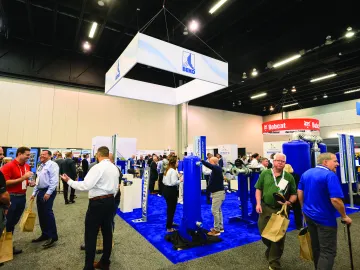
From October 29-31, 2024, professionals who operate, maintain and design industrial compressed air, vacuum, blower, nitrogen generation, process cooling and HVAC systems gathered at the Cobb Galleria Centre in Atlanta, GA, for the 6th annual Best Practices 2024 EXPO & Conference. The event featured two tracks of conference presentations and panels.

The CABP Interview: Sauer Compressors USA, Inc. President, CEO and Chairman of the Board, Don Eaton

Don Eaton, CEO of Sauer Compressors USA, discusses the company’s growth in high-pressure air compressors and industrial air and gas compression. He explores compressor technology, reliability, uptime, strategic investments and distributor training designed to improve customer support and long-term system performance.

Understanding Centrifugal Air Compressor Intercoolers

Intercoolers play a critical role in removing heat between compression stages, directly affecting centrifugal air compressor efficiency and reliability. This article explains the fundamentals of intercooler operation, compares common heat exchanger designs and cooling methods, and explores the design tradeoffs engineers should consider when selecting intercoolers for compressed air applications.

The CABP Interview: Ring Power Director of Power Systems Brian Cholmondeley and Vice President Roger Adkins

Discover how Ring Power’s leadership philosophy, employee development programs and commitment to innovation have fueled decades of growth in the compressed air industry. Company executives share insights on building high-performing teams, fostering a competitive culture and preparing the next generation of industry leaders.

Engineering Sales Associates Maintains Production with Preventive Maintenance

Preventive maintenance is seldom newsworthy inside manufacturing facilities. By design, preventive maintenance should be a non-event. Production keeps running, shifts continue to change, trucks are reloaded and unloaded and work goes on. The reliability of a compressed air system requires focus, attention and discipline: paying attention to variables, detecting patterns and knowing when something seems amiss. Looking deeper into system performance turns routine maintenance into a strategic tool for improving reliability and production stability. 

The 2026 AICD Show Report

The Association of Independent Compressor Distributors (AICD) held its annual trade show in Orlando, FL, in April 2026. Participating distributor members and guests enjoyed the AICD trade show, guest speakers, golf tournament and networking. “Each year, the relationships and synergies keep growing and growing. The AICD is very proud to celebrate our 40th year,” said Sal Calvo, AICD board member and Owner, Compressed AIR USA.  

2026 Compressed Air Distributor Sales Survey

Compressed Air Best Practices® Magazine has conducted its first-ever reader survey for this 20th anniversary issue, and the results show a positive outlook for compressed air system sales in the near future. 

The CABP Interview: FS-Elliott CEO Everson De Campos on Centrifugal Air Compressor Engineering

In this interview, FS-Elliott CEO Everson De Campos discusses the company’s strategic direction, emphasizing innovation, sustainability and advanced manufacturing in centrifugal air compressor technology. He highlights investments in global production, engineered-to-order solutions and new product development, including the Polaris platform, as well as growing demand for oil-free compressed air in critical industries. The conversation also explores lifecycle service innovations, digital monitoring approaches and the importance of workforce and channel partner training in meeting increasingly complex customer requirements.

Variable-Speed Rotary Screw Air Compressors, Food-Grade Oil Selection and System Audits for Food Processing Facilities

Through detailed plant audits, load profiling and system standardization, a regional distributor helped a multi-plant food processor optimize its compressed air infrastructure using 200 hp lubricated VSD rotary screw compressors, 10,000 gallons of storage and properly specified food-grade lubricants. By focusing on correct sizing, temperature monitoring, contamination prevention and lifecycle maintenance practices in dusty environments, the installations delivered stable operating pressures, improved energy performance and scalable capacity for continued expansion.

Rotary Screw Booster Advances for Blow Molding

Compressed air boosters are engineered to amplify medium-pressure air (90–150 psig) to high-pressure ranges up to 435 psig (30 barg) using oil-free rotary screw technology, IE5 permanent magnet motors and advanced VSD+ drivetrains for improved turndown and energy efficiency. By combining Class 0 oil-free air quality, synchronous PM motor performance (up to 97% efficiency) and intelligent controls, next-generation booster systems deliver higher flow stability, reduced specific energy consumption and seamless integration into existing compressed air networks.

Demystifying the Myths of Centrifugal Air Compressors

Centrifugal air compressors are widely used in industrial compressed air systems, yet misconceptions remain regarding capacity control, surge behavior, and operational complexity. This article provides a technical overview of modern centrifugal compressor design, explaining how inlet guide vanes, bypass controls, and microprocessor-based algorithms enable efficient operation across varying demand while mitigating surge. It clarifies proper application and sizing considerations to help engineers and plant operators make informed equipment decisions.

Advanced Compressor Technologies Solves Oversupply Problem

A Southern Indiana office furniture plant was wasting hundreds of dollars per day because its oversized VSD air compressor could not turn down low enough to match reduced demand after a shift to metal fabrication. To avoid drive faults, the plant vented compressed air to create false load. The audit revealed 300 cfm of wasted air—about $400 per day—and led to a redesigned system using a fixed-speed compressor for base load and a VSD unit for trim. The new configuration eliminated artificial demand and cut compressed air energy use in half, setting the stage for further savings through advanced sequencing, storage, and demand control.

Lubricant Analysis Improves Air Compressor Reliability

Effective lubricant analysis delivers substantial and proven ROI measured in increased productivity, oil drain intervals and equipment life. With disciplined deployment and technical oversight, lubricant analysis transforms maintenance from reactive to predictive, aligning with industry best practices and RCM principles.

Egger Modernizes Its Compressed Air System for the ESG Era

Wood-based materials manufacturing plant transformed its compressed air system from an invisible utility into a data-driven energy asset by deploying a modern, multi-zone monitoring and control platform. The upgrade delivered real-time transparency, ISO 50001- and ESG-ready reporting, and verified annual savings of 1.43 GWh, \$166,500 and 889 tons of CO2.

Best Practices 2025 EXPO & Conference Show Report

The Best Practices 2025 EXPO & Conference was the busiest one yet, with 89 presentations, 84 exhibitors and nearly 1,000 registered attendees. It included two conference tracks, five workshops and five EXPO classroom pavilions. The event was so big, we’re splitting our show report into three reports to capture all the activity. 

Hitachi Celebrates 60 Years of Sullair Air Compressors

In this article: We sat down with Hideki Fujimoto, President and CEO of Hitachi Global Air Power Timeline: Major Moments from Sullair’s 60-Year Journey A Picnic 60 Years in the Making Manufacturing in the Midwest: A Conversation with Andy Fayyad

The Business Case for Air Compressor Rentals and Air-Over-the-Fence

There is no single right approach to putting the necessary volume and pressure of air in the pipe to meet production needs. There is a place for purchasing assets, there is a place for renting assets and there is a place for an AOF contract. Just as the business models around these assets change, so do the needs of an industrial plant. This article aims to explore these options and explore some of the pros and cons associated with different methods. 

Maple Leaf Foods Saves with Compressed Air and Heat Recovery Upgrade

One existing air compressor was a rental and not fully integrated into our compressed air system. We upgraded the desiccant compressed air dryer to improve operational efficiency, reduce energy consumption and save on the combined cfm. We save close to 900,000 kWh of electricity, and about 704 cfm every weekday.

Trust Through Testing: Inside the CAGI Performance Verification Program

To further support transparency and confidence in compressed air system equipment performance, CAGI established the Performance Verification Program. This third-party testing initiative verifies that participating manufacturers’ published performance data, such as energy consumption, flow rate and efficiency, are accurate and consistent with industry standards.

Air Compressor Design Considerations for a Successful Compressed Gas Mixing Project

Compressed Gas Mixing provides uniform mixing of water or wastewater tank contents by firing programmed, short-duration, high-intensity bursts of compressed air through engineered nozzles located near the tank floor. Mixing parameters – including pressure, sequence, duration and frequency – may be adjusted, either through operator input or automatic process feedback, to optimize power use and deliver ideally mixed conditions. 

Texas Recycling Plant Saves Water with Air-Cooled Air Compressors

There are multiple compressed air applications in a waste management facility. This new recycling center uses laser-guided optical sorters to divide waste, with no human involvement on the sorting line. Laser optics determine what type of material each scrap is, then compressed air jets maneuver each piece to its collection area. Compressed air also powers handheld blow guns used for cleaning, as well as the bundling and packaging system. 

The Industrial Sustainability 2025 Best Practices EXPO & Conference Show Report

Compressed Air Best Practices® Magazine launched its first event in Europe, the Industrial Sustainability Best Practices EXPO & Conference, in June 2025 in Barcelona, Spain. Designed to educate and connect factories and specifying engineers on the optimization of industrial compressed air, vacuum and cooling water systems, the event featured 12 hours of conference sessions, exhibits and the first Compressed Air Challenge training to take place in Europe. 

The 2025 AICD Show Report

The Association of Independent Compressor Distributors held its annual trade show in Louisville, KY, April 27-29, 2025. Participating distributor members and guests enjoyed the AICD trade show, guest speakers, a golf tournament and a visit to the Louisville Slugger Museum & Factory. This report presents a sampling of the trade show exhibits (by technology, alphabetically) to share company and technology news. 

The Case For Low Horsepower, Two-Stage Rotary Screw Air Compressors

The isentropic efficiency of single-stage rotary screw air compressors, as reported by CAGI data, typically falls between 65% and 75%. Since isentropic efficiency is the ratio of ideal work to actual work, this range suggests these air compressors consume roughly 33% to 54% more power than the theoretical minimum for the given air pressure output. Much of the discussion in this article is theoretical since low-horsepower two-stage air compressors are new to the U.S. market. 

Danmar Industries Custom Engineers for Oil and Gas

The items included three 550 horsepower (hp), oil-flooded, water-cooled, single-stage air compressors with inlet valve modulation capable of providing 1,540 scfm at 165 psi (11.4 bar), two heatless desiccant, 3,138 cfm, 165 psi (11.4 bar) compressed air dryers, and two nitrogen generators for the main station, as well as two smaller air compressors and heatless desiccant compressed air dryers for each of three smaller facilities. Air compressor packages typically meet API 619, but the customer did not request that in this case. The motors, however, need to meet API 547. Air compressor system piping needed to be carbon steel built to ASME B31.3. 

Blue Mountain Reins in a Sprawling Compressed Air System

The plant was intermittently operating a staggering 11 air compressors scattered across its facility. Its system was a patchwork of different air compressor sizes and technologies, including two 25 hp fixed-speed rotary screw air compressors, one 30 hp fixed-speed rotary screw air compressor and one 100 hp fixed-speed rotary screw air compressor as its primary air compressors. It also kept several 15 to 50 hp reciprocating air compressors on standby, turning to them when primary units were down for maintenance.