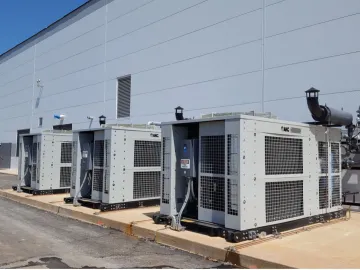
Cooling Systems

By the CAGI Centrifugal Compressor Section

Intercoolers play a critical role in removing heat between compression stages, directly affecting centrifugal air compressor efficiency and reliability. This article explains the fundamentals of intercooler operation, compares common heat exchanger designs and cooling methods, and explores the design tradeoffs engineers should consider when selecting intercoolers for compressed air applications.

The 2026 AICD Show Report

By Bill Smith, Regional Sales Manager, Compressed Air Best Practices® Magazine

The Association of Independent Compressor Distributors (AICD) held its annual trade show in Orlando, FL, in April 2026. Participating distributor members and guests enjoyed the AICD trade show, guest speakers, golf tournament and networking. “Each year, the relationships and synergies keep growing and growing. The AICD is very proud to celebrate our 40th year,” said Sal Calvo, AICD board member and Owner, Compressed AIR USA.  

2026 Compressed Air Distributor Sales Survey

By Troy Dreier, Senior Editor, Compressed Air Best Practices® Magazine 

Compressed Air Best Practices® Magazine has conducted its first-ever reader survey for this 20th anniversary issue, and the results show a positive outlook for compressed air system sales in the near future. 

Industrial Chiller and Heat Rejection Innovation at the 2025 AHR Expo

By Brooke Jones, Digital Content Editor, Chiller & Cooling Best Practices Magazine

More than 1,800 exhibitors and 350 speakers drew in over 50,000 attendees. HVACR professionals from across the globe gathered to discuss the latest regulation updates and explore innovations. This article focuses on chiller, heat rejection and related cooling technologies for industrial use.

New ABB Super Premium Motors Bring Energy Efficiency Gains

By Troy Dreier, Senior Editor, Compressed Air Best Practices® Magazine

SP4 motors provide the high efficiency and reliability required for air compressors which operate under demanding and variable-load conditions. The reduced energy losses and cooler operating temperatures mean a lower total cost of ownership for manufacturers. Additionally, the NEMA Super Premium efficiency level ensures compliance with stringent energy regulations, making this a future-proof investment.

HydroThrift Debuts Advanced Cooling System Control Panel

By Troy Dreier, Compressed Air Best Practices® Magazine

The customers wanted to be able to monitor their system from a control room. They wanted to be able to see the overall view of how the system was running. The bigger thing on the backend – especially for us from an engineering perspective – was being able to do better troubleshooting and helping them without the need to be onsite.

ASHRAE 90.1 Brings New Requirements to Compressed Air System Design

By Troy Dreier, Compressed Air Best Practices® Magazine

Word is beginning to filter out about the 2022 changes to the ASHRAE 90.1 energy efficiency standard, and the changes it promises to bring to how compressed air systems are specified, commissioned and maintained. More specifically, the industry is learning about section 10.4.6 of 90.1, which is the first time the standard has included a section on compressed air. 

The AIM Act’s Impact on HFC Gases

By A-Gas

The AIM (American Innovation and Manufacturing) Act was finalized by the US government at the end of 2021. This legislation introduced a phase-down plan for virgin HFC gases. From now through 2036, the US will reduce the production and importation of virgin HFCs by granting relevant businesses a set number of HFC allowances (or quota), which will decrease over time. 

EVAPCO Celebrates Full Spectrum Evolution at 2023 Global Sales Conference

By Bill Smith, Associate Content Manager, Chiller & Cooling Best Practices Magazine

In October of 2023, eight hundred sales professionals from forty-one countries attended the EVAPCO Global Sales Conference in Baltimore, MD. Under the theme “Full Spectrum Evolution,” EVAPCO celebrated the talent of its global sales network, and the evolution of its full spectrum of heat transfer solutions. This article will recount the event functions and share new developments unveiled at the EVAPCO Global Sales Conference, the first since 2017. 

Evaluating Air Compressor Cooling and Heat Recovery Part 1

By Hank Van Ormer, Technical Director, APenergy

This is a two-part article looking at factors impacting decisions on whether to use air or water-cooled air compressors. It also provides heat recovery guidelines for both situations. Part 1 will provide a brief history on air compressor cooling, a review of cooling water sources and costs, and some cooling cost comparisons between air and water-cooled air compressors.

Cooling Tower & Chiller Innovation at 2023 AHR Expo

By Bill Smith, Associate Content Manager, Compressed Air Best Practices® Magazine

The Cooling Technology Institute’s (CTI) four educational sessions drew standing-room-only crowds. Representatives from BPEARSON Consulting, SPX Cooling Tech, Eurovent and Baltimore Aircoil Company presented Fundamentals of Water Treatment; Cooling Tower Fundamentals; System Sustainability? Prove it with Certified Performance; and Fundamentals of Adiabatic Heat Rejection. Owners and operators of heat rejection equipment can join the CTI and attend its annual conference to meet the several dozens of technical experts with hundreds of years of combined experience capable of assisting with your next project. 

Tank Applications in Central Cooling Systems – Tankless Systems

By Clayton Penhallegon, Jr., P.E., Integrated Services Group

This article will be of particular interest to industrial system operators unfamiliar with tankless (primarily closed) systems who may be considering either installing new systems without tanks or removing existing open tanks.  The topics covered step through an understanding of tankless systems while also including tank system pointers and insights on converting systems with tanks into tankless systems. 

Choosing a Cooling Tower for Your Application – Crossflow or Counterflow?

By Eric Rasmussen, Senior Product Manager, SPX Cooling Technologies, Inc.

With efficient heat exchange an important requirement in the design of an HVAC system, the type of cooling tower you specify to support your project’s unique cooling goals requires careful consideration. After determining the process parameters required for your application – tonnage, range, and approach – cooling tower capabilities can be analyzed.

Air Compressor-Chiller Combination Saves Glassware Manufacturer $9 Million Monthly

By Aggreko

A large manufacturer of consumer glassware products in the North East sought a solution for injecting cold compressed air into its refractory furnace. Doing so would minimize the internal corrosion thereby extending the life of the furnace lining and their annual maintenance interval. The manufacturer opted for a unique solution from Aggreko Engineering featuring a rental, oil-free rotary screw air compressor combined with a heat exchanger and chiller. Installed in 2019, the solution is expected to save the company \$9 million monthly given the ability to maintain extend furnace maintenance from one year to two years – and boost plant uptime.

SHOW REPORT EXTRA Part 2 – Blower, Vacuum, Measurement, Air Purification and Piping at the 2019 BEST PRACTICES EXPO & Conference

By Bill Smith, Compressed Air Best Practices® Magazine

The Best Practices EXPO & Conference held from October 13-16, 2019 in Nashville, Tennessee, saw a significant increase in attendance growing by 15 percent to 850 attendees from 20 countries. End user (factory personnel) attendance grew by 60 percent! The EXPO was also truly international showcasing 115 exhibitors from 16 countries and EXPO attendance was free for qualified industry personnel. This SHOW REPORT EXTRA Part 2 complements our 2019 Best Practices EXPO & Conference Show Report and the Show Extra Part 1 Report. 

SHOW REPORT: The 2019 Best Practices EXPO & Conference – Another Success!

By Mike Grennier, Compressed Air Best Practices® Magazine

The event brought together technology experts, systems assessment professionals, and manufacturing leaders – all of whom shared best practices and ideas manufacturing plants can use to save energy, improve sustainability initiatives and increase the overall reliability and quality of on-site utilities.

SHOW REPORT: The Inaugural BEST PRACTICES EXPO & Conference

By Mike Grennier, Compressed Air Best Practices® Magazine

Held September 16-19, 2018 in Chicago, the first-ever event drew 750 attendees who came together to learn and share ideas about the countless ways to achieve efficiencies with compressed air, blower, vacuum and cooling systems – and in the process – save energy and improve profitability.

Control Panel Cooling Change Saves Compressed Air Electrical Costs

By Ron Marshall for the Compressed Air Challenge®

As a result of compressed air awareness training and a focus on energy management, two facilities in different parts of the world have reduced their compressed air demand substantially by removing vortex style cabinet coolers from some of their electrical panels and reworking the cooling systems.  These facilities were previously unaware of the high cost of compressed air and how much could be saved if other methods of cooling were used. This article describes some of their efforts in demand reduction.

Evaluating Air Compressor Cooling Systems

By Air Technology Group, Hitachi America.

As the population continues to grow in the United States, industrial water use will need to continue to fall to help offset the increases in public-supply water use. Water-cooled compressed air systems provide an opportunity for sustainability managers to reduce associated cooling water consumption and costs. If switching to air-cooled air compressors is not possible, understanding the costs and the alternative types of liquid cooling systems is important.

Specifying an Air Compressor Cooling System

By Bruce Williams, Hydrothrift Corporation

There are several pieces of information that your cooling system specialist will need in order to properly engineer and build a cooling system for your new air compressor. There are many types of air compressors and each has different requirements of the cooling system in order to operate correctly. This article will take the mystery out of some of the terms and specifications for your cooling system.

The Six Basic Types of Liquid Cooling Systems

By Bruce Williams, Regional Sales Manager, Hydrothrift Corporation

There are six basic types of cooling systems that you can choose from to meet the cooling needs of your load. Each one has its strengths and weaknesses. This article was written to identify the different types of cooling systems and identify their strengths and weaknesses so that you can make an informed choice based on your needs.

Calculating the Water Costs of Water-Cooled Air Compressors

By Sullair

Compressed air systems are present in almost all industrial processes and facilities. They have been correctly identified as an area of opportunity to reduce electrical (kW) energy costs through measures like reducing compressed air leaks and identifying artificial demand and inappropriate uses. Water-cooled air compressors can also be significant consumers of water and reducing these costs can represent a second area of opportunity.

Chillers Provide Temperature Regulation For Fine Wine

By John Medeiros, MTA USA

Temperature control of the musts during the fermentation process is required for the production of high quality wines. Alcoholic fermentation is the chemical reaction in which yeast is used to transform the natural sugars of the fruit into alcohol. The heat generated by this exothermic reaction has to be managed. If must temperatures are allowed to reach the 85°F to 105°F range the reaction will be stopped. This results in high sugar content and an unstable product that requires the addition of sulphur dioxide (SO2) to allow it to be stored without spoiling. In general, optimal fermentation temperatures are 65°F - 68°F for white wines and 77°F for red wines.

Chillers Save on Energy and Water Consumption

By Rod Smith, Compressed Air Best Practices®

Industrial plants are major consumers of water. Water is used in many processes. Sustainability projects focus on reducing the consumption of water and the energy-costs associated with cooling water so it may be effectively used.

Paper Mill Upgrades Air Dryer and Cooling System

By Rich Whitmore

This article reviews two major processes in paper mills: compressed air quality and air compressor cooling.  The central air compressor room was expanded and relocated at the largest privately owned paper mill in Canada.  The compressor space was required by a plant expansion, which would occupy the original compressor space for increased production.