System Assessments

Edited by Troy Dreier, Senior Editor, Compressed Air Best Practices® Magazine

We asked a hand-selected list of original equipment manufacturers, independent compressed air system sales and service companies, manufacturing plants and independent system auditors to share their thoughts, highlighting the changes they’ve seen over the past 20 years, then predicting what the next 20 years will bring.

Magnetic Pickups Reduce Compressed Air Demand at Automotive Plant

By Nasr Alkadi, Ph.D., CEM, CSRM, Strategic Energy Management Consultant and Coach, CLEAResult

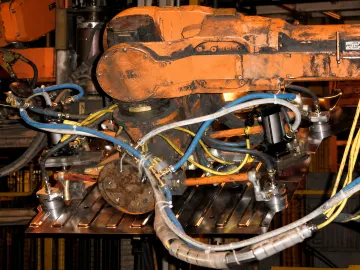
This article focuses on a project to replace vacuum cups with spring-return magnetic pickups for handling ferrous metal parts at an automobile assembly plant in Missouri. The application is most familiar in automotive stamping and body shop operations, but the lesson applies to any plant using vacuum cups to grab steel blanks, panels, brackets or formed parts. The original equipment in this case study used vacuum cups served by venturi devices.

OSHA-Compliant Air Guns: Safety, Performance and Industrial Cleaning

By Troy Dreier, Senior Editor, Compressed Air Best Practices® Magazine
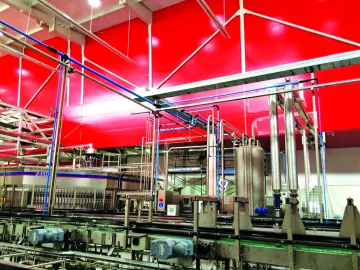
Industrial air guns are essential for cleaning manufacturing equipment and production areas, but improper selection or misuse can create serious safety and compliance risks. This article explains OSHA Standard 1910.242(b), the engineering behind OSHA-compliant safety air guns, and how nozzle design, thrust, noise control, and operator training help facilities improve worker safety while maintaining effective industrial cleaning performance.

Engineering Sales Associates Maintains Production with Preventive Maintenance

By Arthur Pue, President, Engineering Sales Associates 

Preventive maintenance is seldom newsworthy inside manufacturing facilities. By design, preventive maintenance should be a non-event. Production keeps running, shifts continue to change, trucks are reloaded and unloaded and work goes on. The reliability of a compressed air system requires focus, attention and discipline: paying attention to variables, detecting patterns and knowing when something seems amiss. Looking deeper into system performance turns routine maintenance into a strategic tool for improving reliability and production stability.

Thought Leaders on System Optimization Past & Future

Edited by Troy Dreier, Senior Editor, Compressed Air Best Practices® Magazine
We asked a hand-selected list of original equipment manufacturers, independent compressed air system sales and service companies, manufacturing plants and independent system auditors to share their thoughts, highlighting the changes they’ve seen over the past 20 years, then predicting what the next 20 years will bring.

20 Years of Case Studies: Plants Sharing Best Practices

Edited by Troy Dreier, Senior Editor, Compressed Air Best Practices® 

For 20 years, Compressed Air Best Practices® Magazine has published articles focused on helping manufacturers reduce power demand, lower water consumption, and improve the performance of compressed air, cooling, blower and industrial vacuum systems. In this article, we highlight a sampling of those stories across the following industries: Plastics and Packaging Food and Beverage Automotive and Transportation Cement, Building Materials, and Mining Metals, Pulp, and Paper Pharmaceuticals, Healthcare, and Research Wastewater Treatment
Sizing Compressed Air Piping to Manage Pressure, Flow and Velocity

By Ryan Freymuller, Sales Director, Manufacturers Distributor, Inc.

Efficient compressed air distribution depends on proper piping design to balance flow, pressure and velocity. This article explains how modular aluminum piping systems improve performance by reducing friction, minimizing pressure drop and maintaining laminar flow. With smooth interiors, full-bore fittings and leak-free connections, these systems help lower energy consumption and extend equipment life. A real-world case study shows how an optimized design reduced material and installation costs while maintaining performance. The result is a more adaptable, efficient and reliable compressed air network for modern industrial facilities.

Compressed Air at a West Texas Silica Mine

By Troy Dreier, Senior Editor, Compressed Air Best Practices® Magazine 
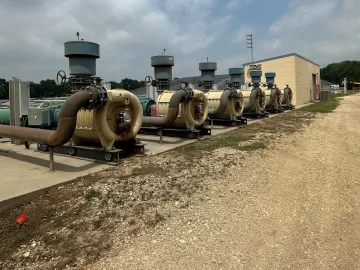
Compressed air system reliability relies on engineering expertise, environmental management and proactive maintenance. This article highlights how Brandon & Clark improved performance in two demanding applications: reducing failures in a dust-heavy silica mining operation through frequent preventive maintenance, and executing a complex disassembly and reassembly of a 300 hp air compressor in a confined university facility while preserving the OEM warranty. These cases show how tailored solutions and long-term service strategies enhance system reliability.

Morey Cuts Nitrogen Costs by $270,000 with On-Premises Generation

By Michael Dolan, Director of Sales and Marketing, South-Tek Systems

What started as a cost concern quickly exposed deeper risks tied to supply reliability, contract constraints and production downtime. Facing a tight deadline, the electronics manufacturing company executed a rapid transition to an on-site nitrogen system that reshaped how its operation is powered. The results reveal why more manufacturers are rethinking their dependence on delivered industrial gases.

R&D Labs Shifting to N2 Generation

By Dave Henning, Sales Manager, MCE Diversified Air

This article explores how on-site nitrogen generation, using PSA and membrane technologies, enables engineers to produce nitrogen on demand with greater control over purity, flow and pressure. It also highlights real-world applications and the operational benefits of improved uptime, reduced handling risks and lower total cost of ownership.

Leland Brewing Adopts Modular Nitrogen Generation

By Troy Dreier, Senior Editor, Compressed Air Best Practices® Magazine 
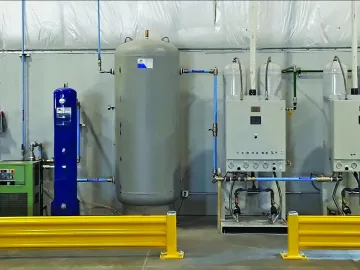
A modular nitrogen generation system integrated with compressed air infrastructure enabled on-site nitrogen production, reducing reliance on delivered CO₂ and improving process efficiency. Adjustable nitrogen purity levels (e.g., 99.99%) optimized flow rate and demand matching while maintaining product quality in brewing applications. The implementation demonstrates how scalable nitrogen generation technology can lower operating costs and support growth in small to mid-sized industrial operations.

Dishaka Strengthens Operational Efficiency with Onsite Nitrogen Generation

By Joshua Blair, Sales Engineer, Liberty Systems

A snack manufacturer, strengthened operational efficiency and product freshness by implementing onsite nitrogen generation at its Houston facility. By replacing delivered nitrogen with PSA-based systems from Liberty Systems, the company gained 24/7 supply reliability, reduced operating costs and improved sustainability performance. The investment supports scalable Modified Atmosphere Packaging (MAP), enhances business continuity and positions Dishaka for long-term growth in the competitive food manufacturing industry.

Renew Energy Partners Fixes Variable Demand on a Large Campus

By Troy Dreier, Senior Editor, Compressed Air Best Practices® Magazine

An aerospace manufacturer worked with Renew Energy Partners to address energy waste caused by variable compressed air demand across a 30-building campus. By upgrading to a variable-speed drive compressor, repairing leaks, and improving air drying under an energy-as-a-service model, the project reduced energy use by more than 270,000 kWh annually while supporting long-term decarbonization goals.

Hyster-Yale Sustainability Recognized by North Carolina DEQ

By Stephen Kelly, Senior EHS Manager, Hyster-Yale Materials Handling

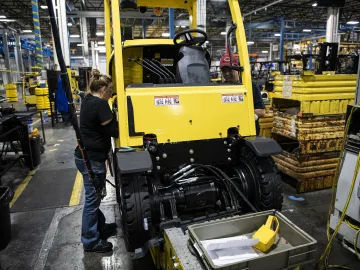
Hyster-Yale’s Greenville, North Carolina, plant reduced compressed air waste through employee-driven leak detection and system optimization, achieving $177,000 in annual energy savings. The initiative also avoided 858 tons of CO2 emissions and earned the facility Environmental Steward recognition from the North Carolina Department of Environmental Quality.

Advanced Compressor Technologies Solves Oversupply Problem

By Troy Dreier, Senior Editor, Compressed Air Best Practices® Magazine 
A Southern Indiana office furniture plant was wasting hundreds of dollars per day because its oversized VSD air compressor could not turn down low enough to match reduced demand after a shift to metal fabrication. To avoid drive faults, the plant vented compressed air to create false load. The audit revealed 300 cfm of wasted air—about $400 per day—and led to a redesigned system using a fixed-speed compressor for base load and a VSD unit for trim. The new configuration eliminated artificial demand and cut compressed air energy use in half, setting the stage for further savings through advanced sequencing, storage, and demand control.

Egger Modernizes Its Compressed Air System for the ESG Era

By Graham Coats, Director of Strategic Product and Business Development, CMC

Wood-based materials manufacturing plant transformed its compressed air system from an invisible utility into a data-driven energy asset by deploying a modern, multi-zone monitoring and control platform. The upgrade delivered real-time transparency, ISO 50001- and ESG-ready reporting, and verified annual savings of 1.43 GWh, $166,500 and 889 tons of CO2.

Ultrasound Saves Energy by Detecting Compressed Air System Leaks

By Robin Marcinkus, Global Content Marketing Specialist, UE Systems

One of the primary applications of ultrasound is detecting and repairing compressed air system leaks. These leaks not only waste money, but also reduce equipment efficiency, increase wear and pose safety risks for employees. However, with a simple point-and-scan approach, maintenance teams can quickly locate leaks. This helps lower energy costs, improve safety and keep industrial operations running at peak efficiency.

The Business Case for Air Compressor Rentals and Air-Over-the-Fence

By Matt Piedmonte, Vice President and General Manager, Americas, Aerzen Rental Solutions

There is no single right approach to putting the necessary volume and pressure of air in the pipe to meet production needs. There is a place for purchasing assets, there is a place for renting assets and there is a place for an AOF contract. Just as the business models around these assets change, so do the needs of an industrial plant. This article aims to explore these options and explore some of the pros and cons associated with different methods.

ADG Concepts Solves Years of Piping Problems for Frozen Foods Plant

By Troy Dreier, Senior Editor, Compressed Air & Cooling Best Practices Magazine

They got to a point where every time they added a new piece of equipment, it did not eliminate their rental, nor did it eliminate the water problems, the leaks and everything else they were experiencing. The system had issues that adding more equipment simply could not fix.

Industrial Blowers Reduce Energy Use in Aluminum Casting Plant

By Alper Alten, Founder, AAPM Project Management and Consulting

This article explores how a focused engineering intervention driven by data and a clear understanding of process requirements led to a transformative change on a aluminum production plant. By switching from traditional compressed air systems to low-pressure industrial blowers the plant not only maintained product quality, but also achieved a dramatic reduction in energy use saving nearly $455,000 annually.

Texas Recycling Plant Saves Water with Air-Cooled Air Compressors

By Troy Dreier, Senior Editor, Compressed Air Best Practices® Magazine

There are multiple compressed air applications in a waste management facility. This new recycling center uses laser-guided optical sorters to divide waste, with no human involvement on the sorting line. Laser optics determine what type of material each scrap is, then compressed air jets maneuver each piece to its collection area. Compressed air also powers handheld blow guns used for cleaning, as well as the bundling and packaging system.

Selecting the Appropriate Nitrogen Gas Purity Level for Your Application

By the Compressed Air & Gas Institute

Producing nitrogen locally is an excellent way to reduce nitrogen costs and ensure a continuous supply of nitrogen gas at the appropriate purity. The ideal nitrogen generation solution varies by application, based on the specific levels of nitrogen purity, flow, pressure and dryness that are required. Environmental factors such as air quality, humidity and temperature also affect the performance of the system.

Cardinal Glass Increases Throughput with Dry Compressed Air

By Troy Dreier, Senior Editor, Compressed Air Best Practices® Magazine

With over 49 locations and 10,000 employees, the company’s Casa Grande, AZ, plant specializes in tempering, taking annealed or raw glass, cutting it to size, running it through a 1,250°F (677°C) oven and then using a pressurized air system to quench the glass and turn it into safety glass. Compressed air powers the plant’s belt systems that transfer materials, the seaming system that rounds the corners and the washer system that cleans particulates off glass before it goes into the furnace.

Kirsh Foundry Drives Energy Efficiency with Compressed Air Optimization

By Juan Espindola, CEM, Facilities Optimization Leader, The Wasmer Company

The energy savings amounted to 550,873.5 kWh per year, resulting in a reduction of $49,579 in energy costs annually. Additionally, nitrogen savings were significant, with annual expenses dropping by $8,602 due to the installation of the on-site nitrogen generator. Overall, the project achieved total annual savings of $58,181, with implementation costs of $74,676 and an impressive payback period of just 1.28 years.

High-Altitude Mining and Steel Production in Peru

By Troy Dreier, Senior Editor, Compressed Air Best Practices® Magazine

Before CAGI data sheets were created, air compressor distributors and their customers could only go by the manufacturers’ claims. He found there wasn’t any uniformity to the numbers manufacturers put out, so making comparisons was challenging. Some compressed air manufacturers measured capacity from the bare airend, while others measured from the air compressor’s outlet.

Compressor Controls

Piping Storage

End Uses

Pressure

Air Treatment/N2

Leaks

Pneumatics

Vacuum/Blowers