Auto

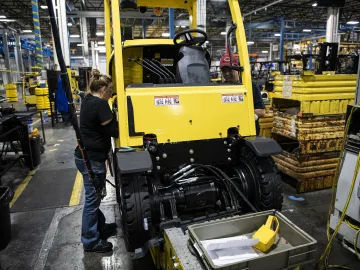
Hyster-Yale’s Greenville, North Carolina, plant reduced compressed air waste through employee-driven leak detection and system optimization, achieving $177,000 in annual energy savings. The initiative also avoided 858 tons of CO2 emissions and earned the facility Environmental Steward recognition from the North Carolina Department of Environmental Quality.

Magnetic Pickups Reduce Compressed Air Demand at Automotive Plant

This article focuses on a project to replace vacuum cups with spring-return magnetic pickups for handling ferrous metal parts at an automobile assembly plant in Missouri. The application is most familiar in automotive stamping and body shop operations, but the lesson applies to any plant using vacuum cups to grab steel blanks, panels, brackets or formed parts. The original equipment in this case study used vacuum cups served by venturi devices.

20 Years of Case Studies: Plants Sharing Best Practices

For 20 years, Compressed Air Best Practices® Magazine has published articles focused on helping manufacturers reduce power demand, lower water consumption, and improve the performance of compressed air, cooling, blower and industrial vacuum systems. In this article, we highlight a sampling of those stories across the following industries: Plastics and Packaging Food and Beverage Automotive and Transportation Cement, Building Materials, and Mining Metals, Pulp, and Paper Pharmaceuticals, Healthcare, and Research Wastewater Treatment 

Achieving Precise Powder Coating Control and Greater Productivity

When building powder coating solutions, it can be a challenge to optimize compressed airflow with minimum reaction time. Without this level of control, the coating thickness may not be uniform and transfer efficiency – the amount of powder adhering to the object being sprayed – may be low. The resulting overspray can waste powder material. The control of a powder coating machine — and the quality and efficiency of the application — depends on the performance of the valve block.

For Abundant Air Compressor, Reliability Is a Best Practice

Compressed Air Best Practices® Magazine sat down with Richard Compton, Owner of Abundant Air Compressor of Springfield, MO, and one of his clients, Kenny Schulte, Owner of A-1 Custom Car Care, to talk about why this regional air compressor installation and maintenance company is known for its excellent service.

Hitting the Gas on Efficient Compressed Air Delivery at Hitachi Astemo

Hitachi Astemo’s efficiency gains will turn into significant cost savings. In this article we outline the savings reported by the client since the changeover was complete. It shows a sizeable reduction in energy costs, air compressor energy costs and maintenance costs to the tune of 21.95%, 24.14% and 24.14%, respectively. Total operating costs to date have dropped from \$1,277,394 to \$941,959 with the new system a decrease of 26.25%.

DENSO Compressed Air Leak Detection Program Drives CO2 Reduction Results

Given that compressed air leak management programs are meant to save energy, reduce CO2 emissions, and generate ROI, DENSO’s Maryville, Tennessee, manufacturing facility can definitively say it has scored a trifecta when it comes to results – and reaped benefits beyond hard numbers alone.

Compressed Air Supports Growth at Roush Yates Manufacturing Solutions

“I’ll say this politely. At the end of the day, we shouldn’t have to worry about compressed air, right? We’ve got more important things to worry about,” English said, adding how a recent partnership with Atlas Copco Compressors and other decisions associated with compressed air have hit the mark. “Without clean, compressed air we wouldn’t be able to complete our day-to-day activities. We’re relieved it’s something we don’t need to worry about.”

A Quarter Century of Positive Change at Automotive Supplier’s Mexico Plant

Today, leading automotive makers rely on the plant for parts used to produce some of the most sought-after vehicles. Additionally, the nearly 600,000-square-foot manufacturing facility achieved ISO 50001 certification in 2021. Here’s a look at how the plant grew for the better over more than 25 years – and its compressed air system along with it. 

Front Row Motorsports Takes the Checkered Flag with Clean, Dry Compressed Air

At the paint booths, FRM team members typically use conventional High-Volume Low-Pressure (HVLP) paint sprayers to prime the chassis and car bodies. Paint pressure pots (also called paint tanks) feed paint to the paint sprayers. The compressed air system supplies air to the paint pots at a steady 65 psi. The tanks regulate air output for the sprayers at 12 to 15 psi in order to deliver the precise amount of paint to a given chassis or car body.

The Gentex Journey to Reliable Energy Conservation - 3 Levels of Compressed Air Systems

The information contained in this article, will help the operator to assess his/her systems, and identify where these systems fall within a three-level category. There are many ways, and opportunities to make a compressed air system produce reliable and good quality air. The three levels discussed here could also be characterized as a “continuous improvement plan” which can be achieved over the course of time, and with the occasional investment of money.

Networked Air Compressors Operate in Harmony at Automotive Manufacturer

When an automotive company added a new 200-horsepower (hp) rotary screw air compressor and accompanying dryer to a satellite building at its Chicago-area assembly plant, it needed a cost-effective way to integrate the equipment into its existing compressed air network. Doing so would allow plant personnel to easily monitor the air compressor’s performance and ensure it operates in harmony with the plant’s centrifugal air compressors. Importantly, it would contribute to efficient and reliable air compressor operation at all times.

Compressed Air System Assessment at Douglas Autotech Bolsters Reliability and Energy Savings

Products manufactured at the 100,000-square-foot plant in Kentucky include columns, I-shafts, covers, keylocks, and other dressings, along with shifter applications, such as straight, tap-up/tap-down and gated shifters. In all, the facility supplies automakers with products used in more than 100 different applications, all of which are designed keep vehicles operating safely, smoothly and reliably.

Ford Motor Company’s Kentucky Truck Plant Helps Paint a Bright Energy Future

The Ford Motor Company Kentucky Truck Plant (KTP) not only manufactures upscale SUVs and pickup trucks painted in wide variety of stellar, high-quality colors and finishes –  it does so cost-effectively by conserving annual compressed air energy of approximately 9.2 GWh thanks to a major overhaul of the plant’s compressed air system.

Tier 1 Automotive Supplier Saves Energy Upgrading Centrifugal Air Compressor Controls

A Tier 1 automotive supplier was concerned its compressed air system was not operating as efficiently as it could be. The situation called for a site visit and metering and evaluation of the company’s air compressors to generate a representative data sample that accurately captured the compressed air needs during typical production and non-production periods.

Fifteen Years of Compressed Air Best Practices Support Gentex Business and Production Goals

While many businesses strive to plan, install and maintain a compressed air system that fulfils the company’s specific needs, I’ve found that implementing compressed air best practices not only accomplishes specific goals, but also results in time-tested advantages that aid in the overall business and production goals of the organization.

SumiRiko Tennessee Saves Energy & Boosts Sustainability with Compressed Air System Upgrade

In a strategic approach to improving its management of compressed air, the company initiated an upgrade of its compressed air system at its Midway plant. In so doing, SumiRiko Tennessee saves 2.1 million kWh and \$100,000 in energy costs per year at the plant.  Additionally, lower energy use resulted in the reduction in CO2 of 800 tons per year. With a utility rebate, the project paid for itself within two years.

Automaker Saves $600,000 Yearly In Energy Costs & Improves Compressed Air System Reliability

The project, which also involved the addition of a booster air compressor and receiver tank – along with the installation of an important pressure control valve – gives the automaker the ability to run fewer centrifugal air compressors during peak production. In so doing, the plant saves nearly 6.1 million kWh and more than \$600,000 per year in energy costs. The project also qualified for a \$369,374 rebate from the local utility, resulting in a six-month project payback – all while improving system reliability.

Profile: Case Controls and Centrifugal Air Compressor Management

Often, multiple centrifugal air compressors are set up to simply react to air demand, which requires the system to not only meet the new demand, but also make up for air depleted in the main header. This typically results in too much supply, which results in bypassing the air to atmosphere. The result is wasted energy use.

Missed Demand-Side Opportunities Part 4 - Utilizing Air- Driven Venturi Vacuum Generators Efficiently

When the 18th Century Italian physicist Giovanni Venturi discovered when air is forced through a conical nozzle its velocity increases as the pressure decreases, neither he nor anyone could conceive it would ultimately spawn one of the most used and most highly controversial products in the industry today- the Venturi vacuum generator (aka, ejector).

Automaker PROTON Attacks Compressed Air Waste

Compressed air optimization measures adopted by PTMSB have reduced the consumption of compressed air by 31 percent resulting in savings of about 3,761,000 kWh per year in energy consumption. The monetary savings are MYR 1,090,627 per year (\$255,000 USD). The CO2 reduction is estimated at 2,735 ton per year.

Control Panel Cooling Change Saves Compressed Air Electrical Costs

As a result of compressed air awareness training and a focus on energy management, two facilities in different parts of the world have reduced their compressed air demand substantially by removing vortex style cabinet coolers from some of their electrical panels and reworking the cooling systems.  These facilities were previously unaware of the high cost of compressed air and how much could be saved if other methods of cooling were used. This article describes some of their efforts in demand reduction.

Atlas Machine Helps Ahresty Save $151,000 with Master Controls

Ahresty Wilmington Corporation (AWC) was founded in 1988 and is located in Wilmington, Ohio. Currently AWC employs over 900 people with sales totaling \$192 million. They have grown steadily, all while continuously improving and staying on the leading edge of technology. AWC is a tier-1 automotive supplier servicing their entire customer base in the United States. AWC has established an efficient and integrated production system that incorporates die-casting, finishing, machining, and assembly operation using just-in-time production methods to provide its customers with quality products at a competitive price.

Nissan Curbs Compressed Air to Achieve Energy Savings

Nissan North America operates on a massive scale. The company’s powertrain assembly plant in Decherd, Tennessee, alone encompasses 1.1 million square feet, and manufactures engines for 14 different vehicles. The facility also handles crankshaft forgings, cylinder block castings, and other machining applications. Over the course of one year, the powertrain plant churns out approximately 1.4 million engines, an equal number of crankshaft forgings, and 456,000 cylinder block castings.

Auto Manufacturer Eliminates Dryer Purge Air

This northeastern U.S. automotive manufacturing facility spends \$269,046 annually on energy to operate their compressed air system. This figure will increase as electric rates are raised from their current average of .019 cents per kWh. The set of projects, in this system assessment, reduce these energy costs by \$110,166 or forty percent. Reliability of compressed air quality, however, is the main concern in this plant and the primary focus of this system assessment.