
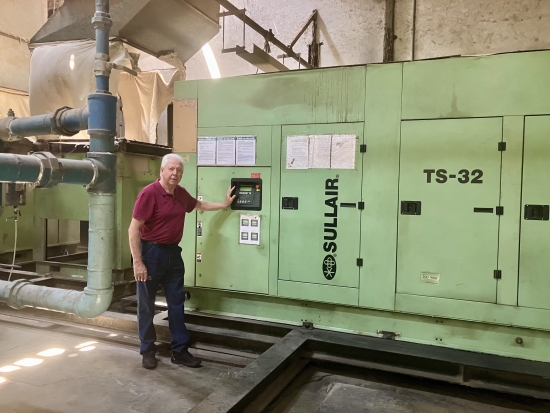
Pedro Secada spent 42 years working in the compressed air industry, much of it as the owner of Sullair del Pacifico in Peru. Driven to help his customers improve efficiency and save money, he challenged himself to keep learning. A large part of his business came from the country’s mines, metal foundries and cement plants. Winning loyal customers meant solving problems quickly.
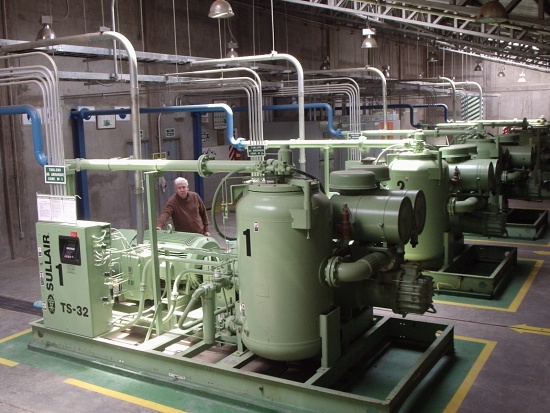
“We’ve partnered with Sullair del Pacifico for more than 45 years. Their experience in the mining industry in particular runs deep,” said Andy Munoz, Area Sales Manager, Hitachi Global Air Power. “They have a profound understanding of the unique challenges that come with high-altitude work and where environmental conditions impact equipment performance. The Sullair del Pacifico team’s passion for excellence and continuous improvement sets them apart as a leader of the industry."
A Lifetime Learning about Compressed AirPedro Secada’s career started in September 1980 when he took a Service Manager position with Sullair del Pacifico’s Peruvian branch, at the time a fully-owned Sullair subsidiary. An avid reader of Sullair’s maintenance manuals, he began studying all he could about maintenance schedules, lifetime hours of operation, valves, capacity control systems and lubrication. He studied electric motors, motor bearings, starters and maintenance schedules. He saw the importance of ambient temperature and oil temperature to air compressor performance. He learned how the design of different capacity control systems impacted the reliability of bearings and gears. A decade later, he had worked up to General Manager, and was given the chance to be his own boss. In July 1990, Sullair sold him the subsidiary’s assets and let him keep the name. Sullair del Pacifico was now his. In 1991, he invested in a FoxPro database to track the hours of operation for every air compressor, refrigeration compressor and vacuum pump his company installed. It grew to include over 4,000 machines. He created weekly service reports for each air compressor, giving his customers reliable information on preventative maintenance. He was also able to work with his wife, who became the company’s Spare Parts and Logistics Manager and excelled at selling customers supplies for preventative maintenance. The benefits of his system were immediate. His database gave him an asset his customers greatly valued. Thanks to the reliability of his information, his company earned a reputation for having air compressors that never failed, and Sullair del Pacifico became a market leader. The company grew to include three locations, with one in Lima and two others in the north and south of Peru. Besides insuring uptime, Secada was also concerned with his customer’s energy costs. Before CAGI data sheets were created, air compressor distributors and their customers could only go by the manufacturers’ claims. He found there wasn’t any uniformity to the numbers manufacturers put out, so making comparisons was challenging. Some compressed air manufacturers measured capacity from the bare airend, while others measured from the air compressor’s outlet. Specs might provide acfm or scfm. “It was difficult understanding how everybody was speaking, but I learned a lot searching through all the published results,” he said. “I had to learn about and compare a variety of specifications. It was confusing, but it was a good learning process.” 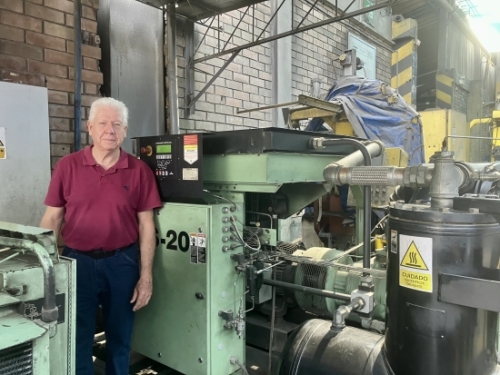  |
Mining at 17,000 Feet Above Sea Level
The mining industry is a major customer segment for Sullair del Pacifico. Peru’s mines aren’t far down below the earth’s surface, but far up in the mountains at almost 17,000 feet. High-altitude operations provided unique challenges.
When high-altitude mining air compressors failed, Secada saw it wasn’t because the motor lost power, but because the thin air presented cooling issues. A standard electric motor can get by with a small fan at sea level, but the same fan doesn’t move enough air at 17,000 feet. To solve the issue, he visited Toshiba in Houston to order electric motors with bigger frames and bigger fans. He also spoke with engineers at Sullair to change the gear ratio of the airends to compensate for lost capacity.
“A lot of miners in Peru continue to purchase Sullair tandem air compressors because they can show you machines that have been working for 20, 25 years. Shutdowns are uncommon,” he said.
One mining customer insisted on purchasing two 350 horsepower (hp) VSD two-stage rotary screw air compressors against Secada’s wishes. After one year, one of them burned out due to voltage variations brought on by electric storms and other issues found at high altitudes. He replaced them with two two-stage 350 hp rotary screw air compressors with components optimized for high altitudes.
“I sold so many two-stage air compressors I was the only one to celebrate the 30th anniversary of the tandems,” he said.
Metal Foundries and Cement Plants
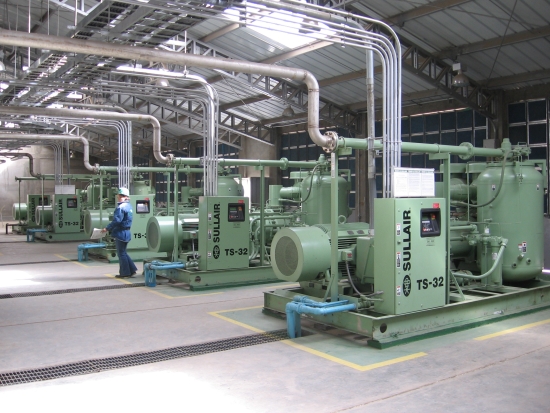
Secada’s industrial customers also included a steel foundry producing building construction material. Due to the length of the steel beams created, the foundry was two miles long. That meant two miles of compressed air piping. Despite multiple air compressors supplying the system, it occasionally ran out of air. After installing meters to measure pressure throughout the compressed air system, Secada discovered an application at one end that produced a huge demand for several hours one or more times per month. The plant operators didn’t see their problem until the system audit showed them. He told them they couldn’t have one compressor room for a system like theirs, but needed three air compressor areas: one at each end and one in the middle.
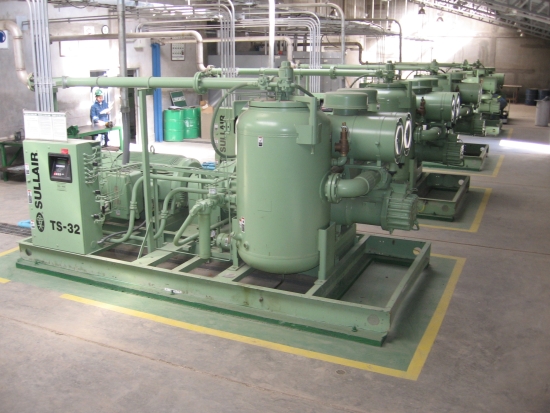
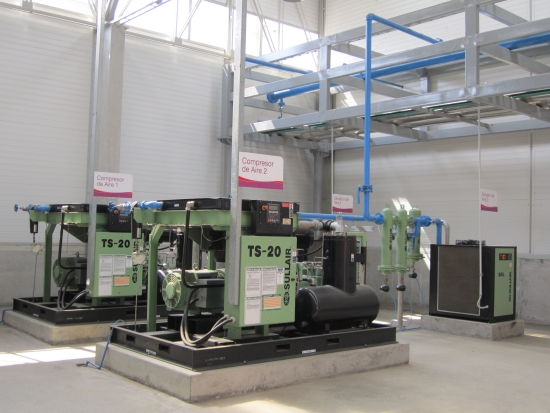
One smaller steel mill moved to Peru from Switzerland and brought with them European-built Sullair air compressors, models Secada didn’t know. It set up 150 miles south of Lima at sea level, 12 miles from the Pacific Ocean, a hot and humid environment. The mill started with two 220 hp European Sullair air compressors, then grew with two U.S.-built 300 hp two-stage air compressors, three 450 hp two-stage air compressors plus additional smaller one- and two-stage air compressors, compressed air dryers, filters and storage tanks. The air compressors were all equipped with variable capacity control (VCC). He taught the mill’s personnel how to use the VCC performance curve to align specific load with specific power. He also taught them how to measure the energy savings from wet and dry storage tanks.
A cement plant presented multiple problems in need of solutions. Since it was located at a high altitude, it needed air compressors optimized for thin air, with the same specially constructed Toshiba motors the high-altitude mining customers used. But because the environment was especially dusty, it required heavy-duty three-stage cyclone inlet filters with primary and secondary air filter elements to fully protect the air compressor airends. He supplied multiple low-pressure oil-lubricated rotary screw air compressors delivering 2,000 acfm of 50 psig compressed air, and a backup 400 hp air compressor that could supply 50 psig or 115 psig. All are still working after more than 120,000 hours without an overhaul, he noted proudly.
Compressed air also solved the problem of black smoke coming from the chimneys of cement plants and steel foundries. The smoke was a mix of ash and hot air. Adding compressed air piping and a water vapor system inside the chimneys cleaned the soot from the exhaust so only hot air was expelled.
These days, Secada is happily retired. He sold his company to Acero Comercial Ecuatoriana in January 2015, and stayed on for another five years at the new owners’ request. He’s still available for consultations when his lifetime of compressed air knowledge is in demand.
“I have a good relationship with them,” he said. “I don't work, but I cooperate with them, especially when they have nice, big projects involving mining or high altitudes.”
Creating a Preventative Maintenance LibraryTo pass his learnings on to his customers, Secada started writing and distributing his own bulletins. By the end of his career, he had created over 200 of them. His bulletins gave specific and useful information. He told customers what oil to use and the part numbers for the filters they should order. Many of his bulletins were about architecting compressed air systems. He showed how to add lower areas to piping so water would drain out and not get passed along to the point-of-use. “If the compressed air pipeline is not well-designed, when the dryer fails you will have a point-of-use with a lot of water. That could be easily avoided if the compressed air pipeline was well-designed,” he said. “We learned if you began to go up from the air compressor and then down with a drain, water will fall to the drain. It will not climb. When customers called with a technical question Secada simply mailed them a few bulletins. His emphasis on preventative maintenance gave a boost to his replacement part sales. Because he tracked air compressor performance, he knew which were approaching 15,000 hours of service and needed replacement parts. He stocked those items so customers didn’t have to wait. “People always told me the way I speak was so reassuring they realized I was giving them good information, and they believed me,” he said. “It’s rewarding to realize the reason you had an economic success was because you did a lot of things the right way.” 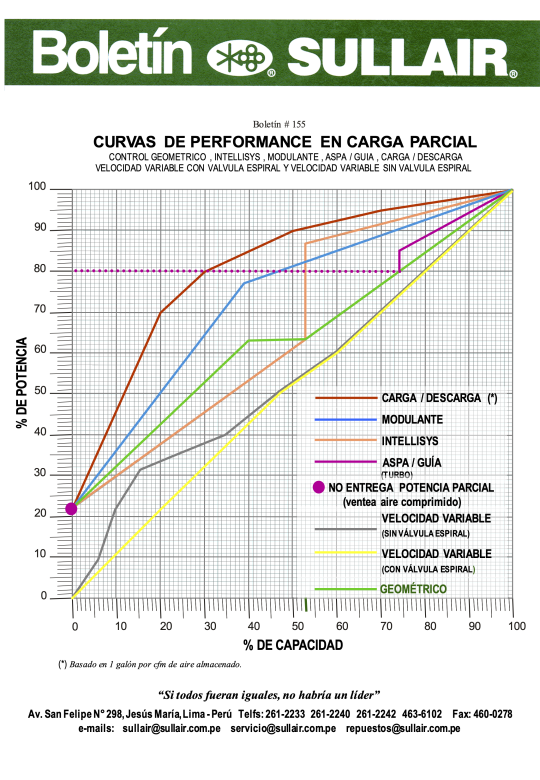 |
For more information, visit https://www.sullair.com.pe.
To read articles about Bulk Industry, visit https://www.airbestpractices.com/technology.
For expert presentations on Air Compressor Technology, visit our webinar archive section at https://www.airbestpractices.com/webinars.
