
How Nitrogen Generation Technology Improves Brewery Operations and Reduces CO₂ Dependence
Leland Brewing is based in Leland, NC, just outside Wilmington. It offers 10 beers year-round, as well as seasonal specials and draft-only options. The brewery specializes in what it calls approachable beer, meaning traditional styles using quality ingredients. Production is 60 barrels per week in the winter and twice that in the summer tourist season.
The brewery began three years ago, and has expanded from self-distribution with one driver to 20 drivers and 15 sales representatives. It’s distributed in the Wilmington and Raleigh-Durham areas, but will soon expand to Charlotte. Besides the brewing area, its headquarters include a taproom and a full-service kitchen.
Brian Quade has been Head Brewer since the brewery opened. He appreciates the support his company has gotten from the community, as establishing a new brewery can be challenging. One unexpected bit of support came from a nitrogen gas generator manufacturer that just happened to be in the neighborhood.
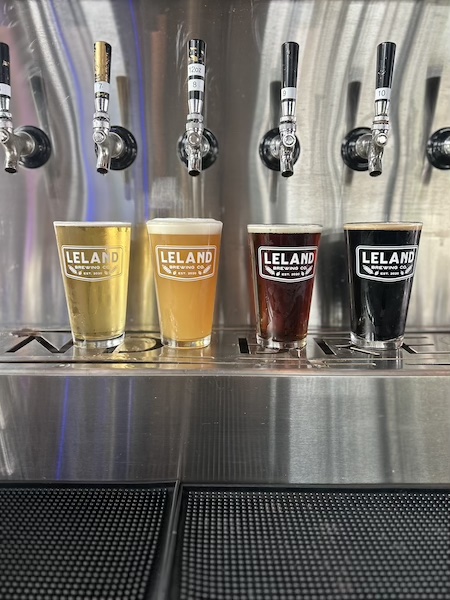
Rotary Screw Air Compressor Powers Pneumatic Processes
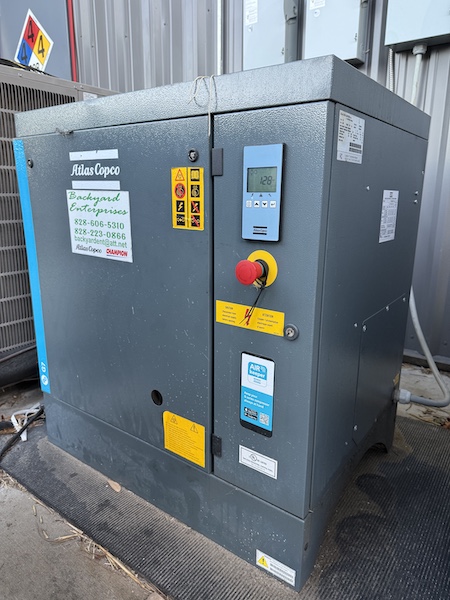
The brewery uses compressed air and nitrogen gas in multiple ways. Compressed air powers its canning line, grain hopper and keg washer, and feeds into its nitrogen generator. Compressed air is supplied by an oil-injected, air-cooled, rotary screw air compressor, which is located outside the brewery under an awning. Backyard Enterprises, based in Spindale, NC, is the brewery’s compressed air distributor, but the brewery handles maintenance. The only problem Quade has with the air compressor is occasional overheating on summer days when the temperature reaches 100°F (38°C). When that happens, he powers it down for 10 to 15 minutes, then starts it up again.
“We thought about putting some sort of fan next to it,” Quade said. “We looked at putting it inside the brewery, but it's hotter inside the brewery than it is outside. We come in at 5:00 AM in the summertime to try and beat the heat.”
The air compressor feeds into a non-cycling refrigerated compressed air dryer, then a dry storage tank. The brewery’s air compressor outputs at 60 psi, but a regulator on the compressed air storage tank lowers that to 25 psi. The brewery’s tanks are rated for 15 psi, so it tries not to go much above that. While the ambient air is humid in Leland, the brewery hasn’t had any problem with moisture getting into the pneumatics. The brewery uses ¾-inch semi-flexible compressed air tubing.
%20copy.jpeg)
The brewery’s oil-injected, air-cooled, rotary screw air compressor is located outside under an awning. Compressed air feeds into a noncycling refrigerated compressed air dryer, then a dry storage tank.
An Opportunity to Beta Test a Modular Nitrogen Generator
Until recently, Leland Brewing used carbon dioxide (CO2) for all operations where beer needed to be kept away from oxygen to maintain freshness, as well as for carbonating the beer. But the brewery is located near the North Wilmington, NC, headquarters of South-Tek Systems, and that led to an opportunity with a product the company was developing.
“A couple of their sales reps would come in here and do some work and get a couple beers. We ended up forming a good relationship with them, from them hanging out at the brewery, and they'd come back and look at what we were doing in the brewing area,” Quade said. “One day, they approached us and said, ‘We're looking for someone to beta test a new unit for the next three months. It'd be no cost to you. If you like it, we'll give you a good deal on it. If you don't like it, we'll put it back on our truck and take it back with us.’”
The beta test was for South-Tek’s N2GEN-FLEX system, and the test began in September 2024. As the company’s first multi-bed, modular, nitrogen gas generation system, it was designed as a cost-effective offering for smaller companies.
‘When we launched this product, we knew that it was going to be popular in brewing, food processing and electronics manufacturing,” said Mike Dolan, Director of Sales and Marketing, South-Tek Systems. “Being based in Wilmington, North Carolina, we had a relationship with the contact. We offered to place the system in for a 90-day test that allowed Brian to test our concept, test the application and see if it could work. It allowed us to look at service intervals, preventative maintenance and what we would need to do to support systems like this in the field. As part of the beta test, they had the option to either decline or purchase the system, which they did.”
“South-Tek showed us how to adjust the user interface,” Quade said. “When we used it for the first time, the company came in and made sure it worked as it should and kept the purity up. They come out every six months to swap out our HEPA filters and do any sort of maintenance. It's nice with them being right there. They train new service techs on the units.” Maintenance is included in the lease.
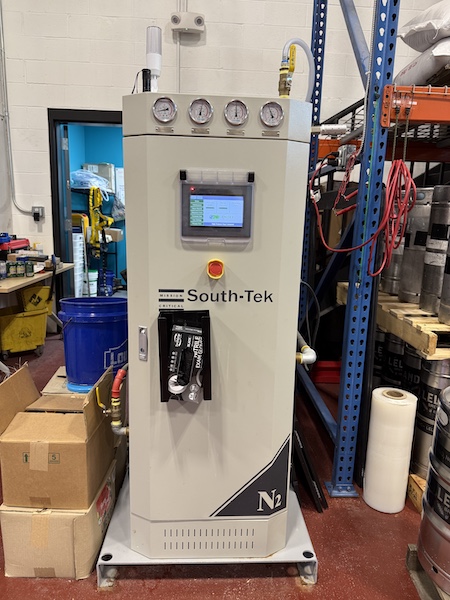
The brewery was able to beta test a new modular nitrogen generation system while it was still in development.
Experimenting with Nitrogen Gas Purity
The brewery first set the nitrogen generator for 99.999% purity. A screen on the front shows the nitrogen purity produced. If the purity level drops, the generator stops output until it reaches the desired purity again. Experimenting with the output, the brewery dropped the purity level to 99.99%, where the generator was better able to match demand, and didn’t experience any problems due to the oxygen content.
“Five nines was the highest it would let us go,” Quade said. “When we first used the nitrogen generator, we wanted to make sure we were getting the purest nitrogen, but then we realized four nines is still a higher purity of nitrogen than it is of CO2 coming in from our bulk tank, and it was able to keep up a lot better. We had a little bit of an issue with some of our bigger tanks when we moved beer from one of our 40-barrel tanks to one of our brite tanks. It wasn’t able to keep up quite as fast. When we switched to four nines, we didn't see any pickup in oxygen, but a much higher flow rate.”
Quade might experiment with three-nines purity in the future, but only if the nitrogen generator isn’t able to meet the brewery’s demand.
“Before this, nobody had made a modular nitrogen unit for our size,” Quade said. “For bigger facilities, they do make modular units, but nothing for the smaller guys to be able to grow with.”
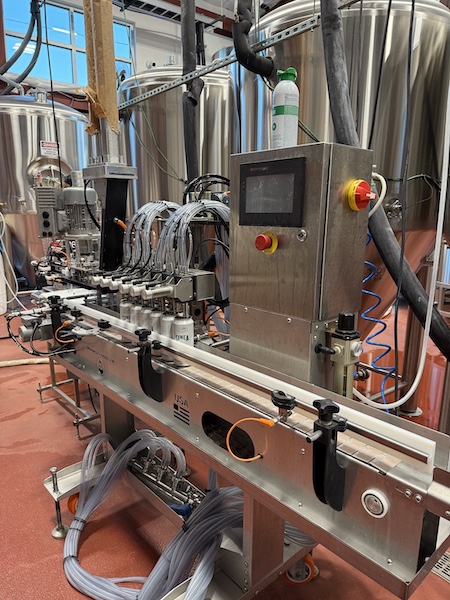
The brewery’s canning line is powered by compressed air.
Nitrogen Starter Tips for Breweries“The biggest challenge is figuring out the right size you need,” Quade said. “We began this beta test with South-Tek Systems, and neither of us really knew what size unit we needed to keep up and have a little bit of room for growth. We didn't want to oversize the system and pay too much money or undersize it and not be able to use it as much as necessary. “Rather than looking at the size of the brewhouse, look at the size of the tanks you're going to be pushing nitrogen into. We're a 15-barrel brewhouse with 15 and 30-barrel tanks. Other brewers I worked with had 60-barrel tanks. Those are four times the size of our smallest and twice as large as our biggest. They would probably need to add a couple more beds on the back of their nitrogen generation system. “Train your staff to use it. Sometimes they forget because a lot of breweries have worked with CO2 and CO2 regulators, and disconnects are right by the tank. It's easy to forget and plug in the CO2 instead of the nitrogen. “Finally, experiment with it. The process is the same with nitrogen as it is for CO2, but we're just substituting one gas for another gas. I've had some people say, ‘We're going to purge our cans with it.’ You can purge your cans with it if you've got a certain type of filler, which would be a counterpressure filler. Then, your can is sealed onto the fill head as you're purging and as you fill up with beer. Ours is open to the atmosphere, so we don't use nitrogen for purging our cans because we want a blanket of CO2 to protect from the oxygen. I've heard some people say, ‘We're going to use it on our canning line.’ I warn them to check all the oxygen levels because they're probably going to be a little bit higher with the nitrogen than with CO2.”
|
N2 Production Leads to Lower CO2 Costs for Brewery
The first thing Quade noticed after starting the beta test was how the brewery’s CO2 costs declined. Even when the brewery increased production, its costs stayed low. The brewery has two 750 pound storage tanks for CO2, which it has delivered. Supplementing with generated N2 means it’s able to keep CO2 costs stable even as its output grows.
“Not many people in the industry have a nitrogen generator,” Quade said. “Big breweries have them, but they have units that aren’t even close to our size. They're a lot bigger. We’re the only one I know using a nitrogen generator for this purpose. There are a few breweries in town that have smaller nitrogen generators for draft purposes, using it to blend in with CO2 to push beer from the kegs to the taps, but we're the only ones I know of in this area with a nitrogen generator for other uses.”
While the brewery’s air compressor has to supply the nitrogen generator, Quade doesn’t see any difference in performance. The nitrogen generator includes a storage tank. Once the storage tank is full, the demand on the air compressor is minimal.
The beta test ended in January 2025. Quade saw a significant decrease in CO2 use during testing, leading to a \$200 per month savings. The brewery chose to purchase the nitrogen generator under a lease-to-own model. If output grows during the lease period, the brewery can request additional nitrogen generation beds be added, with that cost added to the lease-to-own price. He estimates the brewery will break even in three-and-a-half years.
“South-Tek gave us a pretty good deal because of the beta testing,” Quade said. “They're right down the road, so there have been times when they brought a customer over to see the unit and hear how we’re using it. It's always nice when you're buying something to see it out in the wild and talk to people who are actually using it.”
Not only did the brewery gain a cost-effective way of working from this beta test, but South-Tek gained valuable lessons before its commercial launch.
“During the beta test, we learned the service interval on the filter change-out is optimum at six months,” Dolan said. “Also, we were able to make a couple of improvements to the system, allowing for service personnel or the customer to service the unit in a small way without having to break the whole unit down.” The product was commercially released in November 2024.
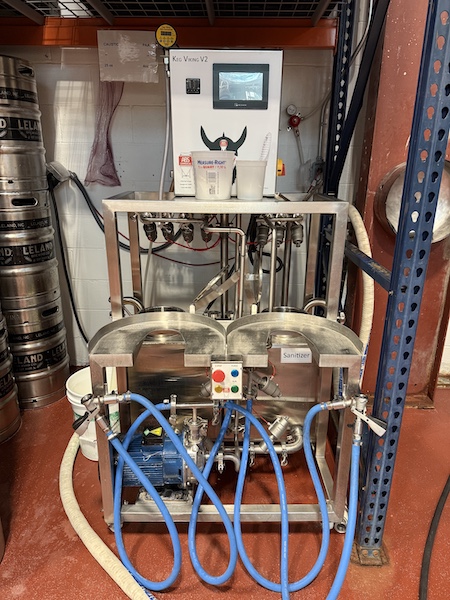
Compressed air also powers the brewery’s keg washer.
For more information, visit https://www.lelandbrewing.com and https://www.southteksystems.com.
To read more Nitrogen Generation Technology articles, visit https://www.airbestpractices.com/technology/air-treatment.
Visit our Webinar Archives to listen to expert presentations on Nitrogen Generation Technology at https://www.airbestpractices.com/webinars.