
Case Study: Processed Metal Innovators Doubles in Size
Industrial Pneumatic Systems is an Atlas Copco distributor in New Prague, MN, servicing Minnesota, North and South Dakota, Iowa and Wisconsin. Roughly 60% of its business is in the Minneapolis-St. Paul metro area.
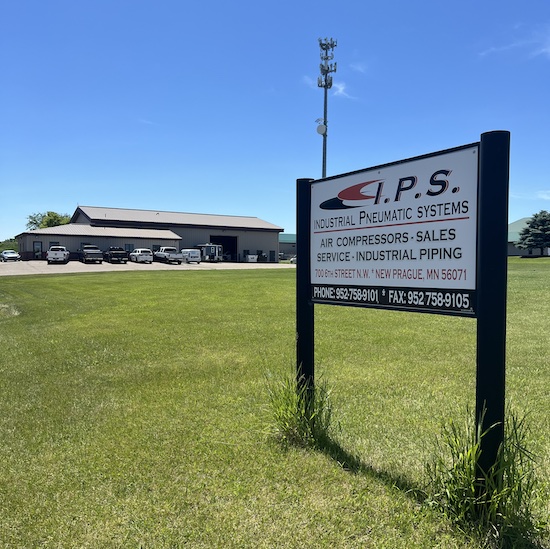
The company’s owner, Rob Hoffman, started in compressed air in 1991 after serving in the Air Force. His first job was with Air Power of Nebraska, which was then a Gardner Denver distributor. Four years later, he moved to Minnesota to take a service tech position with Clayhill, which carried Atlas Copco, working his way up to Service Manager. When Atlas Copco bought out Clayhill he joined CPR Services, which distributed Kaeser Compressors. Kaeser purchased CPR Services in 2012, and Hoffman was given the chance to purchase CPR’s Minnesota division. That’s when IPS was born.
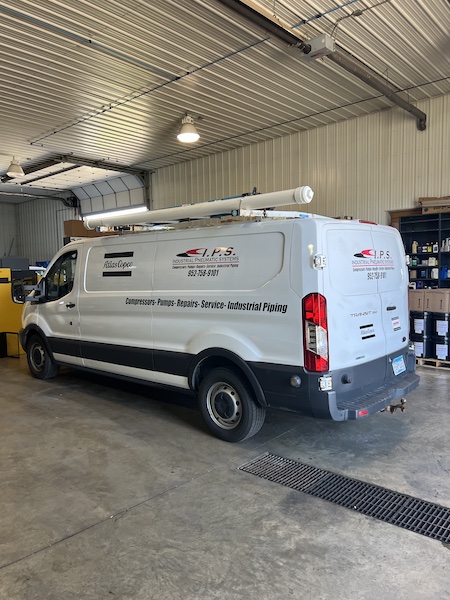
IPS represents Atlas Copco air compressors. “We put a lot into engineering and energy efficiency,” Hoffman said. “We have a nice big selection to pick and choose from to fit certain applications. It’s a good, better, best lineup that includes small machines, medium-sized machines and large machines. We have a whole gamut of products that fit pretty much any type of scenario, cfm or pressure.”
IPS’s customers come from a variety of industries, including food processing, home product manufacturing, medical devices and plastics. The company also works with water treatment plants and supplies NFPA 99 compressed air systems to major hospitals.
Case Study: Processed Metal Innovators Doubles in SizeProcessed Metal Innovators, a metal fabrication company in Bloomer, WI, has worked with IPS for years, calling the company for parts and services as needed. When the company finally outgrew its compressed air system and needed to support an expanding operation, it asked IPS to bid on the project. PMI’s production facility was expanding from 60,000 to 130,000 square feet, and its four existing air compressors (purchased from Clayhill many years before) couldn’t supply the needed cfm. Hoffman and his team consulted with the company, audited the compressed air system and planned a redesigned air compressor room using the plenum model to optimize energy efficiency and capture and repurpose the heat load for comfort heating at the facility. The distributor won the bid, thanks in part to the trust it earned from years of reliable service. It added one new 150 hp VSD air compressor with an integrated refrigerated dryer and retired two older units. The job involved installing three-inch piping and other components, including filters and oil-water separators. A local contractor did the installation. “Integrated compressed air dryers have improved tremendously,” Hoffman said. “Today, we try to sell an integrated compressed air dryer most of the time. It cuts down on the installation costs dramatically. They don’t need another power source; it’s all wired and plumbed. You set it up, and away you go.” IPS is a partner of Focus on Energy, a Wisconsin program to reduce energy waste and promote energy-efficient projects, so it helped the customer prepare an application for incentives from the state before any work was done, completing forms to verify potential savings. In 2024, PMI won an Energy Efficiency Excellence Award from Focus on Energy in recognition of its commitment to sustainability and energy conservation. 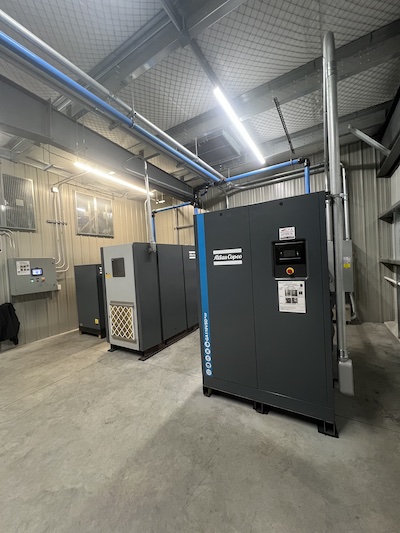 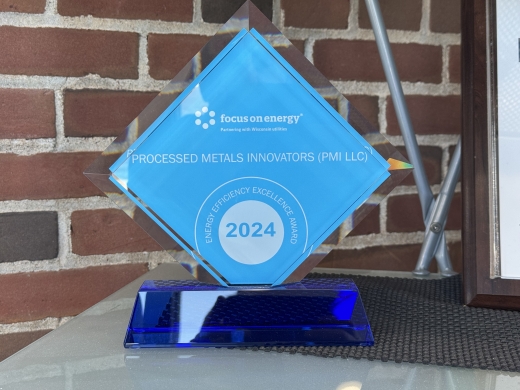 |
Planning for Extreme Heat and Cold
No matter the industry, the geography of the upper Midwest is a challenge. In any year, ambient temperatures can be expected to swing over 100°F (56°C).
“We need to ensure we have the ideal environment for an air compressor, because you can go from extreme warmth, over 100°F (38°C), down to below 0°F (-18°C). Ventilation is the biggest challenge we have to overcome to make sure we maintain the environment within an optimal 50° to 90°F (10° to 32°C) range. We like to design the air compressor room as a plenum, exhausting hot air from the air compressor into the room and using an externally vented variable speed drive (VSD) fan high on a wall to control the room’s temperature, then bringing in ambient outside air through a vent placed lower down and on the other side of the room. That eliminates the need to temper the inlet air to the air compressor. In the past, it was common to hook the air compressor inlet directly to the outside air, but when it’s too cold that freezes up the air compressor.
“If you have an exhaust fan with its thermostat set at 70°F (21°C), it'll stay at 70°F. We don't hook up any ductwork to the air compressor; the air compressor is freestanding in the room. Set the VSD exhaust fan to 70°F (21°C) and it will speed up or slow down to maintain that temperature.”
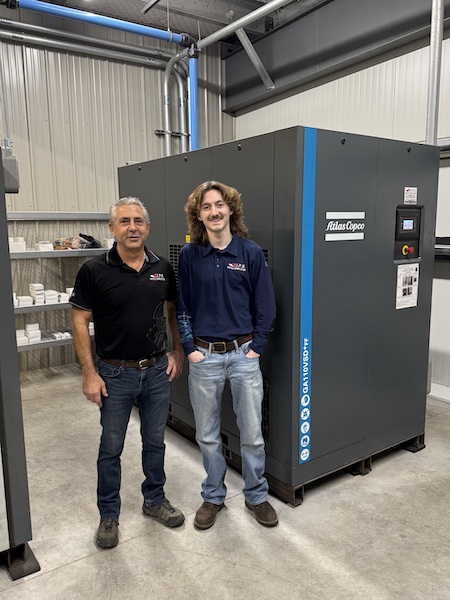
Outdoor Compressed Air Drying Challenges
IPS supplies compressed air to a lot of machinery running outdoors, such as dust collectors and feed mills on grain elevators, as well as to other equipment in environments lower than 32°F (0°C). Temperatures that low require desiccant dryers. Hoffman helps his customers sort out their options and determine which type of desiccant dryer – heatless, heated purge, heated blower purge – is ideal for their needs.
“The customer’s cfm demand will determine which technology is the most energy efficient. At the high end, you can put a refrigerated dryer before a heatless desiccant dryer using dewpoint demand mode. We just did one of those. The customer had issues in the past with water in his line when using only a refrigerated dryer, and he wanted nothing to do with moisture in his air lines. He asked for two desiccant dryers, but I talked him out of it. That setup is hard to control and really inefficient. Instead, we agreed on a compressed air system using an integrated refrigerated dryer and a heatless desiccant dryer with dewpoint demand mode after it. That gives him full redundancy, so if one dryer goes down he’s still operational.”
Desiccant dryer selection should be based on a compressed air system audit, site conditions, and the cost of energy, and not just the initial cost of the desiccant dryer, Hoffman noted. Atlas Copco guidance is to use heatless desiccant dryers for 25 to 1,400 cfm, heated desiccant dryers for 100 to 3,000 cfm and heated blower purge desiccant dryers for 350 to 3,000 cfm.
Tips for Saving Energy
No matter the industry, IPS’s clients want to save energy and run more efficiently. With his years of experience, Hoffman is able to guide them towards smart solutions.
“First thing you have to do is a compressed air system cfm demand audit, because if you don't do an audit you're jumping into the unknown. We need to know what specific parameters we're working with. Once we figure out what we need or what the customer profile is, then we can apply the correct machine that fits that application. Without knowing that, you're making an educated guess.
“Then, we have to consider the VSD air compressor and energy recovery from the heat. There's more energy in the heat than in the compressed air.”
The company sees a strong demand for heat recovery systems. Its top heat recovery use is providing comfort heating to the facility, but it also sees uses in ventilation and water heating.
Multiple VSD Installations
For a few years now, Atlas Copco has trained its distributors on a novel method of combining multiple VSD air compressors in one installation. Rather than using a fixed-speed load/no load air compressor for a base and a VSD air compressor for a trim, the new method uses multiple VSD air compressors. Hoffman had his doubts about the architecture at first, but finds the system provides more stable pressure as multiple VSD air compressors can maintain a closer set point. This configuration is also more efficient with a better specific energy rating. Replacing parts is easier since fewer items are needed in inventory, and the system even runs quieter.
“I like the base load/no load with a VSD air compressor, but we've been taught and trained there are more efficiencies with the VSD air compressor even if we’re base loading it, compared to load/no load.”
Using a VSD air compressor as a base load air compressor is job-driven, but something Hoffman does when he can. He guides his customers on questions to consider when making a decision.
“First, start with a compressed air system audit to understand if the customer has steady or fluctuating demand throughout the day. After that, do they have funds for the project? That's the big question. And then, does it fit the customer’s needs? You could have a 50 horsepower (hp) air compressor at 220 cfm, load/no load, or you could have something at 260 cfm for the VSD air compressor. Do the math, do the calculations with energy and see which one fits to determine which makes more sense,” he said.
Hoffman’s preferred operating range for VSDs is between 30% and 100%.
IPS is also finding success with Atlas Copco Neos drives, which were first used in smaller air compressors but are now in all of their VSD air compressors, as well as their GA FLX line.
“The Neos drive is proprietary. When you get into an industrial setting, your power is usually all over the place with voltage imbalances. Also, it's a dirty environment. Those two things kill standard, off-the-shelf VSD drives. They don't like that. The Neos drive was created for fluctuating voltages. With the Neos drive and permanent magnetic motors, everything is compact and there's still room to work around inside the machine. Plus, they’re highly energy efficient.”
Hoffman appreciates the cooling built into the Neos drive’s permanent magnetic motor. It doesn’t rely on air blowing across the motor for cooling, but rather uses the air compressor’s lubricant. Oil flows through the motor to the airend. It doesn’t rely on external air, which could be dirty, to cool the motor.
“The benefit to customers is that motors run cooler and run in dirtier environments because the motor doesn’t fill with dirt and debris. Also, the footprint is much, much smaller. 100 hp is no bigger than my desk. They're more upright: The motor airend assembly is now vertical.”
That vertical design means Neos-driven air compressors can fit into a footprint roughly half the size of previous air compressor designs, Hoffman finds. Neos drive air compressors are also quieter than load/no load air compressors.
Single-Point and Remote Monitoring
Hoffman sees the compressed air industry moving to a greater use of integrated air compressors that include a built-in refrigerated compressed air dryer. Benefits include having one hookup for the installer, and less piping and wiring. Integrated air compressors can also provide single point monitoring with all the data for the air compressor, dryer, dewpoint, drains and filters in one view. It’s something IPS’s customers have benefited from.
“In single-point monitoring, everything is accessed through the controller. It monitors all the air compressor and refrigerated dryer operations, including the dryer inlet and ambient temperatures, refrigeration suction pressure, dewpoint, evaporator pressure and drain alarms. It's all monitored in one single point,” Hoffman said.
Atlas Copco’s remote monitoring is called Smartlink. Several of Hoffman’s customers use the paid service. IPS monitors the live data to provide better maintenance.
“It reaches out to us and lets us know if the machine is running hot, if it’s tripped out on overload and if there’s high ambient temperatures, for example. It also lets us know when service is due,” he said.
For more information on IPS, visit https://ipscompressors.com.
To read similar articles on Metal Industry, please visit https://www.airbestpractices.com/industries/metals.
Visit our Webinar Archives to listen to expert presentations on Air Compressor Technology at https://www.airbestpractices.com/webinars.
