
Facility Maintenance for Extreme Conditions
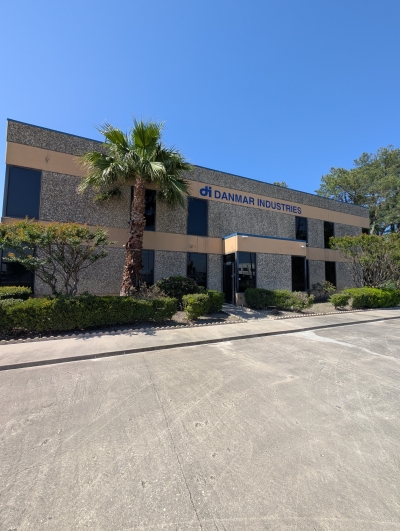
Danmar Industries, based in Houston, TX, is a Gardner Denver distributor, but it’s better known for the custom-fabricated packages it provides customers in the oil and gas industry. Some of its fabrications are simple, involving a few off-the-shelf air compressors and piping on a skid, while others feature completely custom-built air compressors where the company buys subassemblies and joins them with custom controls and user-specific instrumentation.
The company was founded in the early 1980s, and is currently owned by founder Dennis DePauw and the family of founder Mark DePauw.
“We buy equipment and do modifications in-house,” explained Patrick Gebhart, Engineering Packaging Manager, Danmar Industries. “Some of it, like the air compressors we're building now, involves buying an airend from Gardner Denver and building our own skid in-house. We bought a separate motor, basically the coupling was separate. We did all the piping in-house. So it wasn't just modifications, it was a one-off ground-up build of a Danmar air compressor with a Gardner Denver airend.”
Much of the company’s output goes to oil and gas companies. Reliability and ruggedness are key for these customers since the compressed air systems often operate in remote or harsh environments. These customers are willing to sacrifice efficiency for air compressor systems that are rugged.
Custom Engineering for Demanding Environments
Creating custom-built compressed air systems is just as involved as it sounds. Customers often provide an approved manufacturer list for purchases, typically where they have large-scale contracts. The customer will have oversight of purchases and verify its specifications are followed. Danmar provides these specifications to the provider– such as ABB Baldor for the project in this article – and works in partnership to ensure all parties understand what’s required. The company ensures compliance with API specifications, such as API 547 and 541 for medium-voltage motors.
“What's unique about these motors is their service factor and duty rating,” Gebhart said. “On top of that, they’re monitored heavily. They typically have bearing and winding temperature monitoring, as well as vibration monitoring. There will be space heaters both inside the motor and in the conduit box. With the 550 horsepower motors in our shop, the conduit box is literally half the size of the motor, so it has its own structure supporting it. It is that large.”
Producing a custom motor to exact specifications isn’t quick work. This one had a 36-week lead time from the manufacturer, then 12 tests were conducted before it left the facility. All custom parts are thoroughly tested, inspected and confirmed to operate within the customer’s specifications. The company creates a data sheet for every piece of equipment it delivers.
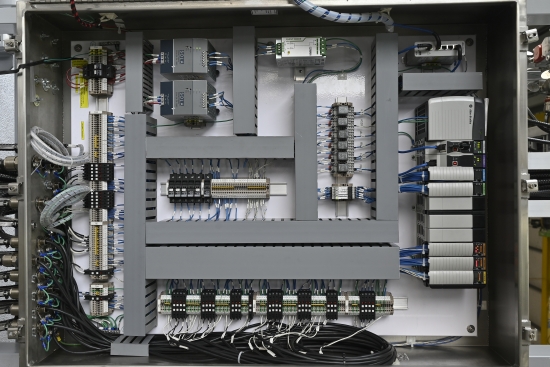
Customers want to be able to monitor and control the equipment even when human operators aren’t at a site, so remote functionality is standard, most often through an Allen Bradley PLC.
For air compressor coolers, the company prefers Alfa Laval plate-and-frame coolers. They can be broken apart easily for cleaning, and their stainless steel construction is durable. Their wavy houndstooth pattern creates a turbulent flow path, which provides self-cleaning.
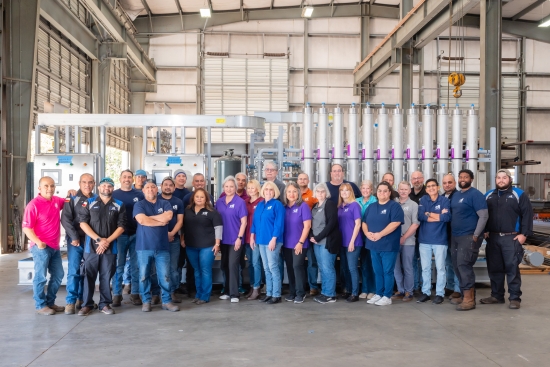
The company has a small engineering team working in its 30,000-square-foot production facility, so employees need to wear several hats. The engineering team includes an in-house engineer to draw up the controls, a 3D modeler, a document control specialist and a fabrication shop manager.
“What makes our team special is everybody has to come together and help out,” Gebhart said. “On the shop floor, we have six full-time guys. The quality of the work is second to none. Four employees are structural steel welders. They are tested to Danmar’s weld procedures and stay current to make sure that the quality of the welds meet the requirements. Three of the guys are qualified in carbon steel piping for our own procedures. Two are qualified for stainless steel piping for our weld procedures. One is our shop electrician. Our shop electrician builds the panels and assembles everything as per the wiring schematics. He also helps with installation on all the skids and does a lot of instrumentation wiring. Like the rest of our teams, those guys have to pitch in wherever they're needed because in a small shop, you have to do whatever is needed at the time.”
Texas Prepares Compressed Air Skids for Alaska
Danmar is currently in the middle of a large project that began in 2021 when it was contacted by an engineering firm with a request for proposal. The job involved an oil and gas drilling station on the north shore of Alaska that would be inaccessible for much of the year. The equipment provided needed to be highly robust so breakdowns would be rare and the on-premises team could handle maintenance without outside help.
“They are going to have to ensure they have all of their maintenance items onsite so that whatever they need they can do themselves,” Gebhart said. “They can call out and talk to somebody, but physical help can take a long time to arrive. Whatever the issue, they have to deal with it themselves.”
Working out the requirements for the project was a years-long process that involved considering different scenarios and deliverables. The proposal stage didn’t wind down until the third quarter of 2023, when all considerations had been made and the engineering firm asked for final bids. In late 2023, the firm completed its evaluations and awarded the purchase order to Danmar.
The items requested included three 550 horsepower (hp), oil-flooded, water-cooled, single-stage air compressors with inlet valve modulation capable of providing 1,540 scfm at 165 psi (11.4 bar), two heatless desiccant, 3,138 cfm, 165 psi (11.4 bar) compressed air dryers, and two nitrogen generators for the main station, as well as two smaller air compressors and heatless desiccant compressed air dryers for each of three smaller facilities. Air compressor packages typically meet API 619, but the customer did not request that in this case. The motors, however, need to meet API 547. Air compressor system piping needed to be carbon steel built to ASME B31.3.
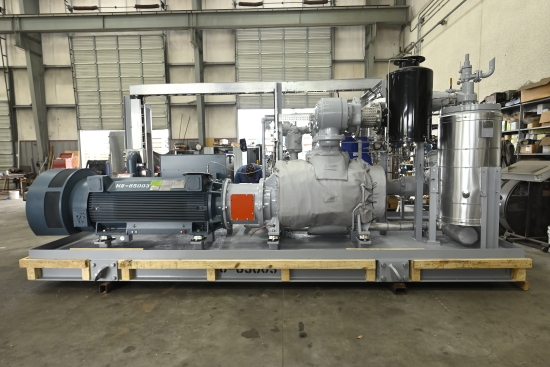
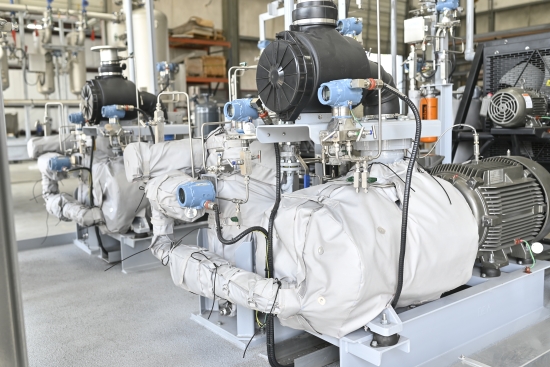
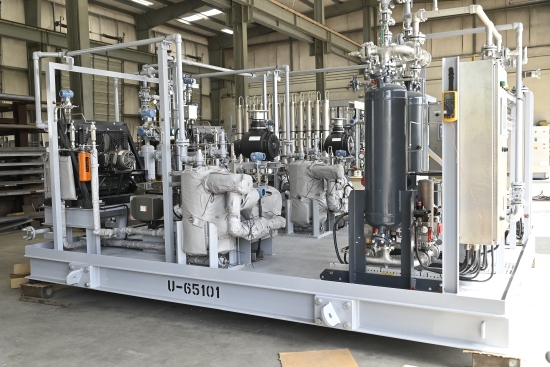
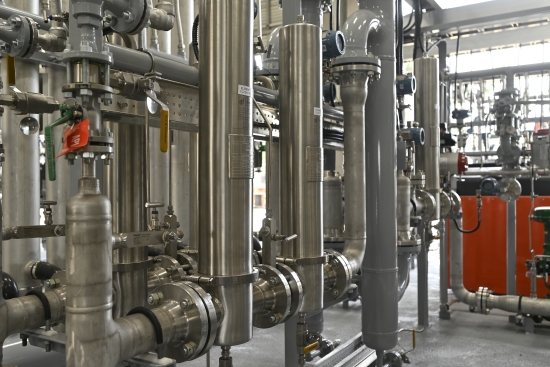
“There'll be three different skids for the air compressors. The air treatment skid has two heatless desiccant dryers on it, and parallel filtration banks with a block and bypass valve for all of it so operators can switch between which filtration bank they want or which compressed air dryer they want to have online,” Gebhart said.
The desiccant compressed air dryer skid used all stainless steel piping. The only thing not stainless steel were the desiccant dryer vessels themselves, which were carbon steel. The filter housings, piping and valving were all stainless steel.
“We do have purge control,” Gebhart said. “Once the unit hits -60°F (-51°C) dew point, it will basically re-pressurize the regenerating tower and then it stalls at the inlet valve switch. That stays in the state it is in until you go back above -60°F (-51°C) dew point. Once it goes back above -60°F (-51°C) it switches the inlet valves and starts the next cycle. One thing we do a little bit differently is it has a little bit higher purge rate and shorter cycle time. Instead of it being a five-minute cycle, it's a three-and-a-half-minute cycle.” The desiccant dryer uses standard activated alumina with 1/8-inch beads.
The engineering firm also sent around 40 different specifications for the equipment, and each specification ranged from 10 to 70 pages. Specifications covered everything required for the job including environmental conditions, pipe welding, pressure vessel welding, coatings, noise requirements and supplier documents. Danmar was expected to procure all equipment from an approved suppliers list, and get prior approval if it needed to use equipment providers not on the list.
One unique requirement for this contract was the constrained footprints the packages needed to have. The company worked with the pressure vessel manufacturers to get nozzles oriented exactly as needed. Off-the-shelf components wouldn’t fit the space.
Facility Maintenance for Extreme Conditions“The most critical thing for maintenance in extreme conditions, whether it’s cold or hot, is oil temperature” explained Patrick Gebhart, Engineering Packaging Manager, Danmar. “In cold applications, oil temperature is the biggest thing people overlook. They assume the air compressor is going to be able to start. But in cold temperatures, you need to heat the oil before starting. Otherwise, you risk damaging your equipment at startup. “In hot temperatures, you have the opposite problem. You have to keep the temperature cool enough so air compressors can continue to operate. It's a balancing act at every one of these facilities. You need to keep it in the right area so you get proper lubrication without a lot of water entrained in your oil. That would physically damage the equipment. “The other critical facility maintenance item is setting and keeping a maintenance schedule. In remote facilities, they need to have all their spares onsite. Maintenance is on a schedule and they do it on time. That is critical. They replace solenoid valves, inlet valves, the IVC and IVO that control the inlet valves. They replace them on schedule whether they went out or not. They don’t wait for parts to fail; they replace them on time to prevent issues before they occur. “Whether it’s a ball valve or butterfly valve, they take apart the actuator on schedule. The worst thing they can see is an unplanned event. All these guys will tell you the more data they have, the better it is. They can see events coming. So, whether it’s vibration or temperature data, they collect it. This data is fed past our controller to their DCS and they extrapolate it over years of service so they can see events coming and plan maintenance before events occur. When they see oil temperature starting to rise or vibrations starting to trend up, they check and rebuild the part before it fails because they're not willing to risk a catastrophic event.” |
A 12-Membrane Nitrogen Generation System
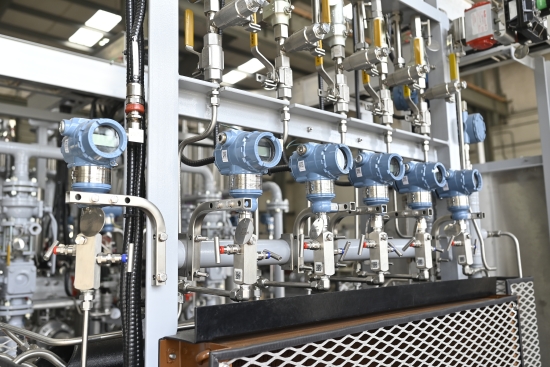
Besides creating a compressed air system for its client, Danmar is creating a nitrogen generation system, as well. The nitrogen generation system is membrane-based using Evonik membranes since only 97% purity is required. The nitrogen generation system is laid out in two banks with 12 membranes, including two spares built into the system. This allows the operators to expand the system in the future, as needed. As 60°F (-51°C) dew point compressed air enters the membrane bank it goes through two stages of filtration, including a coalescing filter and a carbon absorber filter, to ensure any residual oil is removed. It then passes through a heater which raises the temperature to 90°F (32°C) in order maintain a stable temperature, then it passes through a particulate filter and one of the membrane banks.
After the membrane bank, the nitrogen generation system includes a control valve holding the system to 135 psi (9.3 bar) for even, controlled performance. Next is an off-spec valve monitoring for low-purity nitrogen. If that occurs, the valve tries to get the system back on spec. Once it does, the nitrogen passes to a low-pressure output. The nitrogen generation system includes a booster pump capable of boosting the nitrogen to 3,300 psi (227.5 bar), as the facility requires both low-pressure and high-pressure nitrogen.
Storage tanks for the nitrogen generation system were purchased separately and placed around the facility wherever they could fit. This system uses stainless steel piping, as well.
Preparing for the Journey to Alaska’s North Shore
As of this writing, Danmar is cleaning up the compressed air and nitrogen system skids and preparing for the next phase of their journey. First, the skids will travel to a Gulf Coast location near Corpus Christi, where the oil and gas customer has an offshore division. The entire facility will be built there. When that’s complete, it will travel by barge to Alaska’s north shore and be offloaded. Its last leg will involve traveling 100 miles via an ice road. The final destination is an oil drilling site roughly 80 miles from Alaska’s north shore.
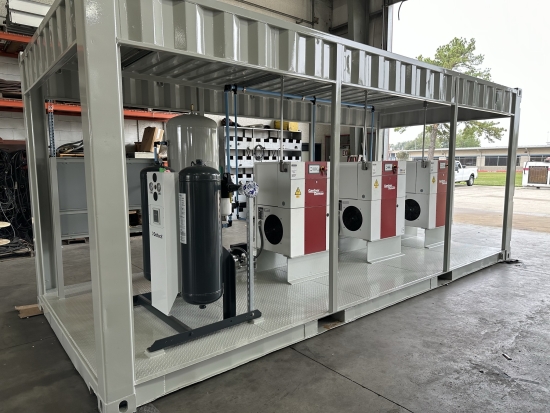
“Everything at the drilling site is operated by compressed air or nitrogen,” Gebhart said. “Their entire facility, all the valving that operates the entire facility operates off compressed air. The seals in the turbines need nitrogen as pad gas, otherwise they have to shut down. The storage tanks and sump piles all have to be blanketed with nitrogen to make the facility safe and operable. Everything that operates the facility or makes the facility safe is being operated by the compressed air and nitrogen generation system we're building. Without it, nothing's going to operate and they're going to have to shut down everything.”
With the construction and travel left, the system will likely not be operational for another four years.

For more information, visit https://www.danmarind.com.
To read similar Oil & Gas industry articles, visit https://www.airbestpractices.com/industries/oil-gas.
Visit our Webinar Archives to listen to expert presentations on the Oil & Gas industry at https://www.airbestpractices.com/webinars.
