
Compressed Natural Gas (CNG) is an alternative fuel source (to diesel and gasoline) with far-reaching benefits to North America. Strategically important benefits include energy independence, improved air quality, job creation, and lower and more stable fuel prices. This article discusses natural gas desiccant dryer requirements in Natural Gas Vehicle (NGV) refueling stations, compares deliquescent to desiccant dryers and reviews two on-site field gas upgrading examples in displacing diesel fuel
Section I: Natural Gas Dryers for NGV Fueling Stations
Xebec Adsorption has been supplying Natural Gas Dryers for CNG (Compressed Natural Gas) fueling stations worldwide for over twenty-five (25) years. It has been only in recent years, however, that more and more countries have been turning to natural gas as an alternative fuel source for transportation. This growing demand is due to a few reasons: natural gas is much less expensive than diesel or gasoline, it is a much cleaner fuel and it can also mean energy independence. In the U.S. alone, it is predicted that 6,000 to 15,000 new NGV refuelling stations will be built by 2023.
The Importance of Low Pressure Dew Points
The dryer on a CNG station is an important component. If the gas is not dry when entering the compressor on the fueling station, it can lead to freeze up problems at the dispenser and in the tank of the vehicle. This is obviously disastrous as it can result in the closing down of the station. So why would a station builder not install a dryer? The most common reason for not installing dryers in NGV refueling stations is the belief that the gas is already dry. However, it should be taken into consideration that although the gas dew point may be as low as -40°C in the pipeline at pipe pressure, the effects of compression will affect the dew point of the gas (Joule-Thomson effect).
Physical laws dictate that the dew point of a gas increases as its pressure increases. Therefore, although the dew point of the gas in a given pipeline may be very low when it reaches the compressor, it will be significantly higher when the gas leaves the compressor. This is why natural gas desiccant dryers are required in the majority of NGV stations in order to conform to the ISO 15403:2000(E) Standard, specifically in areas where lower temperatures are encountered during the colder winter months.
"The single most important safety requirement of compressed natural gas (CNG) fuel is a very low water dew point temperature to preclude the formation of liquid water at any time. Liquid water is the precursor to the formation of corrosive compounds through combination with components in natural gas, namely carbon dioxide and hydrogen sulphide. The combination of corrosive agents, and the pressure cycling, caused by fuel consumption and subsequent refilling of the fuel storage container, can result in crack growth in metals and ultimately damage and failure. Also liquid water itself can be detrimental as it may cause blockages, both liquid and solid, in the fuel system.” - Source: ISO 15403:2000 (E) Standard, paragraph 5.1
What can happen, at a NGV Refueling Station, without the appropriate natural gas desiccant dryer systems?
- First Step: Natural gas (at pipeline pressure dew point) enters the gas compressor. The gas is compressed, significantly increasing gas pressure, temperature and moisture concentration.
- Second Step: Gas enters storage banks and expands. This causes significant decreases in gas temperature and the condensation of moisture. Liquid is now present and we have a problem.
- Third Step: High-pressure gas containing moisture travels to the dispenser, enters the vehicle cylinder and expands once again. The NGV tank is now carrying water along with natural gas!
Monitoring and Measuring Pressure Dew Point
In order to continually measure the moisture level of the gas before it is compressed, every desiccant dryer should feature a pressure dew point probe. It is essential that the probe is recalibrated annually in order to ensure an accurate reading. A new dew point probe can be very costly, so in order to support its customers and ensure safety on the station, Xebec offers a recalibration program where a recalibrated probe is provided in exchange for a used probe. Continuous measuring and monitoring of pressure dew point with dew point probes, ensures the continuous operation of the gas dryer and the NGV refueling station.
Section II: Differences Between Desiccant and Deliquescent Natural Gas Dryers
There are important differences between regenerative "desiccant" type dryers, using molecular sieve as the drying media, and "deliquescent" type dryers. Although they both can reduce the gas dew point, there are important and considerable differences in the dew point performance characteristics between the two.
Deliquescent dryers operate on the principle of dew point suppression, which is entirely dependent on the inlet temperature of the gas to the dryer. Dew point suppression performance, with these dryers, is typically in the range of 10 to 30 F at best. A dew point suppression of 20 F means that if the inlet temperature of the gas to the dryer is 100 F, the pressure dew point of the gas exiting the dryer will be 80 F. This situation can be quite common since this type of dryer is installed at the discharge of the gas compressor. Gas compressor after-coolers can have approach temperatures of 20 F or more.
Deliquescent dryers consist of a vessel filled with a mixture of water-soluble salts or organic compounds, or both, in the form of tablets or beads. As the wet gas passes through the drying media, a percentage of the water vapor is absorbed by the tablets. During this absorption process the tablets gradually dissolve, and droplets of dissolved media and water collect in the bottom of the vessel drain area in the form of a “slurry” which will need to be regularly drained as part of normal operation.
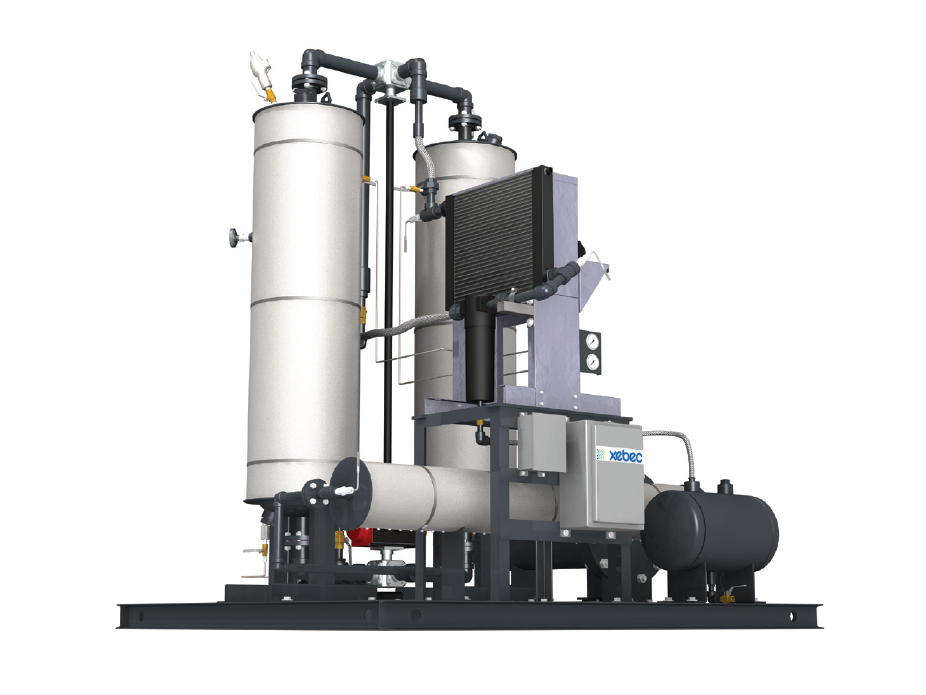 |
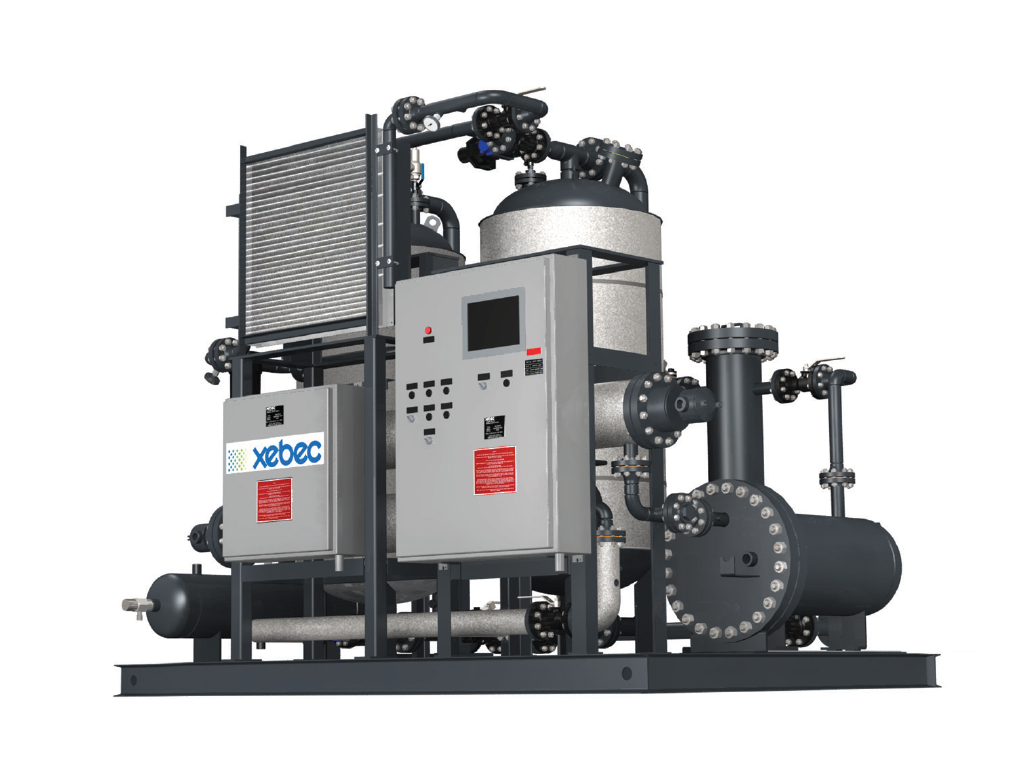 |
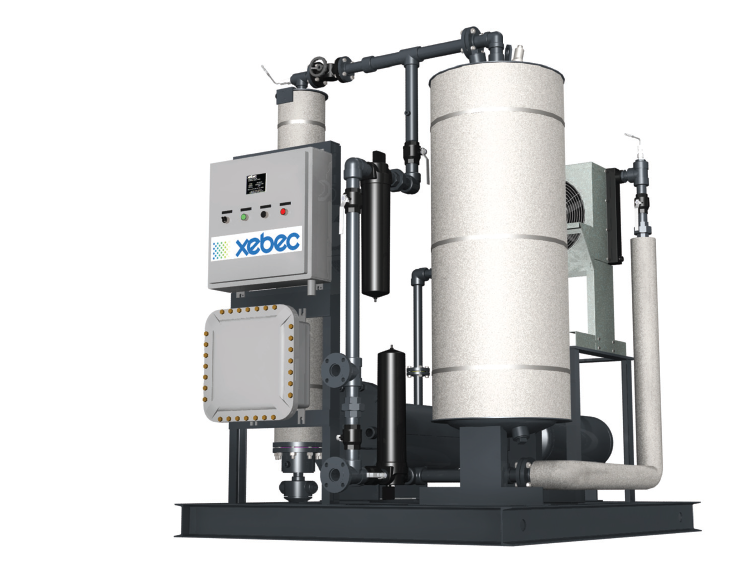 |
A Regenerable Twin-Tower Natural Gas Desiccant Dryer |
A Regenerable Heat Reactivated Twin-Tower Natural Gas Desiccant Dryer |
A Regenerable Single-Tower Natural Gas Desiccant Dryer |
Regenerative Natural Gas Desiccant Dryers
Regenerative gas desiccant dryers, using a molecular sieve desiccant as the drying media, work on a different principle of adsorption.
As the gas passes through the desiccant bed, the water vapor is adsorbed by the molecular sieve desiccant. The desiccant is not dissolved in this process. The molecular sieve continues to remove the moisture from the gas stream until it is exhausted and subsequently regenerated. The time to initiate the automatic regeneration cycle is typically detected by a precision dew point monitor installed at the outlet of the dryer system.
Desiccant dryers use a closed-loop heat reactivated regeneration system which circulates an electrically heated gas flow through the desiccant bed thus removing the moisture from it, then subsequently cooling the gas, and separating the liquid water to drop out into a collection receiver.
Desiccant dryers use a special molecular sieve for natural gas service and the closed loop heat-reactivation regeneration is extremely efficient and will continuously produce dew point levels which exceed worldwide codes that govern the dew point of the gas used in CNG vehicles. The most common codes for CNG gas quality in North America are SAE J1616 and CARB (for California). Both of these codes state that the dew point of the compressed gas at vehicle fuel storage container pressure vessel must be at least 10 F below the 99% winter design condition of the location of installation of the CNG station. As an example, if the 99% coldest winter temperature in San Jose is 35 F, then the dew point of the gas in the storage vessels must be 25 F or less at all times.
Regenerative type molecular sieve dryers can easily exceed such dew points. They are able to reach well below –100 F pressure dew points. Sub 32 F pressure dew points can only be achieved with desiccant dryers. This is why they are commonly used in North American NGV refueling stations. Natural gas desiccant dryers are capable of handling inlet operating pressures from 5-1200 psig and flows up to 25,000 SCFM. These dryers can also be sized for pipeline quality gas applications as well as saturated gas applications.
Section III: Field Gas Upgrading and On-Site Utilization
Oil exploration and production (E&P) operators around the world are facing significant and growing concern over their business models, driven by rising diesel fuel costs and detrimental environmental impact assessments. These challenges present a tremendous opportunity for the natural gas industry.
There are enormous economic and environmental benefits in powering diesel-fueled rigs with natural gas. Conversions have already been proven by a number of early adopters, using both bi-fuel and dedicated natural gas engines. Different sources of natural gas like field gas and liquefied natural gas (LNG) have also been tested. With each technology and fuel type, operators and technology companies are now addressing some operational challenges and looking to increase efficiencies. There is no doubt, however, that the viability of powering rig operations with natural gas is a new reality and can make a major impact on overall fuel consumption on a global level.
Natural Gas Use Benefits to Oil Rig Operations
Extensive use of natural gas in the energy grid builds additional domestic energy security and has implications for rail, mining, military, construction services, freight transportation, airport and port authorities, and more. In oil rig operations, the cost savings and positive environmental impacts that early adopters are experiencing are already significant. There are documented results such as dedicated natural gas engines saving in excess of 1,000 gallons of diesel fuel a day, reducing CO2 and NOx emissions up to 20 percent, and reducing operating costs from a range of $500 to more than $2,000 a day in some locations.
- Oil & gas drillers and frac pump operators can displace up to 60% of their diesel fuel usage with field gas.
- Environmental performance is improved with a significant reduction in carbon dioxide, particulate matter (PM) and nitrogen oxide (NOx) emissions. Plus, natural gas engines run quieter than diesel counterparts and their emissions are odourless.
- There is reduced flaring and improved productivity as extraction does not need to be turned down because of flaring quotas.
Two Projects Displacing Diesel with On-Site Field Gas
Xebec provides a proven, cost-efficient, flexible, containerized solution to displace diesel fuel with on-site field gas. The system addresses the needs of a significant customer base of E&P operators - particularly those in unconventional sources like shale oil and shale gas
The operating system, called AGX, separates well gas into a natural gas stream and produces an exhaust stream rich in Natural Gas Liquids (NGLs). Two field gas conditioning systems were deployed in 2006 and are currently experiencing excellent results.
|
|
|
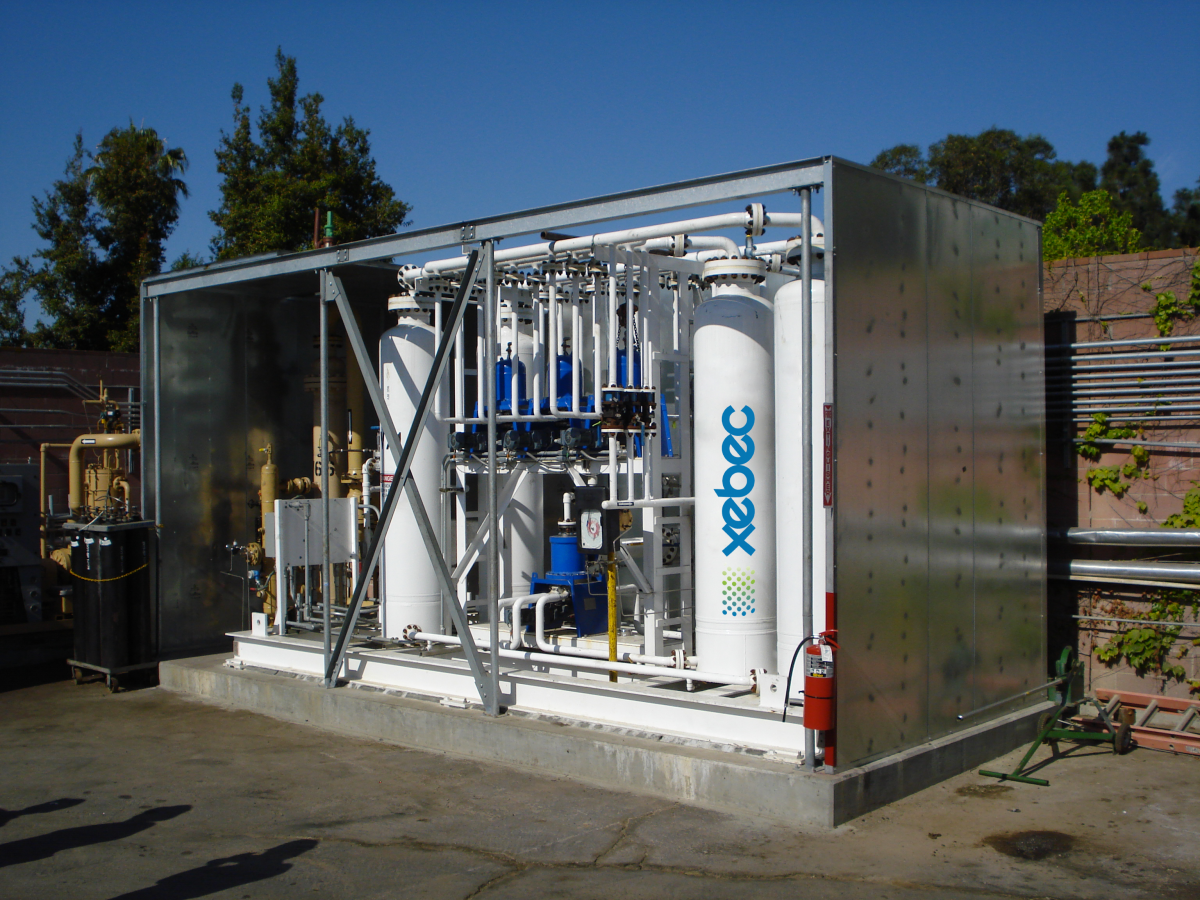
Xebec’s compact M-3100, fast cycle PSA unit was used on an off-shore platform off the California coast. |

- One of the largest independent oil and natural gas companies in California purchased Xebec's purification technology to purify natural gas to meet strict quality specifications for natural gas in California. Our M-3100 unit is installed on a platform off the coast of California. It upgrades the platform’s stranded gas that would otherwise have to be re-injected into sales gas. The successful results comes from not only the superior gas recovery and product purity, but also in respecting the strict space limitations imposed by the offshore platform operator.
- An oil producer, located in Southern California, was struggling to meet California’s new and more stringent sales gas specifications for ethane and heavier hydrocarbons. Oil production had to be decreased due to the limited capacity of their LTS unit, used to dehydrate and de-rich the field gas from the oil wells to produce sales gas. Gas production in an oil field is a necessary function of oil production. Therefore, a limitation in gas throughput automatically drives a decrease in oil production, resulting in revenue loss. The Xebec AGX system cost less than one-third of a new LTS unit and, by reusing the existing LTS to improve methane recovery, the gas throughput capacity doubled.
The market is growing for NGV refuelling stations and on-site gas upgrading. Gas drying is an important part of the process and understanding how to achieve, measure, and manage pressure dew point is important to the success of these installations. Natural gas desiccant dryers will play an important role in the build-out of this new infrastructure in North America.
Compressed Air Best Practices® Magazine interviewed Kurt Sorschak, President and CEO, of Xebec Adsorption Inc.
|

For more information contact Kurt Sorschak, President and CEO, Xebec Adsorption, tel: 450-979-8701, www.xebecinc.com
For more Natural Gas articles, visit www.airbestpractices.com/industries/oil-gas or visit www.airbestpractices.com/technology/air-treatment for Air & Gas Treatment articles.
