Ensuring ISO 8573.1 Compliant Compressed Air and Vacuum Systems in Food Processing and Packaging Facilities
Compressed air can contain various contaminants, including water vapor and aerosols, oil vapor and aerosols, microorganisms, and solid particulates coming from atmospheric air and pipe scale.
Many food packaging and processing plants use the ISO 8573.1 standard as a way to classify and specify the desired purity of their compressed air systems. Depending upon the application, more than one purity specification may be established.
Using ISO 8573.1 to Establish a Specification
The ISO 8573.1 establishes compressed air quality classes, ranging from 0 to 9, with class 0 being the cleanest. It applies these quality classes to varying levels of concentrations of particulates, water and oil.
Class 0 does not imply there are no contaminants, only that it is cleaner than the limits established in class 1. For more on the ISO 8573.1 standard, see the story, “ISO 8573.1 – Contaminants and Purity Classes.”
It is important to note that ISO 8573.1 compressed air quality classifications do not apply to vacuum systems. The compressed air quality classes are established at normal plant working pressures of 100 psig (7 barg). Unlike compressed-air systems, vacuum systems ingest air from the process environment. As a result, the quality of air entering a vacuum system is determined primarily by the process atmosphere itself, rather than by downstream air-treatment equipment.
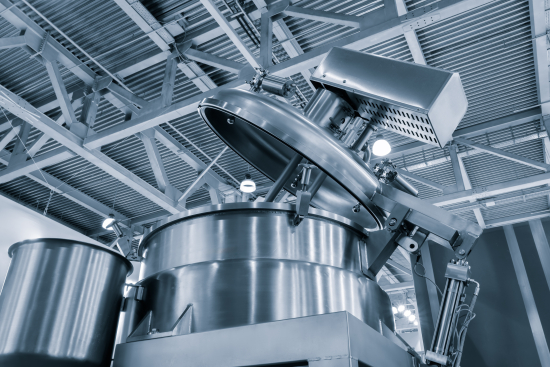
Processing equipment making direct contact with food requires oil-free compressed air.
Three Different Purity Zones for Compressed and Ambient Air
Some advanced food processing plants establish three distinctly different purity zones for compressed and ambient air. This allows the plants to take a different approach, capitalizing on the initial costs, maintenance and operational benefits a more nuanced view provides, depending upon the purity the applications require. To take full advantage of this approach, let’s review each of these areas and their application of compressed air.
- Direct contact
- Indirect contact
- Ambient contact
Direct Contact. Although it’s the most demanding with regard to quality, direct contact is the simplest to understand and interpret. If compressed air reaches or touches the food or beverage, plants require oil-free compressed air. Period. This includes all processing equipment, such as mixers and ovens, as well as some initial packaging equipment.
“No oil” is normally defined as less than or equal to 0.01 mg/m3 of total oil (aerosol, liquid or vapor). To establish this specification, plants specify ISO 8573.1 quality class 0 or 1 in the third digit of the specification, for example 1:2:0 or 1:2:1.
The second digit represents the plant’s pressure dew point specification. With direct contact application, many plants specify Class 2, representing a -40°F (-40°C) pressure dew point specification.
The first digit establishes the quality class of compressed air purity as it relates to solid particulates (microorganisms, ingested ambient solids and pipe scale).
To ensure the air is virtually free of oil, moisture and microbes, ISO 8573-1 requires Class 1:2:1 or Class 0 for these applications. There are several ways to deliver compressed air meeting these standards, as discussed below.
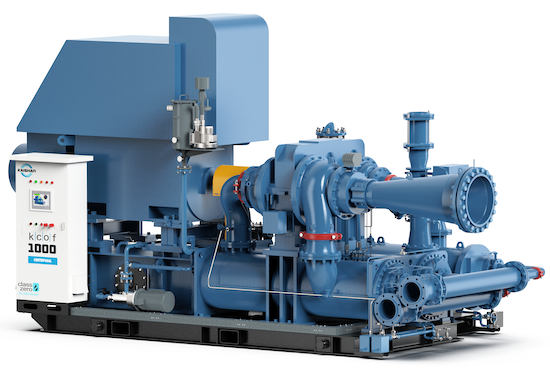
Oil-free centrifugal air compressors do not introduce oil into the system.
Indirect Contact. There are other areas of the plant with indirect contact with food or beverage products. These stages occur when the product is initially packaged and prepared for distribution, sale and storage.
In indirect-contact applications, a barrier, such as a packaging material, separates the food from the compressed air. These include form-fill-seal machines, where compressed air does not contact the food directly, yet is in contact with a packaging material which will then come into contact with food and beverage products.
Some food manufacturers choose oil-flooded rotary screw air compressors paired with food-grade lubricants for applications that don’t involve direct food contact.
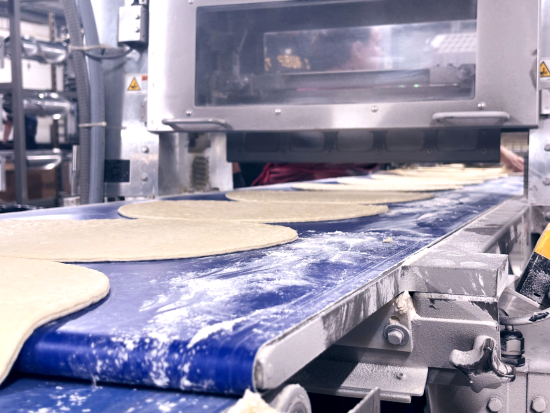
Because compressed air doesn’t come into direct contact with food, the Fire Roasted Crust Co. in Wexford, PA, saved money by purchasing an oil-lubricated direct-drive rotary screw air compressor to drive an oven conveyor belt. The company also used a food-grade lubricant in the air compressor to prevent issues in the event of a failure.
Larger manufacturing facilities sometimes use both oil-free and oil-flooded air compressors. However, they need to be separate systems, with different headers, storage and air treatment. Once oil is in the compressed air system, it will stay there.
Ambient Contact. Ambient contact refers to the air inside the factory. Since they introduce air into the factory environment, compressed air and vacuum systems can be sources of ambient air contamination.
The ambient air entering an air compressor can contain millions of organic and inorganic particles and hydrocarbons, as well as water vapor. Atmospheric pollutants, such as diesel fumes from the loading dock, can be concentrated during compression and contaminate food products. In this situation, one can see oil present even when an oil-free air compressor is used. This is why compressed air treatment requirements do not necessarily change based on the air compressor type selected.
While it’s almost impossible for vacuum systems to introduce contaminants during vacuum operation, many food facilities rely on small vane pumps that emit oil mist from their exhaust. That’s one reason some plants centralize vacuum systems to take vacuum pumps away from production areas.
Dew Point and Piping Considerations for Food Processors and Packagers
To deliver compressed air meeting the desired ISO 8573.1 quality class specifications, food processing plants must address several issues, including reducing moisture, eliminating particulates and preventing microbial growth. The solutions they choose determine pressure dew points, filtration and pipe materials.
Pressure Dew Point. One challenge in providing clean, high-quality air in a food processing facility is reducing the moisture content of compressed air. The ambient air drawn into an air compressor contains water vapor, and the more it’s compressed, the greater the moisture content. That changes the pressure dew point, the temperature at which water condenses out of the air at pressure.
Measuring pressure dew point can be tricky. It doesn’t stay constant: If the pressure in a line drops, so does the pressure dew point. And a line can have slugs of water or oil, causing inaccurate readings.
Food processing facilities need to carefully monitor the pressure dew point. Condensation from compressed air can damage pipes and other equipment, allowing microbial growth in stagnant water. It’s especially a problem in food processing facilities, where large areas such as packaging zones expose compressed air piping to refrigerated areas.
Consider this scenario: Your compressed air flows through pipes in room temperature areas of the plant, then enters a refrigerated space with temperatures around -22°F to -40°F (-30°C to -40°C). Water quickly condenses. Airflow is restricted, perhaps even blocked if ice forms inside the pipes. Water pools and stagnates, leading to contamination. It may even freeze. Metal components can rust. Overall, it's a recipe for disaster.
As a result, compressed air operators must ensure the pressure dew point of the compressed air is lower than the temperature of the refrigerated areas it passes through. If it isn’t, water may condense out of the air. Also, make sure the air piping system doesn’t have drip legs. Stagnant water in drip legs should be avoided. Use a combination of compressed air dryers and filters to remove excess moisture.
Piping Materials. Aluminum and stainless steel piping prevents oxidation caused by moisture in the line. Any rough spots in the pipe can cause pressure drops, potentially allowing moisture to accumulate and promote microbial growth.
Aluminum pipe can oxidize if there’s a great deal of moisture in the line. Here’s why: A small oxidation layer in an aluminum pipe is not a bad thing, providing a thin protective layer that prevents further oxidation. Think of it like anodizing aluminum: A thin protective layer protects the rest of the material.
Moving clean water does not directly oxidize the aluminum pipe; it is typically contaminants ingested from the environment (acids, alkalis and process chemicals) mixing with the water, thereby altering the pH, which can accelerate oxidation. The water then becomes a carrier for the contamination.
Standing water also continuously introduces oxygen to the pipe surface, leading to thickening of the oxidized layer on the aluminum pipe. In addition, if the air velocity is too high, high-velocity water can continuously erode the protective oxide layer, exposing fresh aluminum and making it susceptible to further oxidation.
Vacuum Capabilities and Food Processing
Vacuum technology is also part of the food packaging discussion, but not for the reasons some might imagine. Vacuum pumps are essential in food processing. They handle and package delicate fruits and vegetables. They assist in moving food products between stations. They’re used in case packing to reduce physical demands on operators and speed up processes. Vacuums help form flat-film containers and create vacuum seals, preserving freshness and extending shelf life. They handle cups used in ready-to-eat meals and work with a wide range of materials from pods to pallets.
Because they operate similarly, vacuum pumps are often viewed in the same way as air compressors, with food processing companies seeking oil-free units to avoid any risk of contamination. Since they draw in air, however, there’s almost no chance the vacuum process will contaminate a food processing and packaging operation.
Vacuum system exhaust is another matter. Many older vacuum pumps are oil-lubricated and expel oil mist into the ambient air, impacting plant air quality. Many plants use dozens of small vacuum pumps, each serving a single point-of-use application like a form-fill-and-seal machine, releasing oil into the air. Plants with older vacuum pumps should make sure they’re not in the same room as an air compressor, or they may send aerosolized oil into the air compressor’s air stream.
Space-constrained plants with no choice but to locate both the air compressor and vacuum pump in the same room will want to bring in outside air for the air compressor and exhaust the vacuum outside.
Maintenance Tips for Food Processing Plants
Maintenance is essential for both compressed air and vacuum pump technology in food processing, not only to maintain productivity and prevent product contamination, but also to ensure equipment life.
Air Quality Testing. Consider conducting tests to ensure compressed air systems provide the high-quality air a food-processing plant requires. The least expensive option uses small absorbent discs inserted into the airflow, then sent for testing. A more comprehensive approach is conducting separate tests for hydrocarbons, particulates and pressure dew point.
Moisture. As mentioned previously, moisture can have a range of negative effects on food processing operations, creating a breeding ground for mold and microbial growth. Make sure drains and moisture traps are clean and functioning properly.
Compressed air drains are one of the obvious ways of extracting water from a compressed air system. Not surprisingly, clogged, backed-up or malfunctioning drains are the leading failure point for air-stream moisture. Depending on their design, they can become clogged with debris, rust or sludge. As a result, we recommend plants test compressed air drains daily in all key system equipment or install drain alarms.
Moisture drains and traps are critical components located at intercoolers, aftercoolers and receiver tanks to prevent liquid water from reaching the packaging line. Dryers, filters and receiver tanks also include them, and they’re found at the bottom of receiver tanks, filters and compressed air dryers.
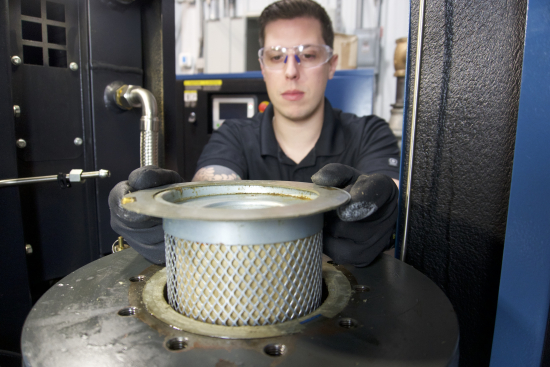
To keep oil carryover below the manufacturer’s three parts per million, follow a preventive maintenance program: Check the air-oil separator annually and replace inline filters every six months.
Filters. Check and replace compressed air system filters regularly. While many filters last up to a year, consider replacing them every six months. Filters, after all, are a small investment compared to downtime or potential lawsuits.
Filters are critical for both air compressors and vacuum pumps: They make compressed air usable. With vacuums, they offer essential protection. Consider all the organic and inorganic materials vacuums ingest to realize the importance of filters in vacuum technology.
Maintain the plant’s air-oil separator, replacing it annually. Varnish can drop out of the oil and coat the separator, creating a significant pressure differential, damaging the separator and sending oil downstream.
Finally, be sure to use the lubricants and filter media specified by the air compressor manufacturer. Original equipment manufacturers devote time and effort to developing filter media designed to work with the air velocity and specific gravity of their recommended lubricants. Using OEM-recommended filters and oil pays off in the long run.
Oil Sampling. As crucial as oil sampling is in standard applications, it is even more critical when using food-grade lubricants. Food-grade lubricants use a base stock similar to standard air compressor oils. The major difference is traditional lubricants contain proprietary antioxidants and additives extending their service life. Without those additives, food-grade lubricants can't withstand heat as effectively. They’ll age faster and break down sooner.
Key takeaways for food packaging and processing companies:
- To ensure food safety, use the ISO 8573-1 quality classes to establish specifications for zones where compressed air comes into direct and/or indirect contact with food and beverage production.
- The most advanced food processing companies are reducing maintenance and initial costs by organizing their plants according to the level of compressed air contact with food.
- One hidden challenge in providing clean, high-quality compressed air in a food processing facility with refrigerated areas is reducing the moisture content of compressed air.
- Consider replacing individual point-of-use vacuum pumps with centralized vacuum systems to reduce aerosolized oil released by the smaller pumps.
- Most companies will benefit from expert help with selecting, operating and maintaining compressed air and vacuum systems.
About the Authors
 |
 |
 |
|
John Schmitt |
Weston Benton |
Rob Grizzle |
John Schmitt serves as a Product Marketing Manager at Kaishan USA, bringing nearly 30 years of experience in the air compressor and manufacturing industries. He applies his background in product engineering, operations leadership and product management to bring a deep, end-to-end perspective on how industrial products are designed, built and brought to market.
Weston Benton serves as a Vacuum and Low-pressure Channel Manager at Kaishan USA. With a background in mechanical engineering, he brings deep application expertise to help distributors and end users specify, deploy and operate vacuum systems correctly and efficiently.
Rob Grizzle serves as a Midwest Sales Manager at Kaishan USA and brings more than 30 years of experience in industrial sales, distribution and operations. He works closely with air compressor distributors across the region, applying a relationship-driven, hands-on approach to grow market share, strengthen partnerships and solve real-world compressed air challenges.
About Kaishan USA
Kaishan USA partners with a nationwide network of independent distributors to ensure customers receive on-site help and consultation. Whether a plant is using all oil-free compressed air or combining oil-free and oil-flooded air compressors with advanced filtering and food-grade oil, it will benefit from expert help in selecting, operating and maintaining its compressed air system. Kaishan USA’s partners are independent, local distributors that have factory-trained technicians with a deep understanding of food-industry applications, helping maximize efficiency and minimize downtime. They can help refine compressed air and vacuum systems to meet ISO 8573-1 Class 0 requirements while also reducing costs, cutting maintenance burdens and conserving energy. For more information, visit https://kaishanusa.com.
For similar articles on Food-Grade Air, please visit https://www.airbestpractices.com/standards/food-grade-air.
Visit our Webinar Archives to listen to expert presentations on the Food Industry at https://www.airbestpractices.com/webinars.