
ISO 8573-1 classification requirements
In compressed air systems, maintaining clean, dry air is essential. It ensures regulatory compliance, protects product quality and supports reliable system performance.
The ISO 8573-1 standard defines clear limits for various compressed air quality parameters. This helps users classify their systems consistently, compare results across applications and set the right requirements for specific processes.
One important parameter is the pressure dew point. However, the correct approach to measuring and classifying dew point is often misunderstood. This confusion arises because the ISO 8573-1 classification table does not explain the full measurement process.
This article explains the key points of the ISO 8573 standard and guides you through the correct way to measure and classify pressure dew point for compliance.
ISO 8573-1 Limits and Pressure Dew Point
Chapter 5.3 of ISO 8573-1 defines the dew point limits for each purity class. To classify a compressed air system correctly, measurements must follow the procedures outlined in Part 3 of the standard.
In many cases, users only refer to the classification table and are not familiar with the complete standard. However, Part 3 explains the correct test methods and measurement conditions for humidity, which are essential for reliable and compliant results.
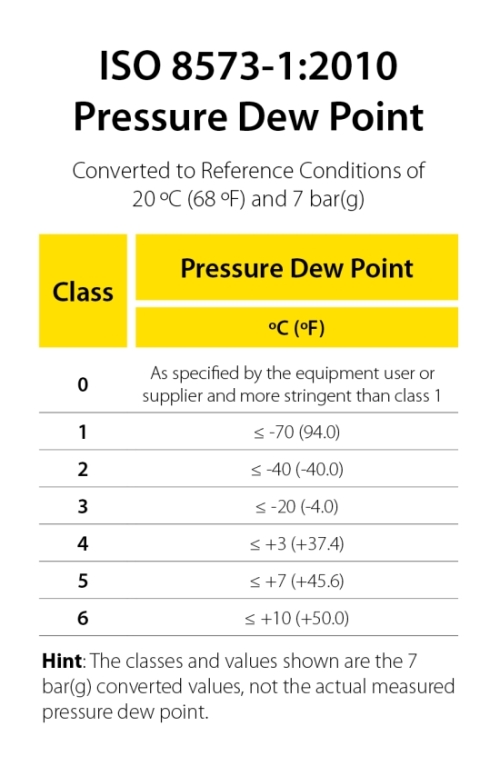
Pressure dew points converted to reference conditions.
Measurement Standards and Required Conversions
According to Chapter 8, Article 8.1 of ISO 8573-3, all pressure dew point measurements must be converted to reference conditions of 68°F (20°C) and 102 psig (7 barg). This conversion is essential because dew point depends on pressure.
A dew point measurement taken at the system's actual pressure cannot be used directly for classification unless the system operates exactly at 102 psig (7 barg). In all other cases, the measured pressure dew point must be converted to the standard reference conditions.
For example, a dew point reading of 37°F (3°C) at 58 psig (4 barg) might seem to meet the limits of Class 4. However, when converted to the reference conditions of 102 psi (7 barg), the dew point becomes 50°F (9.8°C) dewpoint temperature (Td) and falls into Class 6.
This is a critical consideration. A system designed for Class 4 may appear compliant based on the raw measurement, but after conversion, it does not meet the required class.
If the system pressure is close to 102 psig (7 barg), the difference between the measured and converted values remains small. In low-pressure systems, however, this difference can be significant. Therefore, accurate conversion is particularly important when classifying systems operating at lower pressures.
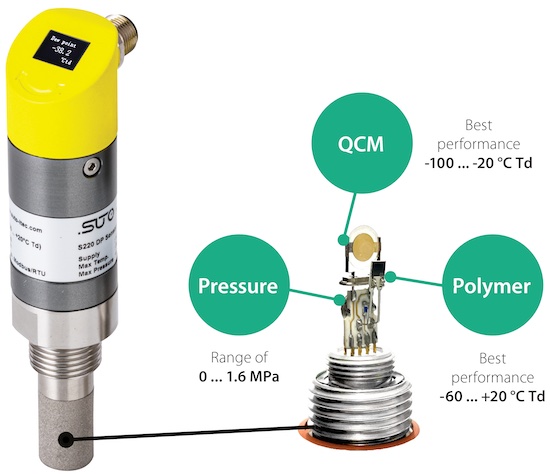
A dew point sensor for compressed air and gases.
The Importance of Measuring Pressure Alongside Dew Point
To classify a compressed air system correctly according to ISO 8573-1, it’s essential to measure pressure and dew point simultaneously. This approach ensures that the pressure dew point of the system is accurately determined.
Without pressure measurement, the dew point reading does not reflect the actual moisture content of the compressed air under the reference conditions of 102 psig (7 barg). This can lead to incorrect or misleading classifications.
ISO 8573-1 classification requires the following:
- Instruments capable of measuring both dew point and system pressure in parallel
- Conversion of dew point values to the reference conditions of 68°F (20°C) and 102 psig (7 barg)
- Compliance with ISO 8573-3 test methods and documentation standards
- Clear reporting of both the measured and converted dew point values
- Documentation of the system pressure during measurement
Using devices that integrate both pressure and dew point measurement simplifies this process. These instruments eliminate the need for manual calculations, minimize audit risks and support classification in line with the standard.
Many dew point sensors and measurement devices do not include a built-in pressure sensor. While this may be sufficient for basic dew point monitoring, it is essential for ISO 8573-1 classification to use a device that includes integrated pressure measurement.
Some manufacturers offer dew point sensors with integrated pressure measurement and automatic conversion to standard conditions. These solutions provide ready-to-use outputs for ISO-compliant classification and make it easier for auditors to verify compliance with the requirements of ISO 8573 Part 3.
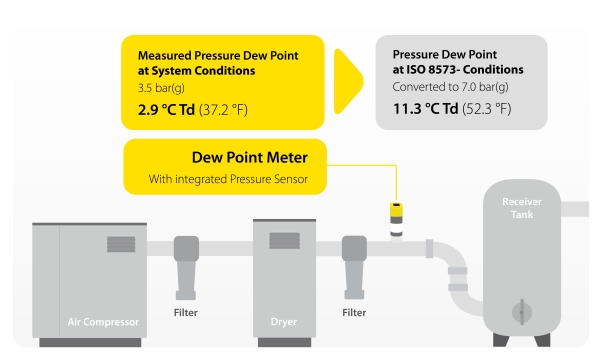
It’s important to measure pressure and dew point simultaneously.
_1.jpg)
This portable dew point meter includes built-in pressure measurement for direct ISO class indication without external conversion.
Special Considerations for Low-Pressure Systems
Low-pressure compressed air systems often face a higher risk of classification errors. A dew point that meets operational expectations at low pressure may appear non-compliant after conversion to the ISO reference conditions.
This occurs because compressed air at lower pressure can hold more moisture, making the dew point seem compliant with the required class. However, when recalculated at 102 psig (7 barg), the dew point shifts upward and may exceed the threshold for the intended ISO class.
Even if the system performs adequately in daily operations, it may fail an audit if this conversion is not applied. For this reason, pressure-compensated dew point monitoring is particularly important in low-pressure compressed air systems, especially those using refrigerated compressed air dryers.
Building Confidence in Compressed Air System Compliance
Compressed air systems require precise monitoring to maintain compliance and operational reliability. Regular reviews of measurement practices help ensure systems meet ISO 8573 standards.
Key questions to evaluate include:
- Are dew point readings converted to ISO reference conditions?
- Are the instruments compliant with ISO 8573-3 measurement methods?
- Does the measurement process account for system operating pressure?
- Can the reporting withstand the requirements of an external audit?
Using dedicated and well-selected dew point monitoring systems helps minimize audit risks and improves the long-term reliability and efficiency of compressed air operations.
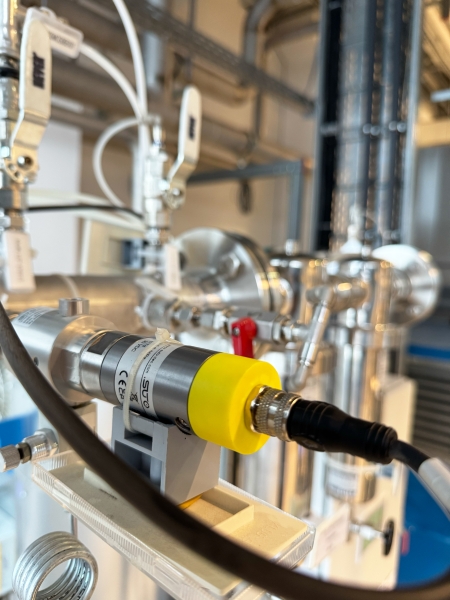
A dew point measurement at system pressure with conversion to ISO 8573 reference conditions.
Key Takeaways
To sum up the key points covered in this article, the following aspects are critical for achieving accurate classification and maintaining compliance with ISO 8573-1.
• ISO 8573-1 classification requires converting dew point values to 68°F (20°C) and 102 psig (7 barg).
• Pressure and dew point must be measured together for accurate classification.
• Low-pressure systems are more likely to be misclassified due to pressure effects on dew point.
• Integrated pressure sensors simplify audits and reduce errors.
• ISO-compliant dew point sensors with built-in pressure measurement support continuous, reliable monitoring.
Together, these practices form a reliable foundation for maintaining compressed air purity, ensuring regulatory compliance and optimizing system performance in industrial environments.
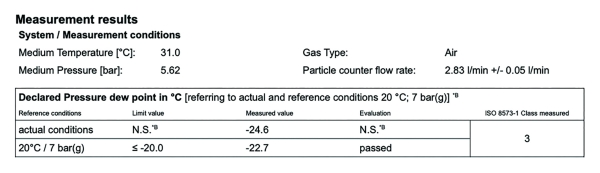
This air quality report shows both the system pressure dew point and the ISO 8573-1 converted dew point. Click to enlarge.
All images courtesy of SUTO iTEC.
About the Author

Simon Gleissner has over a decade of experience in measurement technology for compressed air and gases. He is the Product Manager for in-house software developments, as well as Product Manager for compressed air quality and purity measurement tools. He is also responsible for the German operations of SUTO iTEC, acting as Managing Director since 2019.
About SUTO iTEC
SUTO iTEC is a global leader in the field of compressed air and gas measurement technology. With over 20 years of experience and a product portfolio that includes dew point sensors, flow meters, particle counters and smart data platforms, SUTO iTEC serves industries across more than 100 countries. Known for precision engineering and customer-focused innovation, SUTO iTEC helps industrial operations meet the highest standards of energy efficiency, quality control and ISO compliance. For more information, visit https://www.suto-itec.com.

SUTO iTEC’s calibration and production facilities are based in Heitersheim, Germany.
To read articles on Compressed Air Instrumentation, visit https://www.airbestpractices.com/technology/instrumentation.
For expert presentations, visit our Webinar Archive Section dedicated to Compressed Air Instrumentation at https://www.airbestpractices.com/webinars.