
How to Select Dryers, Filtration and Dew Point Requirements for Reliable Operation
In the world of industrial automation, compressed air isn't just a utility – it’s the lifeblood of control systems. While plant air can usually have a little moisture, oil and particulate, instrument-grade compressed air must meet higher quality standards. Trace amounts of contaminants in the compressed air stream can quickly accumulate and cause costly production problems.
Here is what plant managers, engineers and operators need to know about defining, achieving and maintaining instrument-grade compressed air.
What Is Instrument Air? Defining the Standard
Instrument air is high-purity compressed air used to power pneumatic instruments, control valves and automated systems. The global benchmark for this is ISA-7.0.01-1996 (Quality Standard for Instrument Air), established by the International Society of Automation (ISA).
It’s widely believed instrument air requires desiccant compressed air dryers so a -40°F (-40°C) or lower pressure dewpoint is achieved. While this approach is definitely warranted in some circumstances, it’s not needed in every situation. Going with desiccant compressed air dryers is the safer, conservative approach, but it comes with higher purchase and operating costs.
To be classified as instrument air, compressed air must meet four strict criteria:
- Pressure Dew Point: At least 18°F (10°C) below the lowest ambient temperature to which any part of the instrument air system is exposed. It should never exceed 39°F (4°C) at line pressure.
- Particle Size: Maximum particle size of 40 micrometers (microns) in the air stream.
- Oil Content: Maximum total oil content (liquid and vapor) of 1 ppm (w/w)
- Contaminants: Free of corrosive, flammable or toxic contaminants.
Who Set the Standard and How Has it Evolved?
The instrument air standard was originally developed by ISA (formerly the Instrument Society of America) to prevent pneumatic component failures. It evolved from prior ISA standards starting in 1956, and has not changed since 1996.
As modern manufacturing has adopted more sensitive, micro-pneumatic components and smart positioners, users and specifiers have become more stringent. In practice, ISA-7.0.01 has been somewhat supplanted by ISO 8573-1. For example, the ISA standard allows 1 ppm oil content, but this is considered dirty air in many plants. They apply stricter ISO grades as insurance, usually grades 1.2.1 or 1.4.1. Some even specify oil-free air compressors. This may not be strictly necessary for the instrument air in the plant, but if much of the plant air is also used in food, pharmaceutical or other sensitive applications, it’s surely simpler (and likely more economical) than operating a separate instrument air system.
Why Instrument Air Matters: Verticals and Critical Touchpoints
If instrument air fails, automation fails. When a pneumatic valve gets stuck due to moisture or oil gumming up the internals, processes experience unsafe pressure spikes, product contamination or emergency shutdowns. Consult general guidelines for each industry when choosing compressed air treatment.
- Chemical and Petrochemical: Refineries and chemical plants rely on thousands of pneumatic control valves spread across vast outdoor pipe racks. A freeze-up or sticky valve can cause catastrophic safety hazards.
- Pharmaceuticals and Life Sciences: Air used for pill coating, packaging or valving must be ultra-pure. Oil or moisture contamination can ruin entire batches and violate FDA regulations.
- Food and Beverage: Used in automated sorting, bottling and packaging. Any contact between compressed air and the product demands strict adherence to instrument/food-grade standards to prevent microbial growth.
- Power Generation: Pneumatic actuators control critical steam and water valves. Reliability keeps the electrical grid stable. They also start and control natural gas-driven generators such as those used at the growing number of data centers.
Achieving Instrument Air: Dryers and Filtration
Raw compressed air is hot, wet and dirty. Turning it into instrument-grade air requires a combination of drying and filtration equipment. To achieve the required dew points, facilities rely on two primary compressed air dryer categories:
|
Dryer Type |
Operating Principle |
Typical Dew Point |
Best Used For |
|
Refrigerated Dryers |
Cools air to condense water out. |
35°F to 39°F (2°C to 4°C) |
Indoor plants where ambient temperatures never drop below freezing. |
|
Desiccant Dryers (Twin-Tower) |
Uses materials like activated alumina to adsorb moisture. |
-20°F to -94°F (-29°C to -70°C) |
Outdoor piping, cold climates and high-purity processes. |
Desiccant compressed air dryers can be heatless (using a portion of the compressed air as purge air to dry the adsorbent material, which wastes about 15% of the compressed air) or heated purge (using heated purge air to regenerate the desiccant, saving compressed air energy at the cost of electrical heat). Blower purge compressed air dryers experience short-term dewpoint spikes at certain times.
The effectiveness of heated purge and blower purge desiccant compressed air dryers is governed by the temperature and pressure of the air entering the dryer. The effectiveness of refrigerated compressed air dryers is also governed by the temperature of the ambient air. Dryer sizing must take these factors into account.
The Critical Filtration Chain for Instrument Air
Compressed air drying is useless without proper filtration. A standard instrument air train requires a multi-stage approach:
- Water Separator/Bulk Moisture Filter: Removes bulk liquid water and large scale before it hits the compressed air dryer.
- Coalescing Filter (Pre-Filter to Dryer): Catches fine oil mists and water droplets down to 0.01 microns or less. This protects desiccant beds from oil fouling, which ruins their ability to adsorb water.
- Particulate After-Filter (Post-Dryer): Desiccant beads naturally abrade and create fine dust (called desiccant fines). A high-temperature particulate filter is placed after the desiccant compressed air dryer to catch these particles before they reach instruments.
- Activated Carbon Filter (Optional): Removes oil vapors and odors. This is critical for the food and pharmaceutical verticals.
Determining and Optimizing for the Right Dew Point
One of the costliest mistakes a plant can make is over-specifying its dew point without realizing the energy and service cost penalties. Achieving a -40°F (-40°C) dew point with a desiccant compressed air dryer requires significantly more energy (either via compressed air purge loss or electrical heating elements or blowers) than running a refrigerated dryer at 38°F (3°C). Plant managers must balance operational surety with lifecycle costs, including purchase price, maintenance costs, repairs and energy consumption.
The golden rule for determining a plant’s dew point comes from the ISA standard: The dew point must be 18°F (10°C) lower than the lowest ambient temperature the downstream piping and process equipment will ever experience.
Scenario A (Indoor Facility): A plant in a climate-controlled building where the temperature never drops below 65°F (18°C).
Calculation: 65°F-18°F = 47°F (8°C). Since the ISA maximum cap is 39°F (4°C), a properly sized refrigerated compressed air dryer achieving 38-45°F (3-7°C) pdp is acceptable and energy efficient.
Scenario B (Outdoor/Unheated Facility): A chemical plant in Ohio where winter temperatures can drop to -10°F (-23°C).
Calculation: -10°F-18°F= -28°F (-33°C). A refrigerated compressed air dryer will fail here. Moisture in the air will condense and freeze, creating reliability issues in the facility. This facility selects a desiccant dryer rated for -40°F (-40°C)
Air Compressor Selection: Oil-Free vs Oil-Flooded
Both oil-flooded and oil-free air compressors are used in instrument air applications. There are significant cost implications for purchase, service and energy. Consider the following design questions when deciding between the two:
- Is there an industry- or company-specific standard? For instance, the 2011 ISPE (International Society of Pharmaceutical Engineering) Good Practice Guide for Process Gases requires a -40°F (-40°C) pdp and little to no hydrocarbon carryover.
- Will compressed air come in contact with the product?
- What is the consequence of contamination due to oil? What is the hourly cost to production if a sensor is contaminated due to oil carryover?
- Does the facility have the ability to shut down to replace dirty or clogged filters? Should the system be designed to allow maintenance to take place on any piece of equipment without the system being offline?
In either case, they require the correct compressed air dryer and proper filtration.
Determining Compressed Air Demand
Before selecting equipment, you must calculate total demand (cfm or m3/min).
- Sum the Components: Add up the air consumption of all pneumatic instruments, control loops and cylinders based on manufacturer datasheets.
- Apply a Load/Duty Factor: Not every valve actuates at the same millisecond. Apply a concurrency factor (typically 50-70% for large instrument networks).
- Account for Future Growth and Leaks: Add a 20-30% buffer for future plant expansion and an unavoidable 10-15% buffer for leaks.
Consider reliability and redundancy as you would for any compressed air system. A modular approach and/or variable speed drives can significantly reduce operating costs.
Case Study 1: The Coastal Food Packaging Plant
The Challenge: A humid, indoor packaging facility experiences frequent micro-valve failures on its sorting matrix, causing packaging misalignment.
The Selection: Total demand is calculated at 300 scfm. Because this is an indoor facility, a -4°F (-20°C) dew point isn't required, but oil-free compressed air may be required if air contacts food.
The Solution: A properly sized refrigerated compressed air dryer producing a 38°F (3°C) dew point, a multi-stage coalescing filtration array and a carbon vapor filter.
The Outcome: Valve failures dropped to zero, and the plant saved thousands in energy costs by avoiding an oversized desiccant compressed air dryer system.
Case Study 2: The Northern Oil Refinery
The Challenge: An oil refinery spans several outdoor acres in a region where winters regularly hit -15°F (-26°C). Main control lines are prone to freezing, shutting down critical process loops.
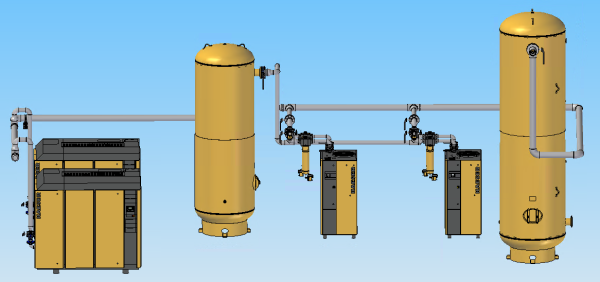
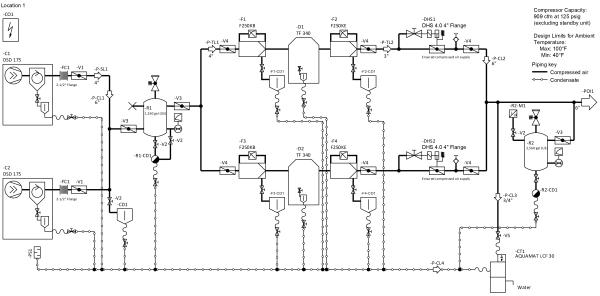
The Selection: Total instrument air demand is 1,500 cfm.
The Solution: A duplex skid design featuring two rotary screw air compressors (configured for 100% redundancy), dual desiccant compressed air dryers (achieving a -40°F/-40°C pdp), heavy-duty oil-coalescing pre-filters and particulate after-filters.
The Outcome: The desiccant compressed air system with -40°F (-40°C) pdp eliminated winter line freeze-ups.
Case Study 3: The Unmanned Station
The Challenge: Design and maintain an unattended compressed air system able to supply instrument-quality compressed air around the clock in all four seasons and alert personnel when the station is not operating.
The Selection: Total instrument air demand is 120 scfm.
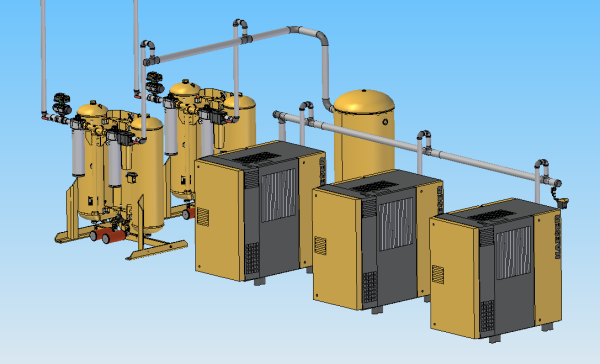
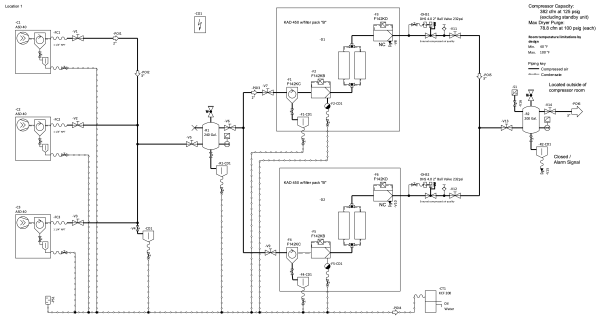
The Solution: A fully enclosed compressed air station with thermostatic louvers, exhaust ductwork, two rotary screw air compressors, two heatless desiccant compressed air dryers and redundant filters, rated for both low and high temperature extremes at the elevation, with all key operating parameters (temperature, pressure, dewpoint and equipment alarms) remotely monitored via a cellular modem. This system features single-point connections for power, air and condensate.
To minimize footprint and installation costs, modern plants may opt for pre-engineered, pre-built instrument air skids. These modular systems integrate air compressors, receivers, filters, compressed air dryers and measurement devices onto a single structural frame, complete with all interconnecting piping and wired to NEC standards with single-point utility connections. These options often save time and money if a building needs to be modified or the installation is in a remote location. They also ensure the system’s components work together.
Maintenance and Concerns for Plant Managers
An instrument air system is only as reliable as its maintenance schedule. Plant managers should keep a strict eye on the following:
Condensate Drain Management. The best filters in the world are useless if their automatic drains are clogged. If a drain valve fails to open, water and other contaminants re-enter the air stream. Inspect drains frequently. Some have function alarms that can be monitored remotely.
Filter Element Differential Pressure. As filters catch hydrocarbons, they create pressure drop. Running air through a clogged filter forces the air compressor to work harder, increasing operating costs. Replace elements as needed on a regular schedule. As with drains, alarm devices are available for in-line filters.
Desiccant Degradation. Over time, desiccant beads break down. Monitor dew point sensors continuously. A rising dew point indicates it’s time to replace the desiccant beds
Leak Detection Audits. Pneumatic fittings and valve packings inevitably develop leaks. Because instrument air is expensive to produce, an aggressive leak detection program ensures operations and can save a facility tens of thousands of dollars annually.
The Ultimate Yield on Clean Air
At first glance, designing and maintaining a true instrument-grade compressed air system can look like an expensive hurdle. The specialized compressed air dryers, duplicate filtration and precise monitoring equipment represent real capital and operational costs. However, looking at these systems solely as an expense is a mistake. In modern manufacturing, high-purity air is an insurance policy against unplanned downtime (preventing a single line stoppage caused by a stuck pneumatic valve can instantly pay for a year of premium filtration), product spoilage (keeping oil and water out of packaging and process lines protects batch integrity and preserves brand reputation) and asset degradation (clean, dry air extends the lifespan of sensitive pneumatic actuators, smart positioners and control valves by years).
Clean air equals smooth operations. By basing your system's dew point on your lowest ambient temperatures – rather than on desiccant compressed air dryers by default – you can optimize your energy footprint. Pair this smart design with a disciplined maintenance routine focusing on drain integrity, filter replacement and routine leak audits, and your instrument air system will become the reliable backbone of your facility.
About the Author

Joe D’Orazio is the National Sales Manager for Kaeser Compressors. With 29 years in the compressed air industry, he has helped thousands of customers improve the reliability, productivity and efficiency of their compressed air systems. Joe holds a Bachelor of Science in Mechanical Engineering from Clarkson University and a Master’s in Business Administration from the University of Florida.
About Kaeser Compressors
Kaeser Compressors is a leader in reliable, energy-efficient compressed air equipment and system design. It offers a complete line of industrial air compressors as well as compressed air dryers, filters, SmartPipe™, master controls and other system accessories. Kaeser also offers blowers, vacuum pumps and portable gasoline and diesel screw air compressors. Its national service network provides installation, rentals, maintenance, repair and system audits. Kaeser is an ENERGY STAR Partner. For more information, visit https://us.kaeser.com/.
To read similar articles on Compressed Air Standards, please visit https://www.airbestpractices.com/standards.
Visit our Webinar Archives to listen to expert presentations on Compressed Air Standards at https://www.airbestpractices.com/webinars.
