
Compressed Air Systems (CAS) began in 1963, founded by Richard “Dick” Hall in Mulberry, FL. The company expanded over the decades and now has a 30,000-square-foot headquarters in Tampa and a 4,000-square-foot facility in Central Florida. Hall’s four daughters are now the owners, and it’s still a family-run operation. It currently has 57 employees and is a distributor for Kaeser Compressors. Its 60-year anniversary celebration, delayed by Covid, will take place this fall.
The company had already created three compressed air systems for a local recycling firm when it got a call to design a fourth – this one far away in San Antonio, TX. The local recycler had been acquired by a Texas-based firm, Balcones Recycling, and the Florida company’s owner was brought in as a Business Development Manager. He told his new Balcones partners that Compressed Air Systems was the right company to create the compressed air system for its new high-tech recycling plant, and they listened. That’s how Compressed Air Systems left its usual distribution area – with permission from Kaeser for a cross-border assignment – to complete a job in the Lone Star State.
While the territory might have been different, the challenges were much the same. Conserving water is just as important in Texas as in Florida, thanks to water scarcity, local allowances and high costs for city water. This installation, like nearly all installations Compressed Air Systems completed, relied on air-cooled air compressors.
The project started in June 2023. There are multiple compressed air applications in a waste management facility. This new recycling center uses laser-guided optical sorters to divide waste, with no human involvement on the sorting line. Laser optics determine what type of material each scrap is, then compressed air jets maneuver each piece to its collection area. Compressed air also powers handheld blow guns used for cleaning, as well as the bundling and packaging system. The customer chose to power its blow guns with air compressors instead of industrial blowers so they’d have to force to drive debris out of small crevices.
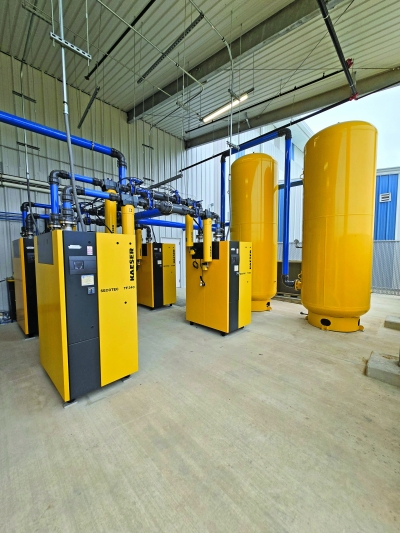
Balcones was creating an entirely new facility, so the company would be working from scratch. Redundancy was critical for the customer, so the plan was to provide as much redundancy as possible. The processes called for a constant compressed air stream of 2,255 scfm at 115 psig. The company supplied four fixed speed, single stage rotary screw air compressors supplying 888 scfm at 125 psig. These included built-in cyclonic moisture separators, which remove a significant percentage of the moisture from the compressed air. The compressed air room was an open-air enclosure on the facility’s north side, as far as possible from the drop-off area where large trucks kick up dust and debris.

Creating a Dry Compressed Air System for a Humid Environment
Removing moisture from the compressed air stream was critical, as it would ruin the high-priced laser optics used for sorting. Each of the 12 laser-guided optic components costs $8,000 and requires 55 to 325 scfm at 80 psig. The dew point from a refrigerated compressed air dryer was good enough for these components, but the system would encounter critical issues if the dew point rose above 50°F (10°C).
Two 1,550-gallon wet storage tanks remove much of the condensate and some of the heat from the compressed air stream. The wet tanks are equipped with 500 gallon per hour mechanical float drains to remove condensate and cool the air. After that, the compressed air splits in parallel to four refrigerated cycling compressed air dryers equipped with zero-loss electronic drains. These were outfitted with oil and particulate filters on entry and exit. A three-way bypass valve allows the operator to stream the compressed air to one of the refrigerated cycling compressed air dryers, if needed, for servicing. Built with a thermal mass, these refrigerated cycling compressed air dryers are especially efficient. A cool pack similar to a medical ice pack is chilled and cools the air passively.
From there, the compressed air stream travels to two 1,550-gallon dry storage tanks. These tanks includes 2400 scfm electronic drains, which can send an alert if they detect moisture or a failure occurs. The compressed air system also includes a modular oil-water separator, which includes a notification alarm. The compressed air system’s components are linked with a Sigma Air Manager 4.0 management system that alerts operators if moisture is present. Tablet-sized, the wall-mounted system monitors air compressor performance and energy use, helping operators plan start and stop times with real-time monitoring. It can also email the maintenance department automatically when it detects a fault.
The compressed air system loads at 110 psi and unloads at 120 psi. The customer initially requested a system pressure of 125 psi, but CAS was able to show that level wasn’t needed, creating a more efficient and less expensive compressed air system.
Calculating Correction Factors for Refrigerated Compressed Air Dryers
While the work of designing the compressed air system would normally be done by a mechanical engineer, the customer trusted the company to do the work based on past successes. Kyle Randall, Vice President and Director of Sales, explains that his company received a spec detailing the compressed air requirements of the optical systems, handheld blow guns and packaging system, and created a detailed plan with full redundancy.

“They wanted to put this in an outdoor location,” said Randall. “We knew the heat and humidity in Texas are similar to Florida, so it could be very cold in the morning, very hot in the afternoon. There was dust outside, so variable speed drive air compressors weren't something we wanted to use in this situation. We liked the idea of having two full base load units and then trimming with the third air compressor. The control settings would ensure all air compressors get equal running time, and the fourth air compressor provides 50% redundancy. But, the real efficiency came from using cycling refrigerated compressed air dryers, as well as keeping the demand as close to the air compressors as possible. We were hoping that the two main air compressors would run at full capacity, and the third air compressor would be about 70% loaded. If they needed more flow, it could go to 100%. That's the most efficient we could get with that system.”
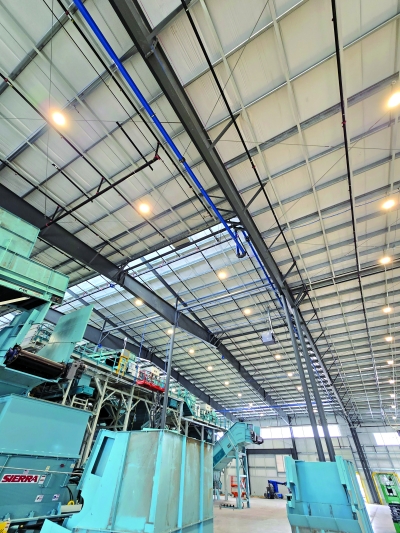
The purchase order was delivered by the end of 2023, and the compressed air system installed in May 2024. The company’s crew drove in from Florida to install the compressed air system and connect it with aluminum piping, creating a loop distribution system. The compressed air system includes over 1,000 feet of pipe with drops to conveyor belts and other work areas. Kaeser Compressors of Houston helped with the commissioning, which took three days.
The compressed air room is in a partially sheltered outside enclosure, which saves room in the recycling facility but also causes environmental challenges. To ensure proper functioning even with high ambient heat and humidity, the company oversized the refrigerated compressed air dryers by 30%. The goal was to ensure the dew point stays at 40°F (4°C) and never rises above 45°F (7°C). Sizing a refrigerated compressed air dryer correctly means applying the right correction factor.
“I've been doing this for 27 years, knowing the worst case scenario in Florida is usually August,” Randall said. “In that month, your dew point or your humidity level is super high. Your correction factor is basically 30% above. Refrigerated compressed air dryers have their rated capacity based on a 100°F (38°C) ambient temperature with compressed air saturated at 100°F (38°C) and 100 psig. If you go above that, there is a correction factor table you can use. You put in your worst-case conditions and come up with the correction factor. I've typically seen that if you oversize to 30%, you're fine. It's a good number to use. For this application, I sized the refrigerated compressed air dryers to 1,130 scfm rated capacity with 888 scfm of compressed air delivered from each unit, but because all four refrigerated compressed air dryers are cycling, totaling 4,520 scfm, and piped in parallel, they cycle off half the time. This is how the customer not only saves energy, but also add longevity to its refrigerated compressed air dryers.”
Water Savings with Air-Cooled Air Compressors
Air-cooled air compressors are the norm in Florida and Texas for a variety of reasons. The water table is filled with minerals, so any water sourced from the ground needs a lot of cleaning, and water-cooled systems require extra maintenance. The company has found water cooling systems tend to get clogged within two or three years. Using city water in South Florida is prohibitively expensive and can create environmental issues. For these reasons, nearly all the company’s installations include air-cooled air compressors.
Kaeser Compressors estimates the customer is saving 13,650,000 gallons of water each year by using air-cooled air compressors.
“Except in rare cases where air cooling would compromise reliability due to ambient conditions and a chilled water system is already in place, we recommend air-cooled air compressors as a more cost-effective solution for the customer,” said Neil Mehltretter, Technical Director, Kaeser Compressors. “It's true that a water-cooled air compressor may have marginally higher efficiency, but this is offset by the energy and maintenance costs of operating a chilled water system. If the chilled water system is not already in place, the costs of engineering, installation, plumbing and plant space would make it prohibitive.”
Randall has learned to upsize the fan on his air-cooled air compressors by three to five horsepower (hp). This adds to the expense; however, the hot air expelled can be used in heat recovery projects. He has one customer in South Florida that uses the hot air from an air-cooled air compressor to dry paint on an assembly line.
When it’s time to choose between air-cooled and water-cooled air compressors, Randall has advice for his customers.
“It comes down to whether or not they already have cooling towers or cooling. If they're designing a new compressed air system and it’s going to have access to chilled water, then they can look at water-cooled air compressors. They can oversize the air compressor a little bit more, and the air compressor room will stay nice and cool. We've had some customers, like one Florida theme park, for example, that needed water-cooled air compressors. You couldn't get the heat out of the basement with air-cooled air compressors. There are instances where water-cooled air compressors are a great solution, but 99% of our sales are air-cooled air compressors.”
Maintenance for Air-Cooled Air Compressors
Air-cooled air compressors have special maintenance concerns, with cleanliness the chief issue. When located in a dusty environment, as with this San Antonio installation, adding filtration in front of the cooler will help. Randall prefers externally mounted, magnetic Permatron industrial air filters. Intensely dusty locations require adding a pre-filter dust eliminator before the main air filter.
“Another thing to consider is that with air-cooled after-coolers, one side of the cooler contains oil, and the other side has air. They're combo coolers,” Randall said. “You have the oil cooler and then the air cooler on the other side. Keeping them clean and inspecting them is important. We've seen a lot in dusty environments where they should be blowing them off or using an air refrigeration cleaner. It's a solution you can spray on, and it brings all the dirt off. You just wash it off with water and it’s environmentally safe.”
A lack of filtration for air-cooled air compressors leads to particles and dust fouling the oil and the airend, shortening equipment life. Bearings get clogged, leading to higher heat. Raising oil temperature by 10°F (6°C) cuts its life by a quarter, Randall noted. In this installation, the customer chose to get ongoing compressed air system maintenance through an annual contract with Kaeser Compressors of Houston.
“We've been a Kaeser dealer since 1986, when it came to America, and we collaborated with it when developing ideas and procedures. When designing a compressed air system, we don't skimp on anything, including the valve, flex line and proper-size piping. We think about expanding for the future, if that’s a possibility, and making sure the compressed air system is piped correctly. We also paint all of our tanks Kaeser yellow to match. They last longer and look nice. Little details make the compressed air system look so good. We try to eliminate as many 90° turns as we can to keep the system flowing well with less pressure drop. I think Kaeser's best practice is the same. We're all on the same page.”
For more information on Compressed Air Systems, visit https://www.compressedairsystems.com.
To read articles about Water Conservation, visit https://www.airbestpractices.com/sustainability-projects/water-conservation.
For expert presentations on Air Compressor Technology, visit our webinar archive section at https://www.airbestpractices.com/webinars.
