Right-Sizing the Refrigerated Compressed Air Dryers

The Casa Grande, AZ, Cardinal Glass plant increased production by upgrading its refrigerated compressed air dryers.
Cardinal Glass began when it was spun off from its parent company in 1962. Today, it’s grown to become one of the leaders in residential glass manufacturing with over 49 locations and 10,000 employees. The company’s Casa Grande, AZ, plant specializes in tempering, taking annealed or raw glass, cutting it to size, running it through a 1,250°F (677°C) oven and then using a pressurized air system to quench the glass and turn it into safety glass. Tempered glass breaks into small, safe pieces, rather than jagged shards. The 120,000-square-foot plant employs 62 people. It produces 5,000 pieces per day, or 30,000 to 40,000 square feet of glass.
The plant uses compressed air in a variety of ways, including powering its pneumatic cylinders. Compressed air powers the plant’s belt systems that transfer materials, the seaming system that rounds the corners and the washer system that cleans particulates off glass before it goes into the furnace.
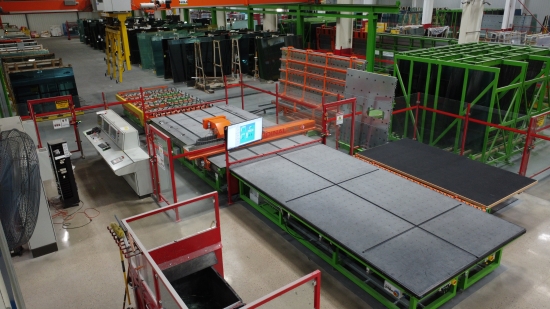
The 120,000-square-foot plant produces 5,000 sheets of glass each day.
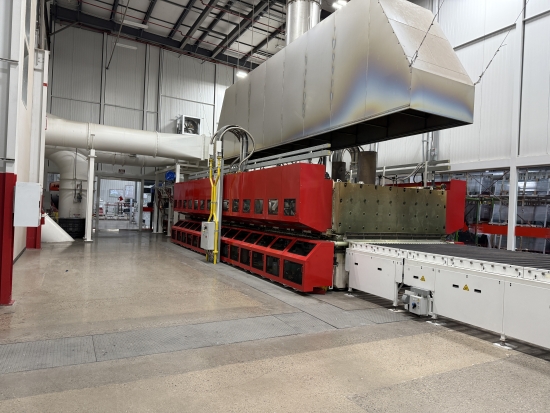
The plant’s tempering furnace reaches 1,250°F (677°C).

The quench system uses pressurized air to cool the glass.
Overloading the Refrigerated Compressed Air Dryer
Logen Kelly was hired as the plant’s Maintenance Manager in January 2016. He describes the compressed air system he inherited as old and out of date. It consisted of one 30 hp rotary screw air compressor powering the plant, two poorly functioning 50 hp and 100 hp rotary screw air compressors held as backups and one refrigerated compressed air dryer rated for 100 cfm. The 30 hp air compressor gave out from motor failure in 2017, so he replaced it with another 30 hp air compressor.
The plant’s compressed air machinery is located outside under an awning. It’s shaded on its west side, but by mid-afternoon every day it experiences direct sunlight. Ambient temperatures are cool in the winter – sometimes around 30°F or 40°F (-1°C or 4°C) – but in the summer routinely rise to over 100°F (38°C). With added heat from nearby machinery, some summer temperatures reach 122°F (50°C). Under those conditions, the refrigerated compressed air dryer couldn’t keep up and often worked at reduced capacity due to the high heat. The compressed air system’s biggest problem was water constantly reaching production and ruining product. The refrigerated compressed air dryer also lacked an oil-water separator, and drained directly into the soil.
Cardinal Glass purchased the plant in 2004, and ran a single production line for 20 years, until it added a second. The compressed air system includes 120,000 feet of 1½-inch piping with drops every 50 to 70 feet.
“Just counting the pipes alone, that's a lot of volume. The compressed air piping runs everywhere,” Kelly said. “When I got here, there was a lot of water in a lot of pipes. The refrigerated compressed air dryer was an issue.”
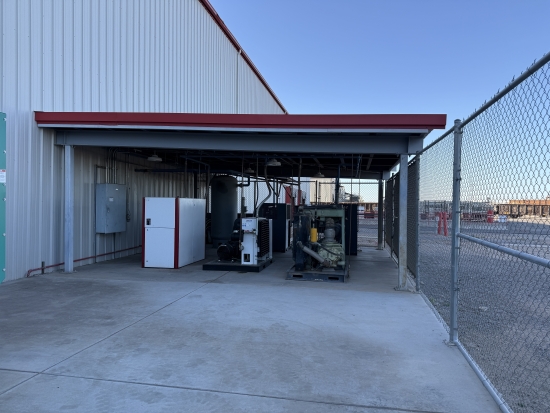
The plant’s compressed air equipment is housed outside under an awning.
Water in the Compressed Air System Causes Inconsistent Operation
In his first month at the plant, Kelly saw how water in the compressed air system caused a variety of problems. Pneumatic cylinders would operate sporadically, causing the conveying system or CNC machines to mishandle and even damage the glass. Diagnosing the problems was challenging since the machinery seemed to work when physically actuated, but produced errors when in use. Pockets of air and water in the fine tubing caused the machinery to malfunction, but never on a consistent basis.
“It was bad when I got here. I’d pull a cylinder out and see drips of water coming out of it,” Kelly said.
The solution was to replace much of the plant’s compressed air system and actuating cylinders, but that solution was costly. Unable to get the funds necessary, he first turned to desiccant filters to dry his compressed air.
“Inconsistent compressed air pressure because of the water will cause these errors,” Kelly said. “Before long, the cylinders corrode. You'll start getting rust and corrosion on all the components that touch compressed air, and you get material in there that shouldn't be there. We tried to combat it by adding a desiccant bowl in the compressed air system before the compressed air reached the production machines. We were fighting the symptoms instead of going to the source.”
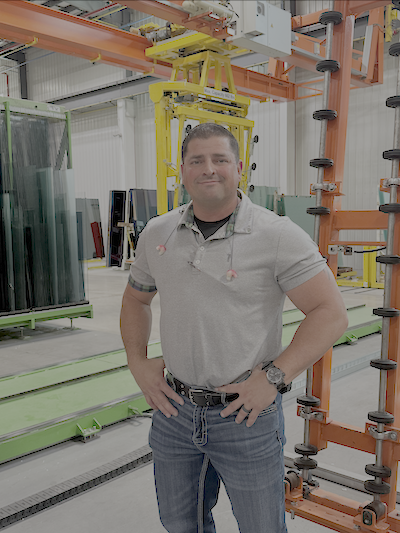
Logen Kelly started as the Maintenance Manager and is now the Plant Manager.
Quality and PerformanceLogen Kelly has gotten an on-the-job education in compressed air system quality since signing on with Cardinal Glass. After rebuilding much of his plant’s compressed air system and learning to keep it clean through proactive maintenance, he discovered these tips for maintaining quality. 1. Buy Good Quality Parts: “Buy a good product or buy two good products so you have redundancy. Put money into it at the beginning, and develop a preventative maintenance schedule and make sure your maintenance techs service every piece of equipment. The quality of material you purchase is the quality you're going to have long-term. When it came to the quality of our air compressor parts, we valued top-quality equipment. Buy something you know is going to last. Use the right valves and solder the copper in or compress the copper, whichever works best. You don't want a low-quality system because it’s going to fail on you. Have the right amount of filters, so by the time the compressed air gets to the point of application it’s clean with the right level of quality. 2. Plan for Redundancy: “Components in the compressed air system aren’t going to run 100% of the time. Maintenance technicians can’t always perform checks when something is operating. Without built-in redundancy, you’re setting yourself up to fail because you're going to be reactive to the piece of equipment failing. Then, you're not going to repair it well because you're either going to do it fast or you're going to cut corners to get the equipment running quickly. If you're running 24/7 and you have no redundancy, how do you expect to perform the maintenance that needs to be done? How can you check anything?” 3. Include Plenty of Shut-Off Valves: “This goes along with redundancy. When you create your compressed air system, make sure you have enough shut-off valves. For maintenance safety, you need to have enough shut-off valves so employees don’t need to perform maintenance on active compressed air systems. Without valves, you can’t do preventative maintenance on a piece of machinery and then bring it back up. That can't be done because you're going to lose the air pressure you need in the plant. ” |
Calling in a Specialist to Diagnose Compressed Air Problems
Logen Kelly didn’t have to do all the work himself. He got assistance from Arizona Pneumatic Systems, a Gardner Denver distributor. Account Manager David Robertson cold-called him in early 2016 and found a potential customer in need. The partnership started with a plant tour. Kelly doesn’t have a background in compressed air systems, so Robertson not only pointed out the compressed air system’s problems, but also explained why they were problems. The two worked through the plant’s equipment piece by piece.
“When I first inspected Cardinal Glass's compressed air system, I immediately noticed several significant concerns that needed addressing,” Robertson said. “The air compressor in operation was clearly oversized for the actual demand, which was causing energy inefficiency and unnecessary operational costs. This was particularly problematic given that the refrigerated air dryers were undersized for the higher-than-necessary flow rate and high ambient temperature desert conditions, making them unable to properly condition and maintain a year-round stable dew point of ISO 8573-1-2010 Class 4-5.”
During peak temperature periods, the refrigerated compressed air dryer couldn't remove moisture effectively from the compressed air stream, allowing water vapor to travel downstream into the system. Also, a malfunctioning electric timed drain on the coalescing filter after the dryer compounded the problem. The moisture successfully captured by the filter couldn't be properly discharged due to the malfunctioning drain, causing accumulated condensate to be pushed back into the compressed air system during pressure fluctuations.
To remedy these problems, a comprehensive approach was implemented. Arizona Pneumatic Systems replaced the undersized refrigerated compressed air dryer with a cycling refrigerated compressed air dryer sized for high ambient temperature desert conditions, ensuring it had sufficient capacity to handle peak summer temperatures. Additionally, it replaced the malfunctioning electric timed drain with a zero-loss condensate drain, ensuring consistent and automatic removal of collected moisture. This two-pronged approach effectively eliminated water intrusion into the compressed air system, protecting downstream equipment and improving overall system reliability and efficiency.
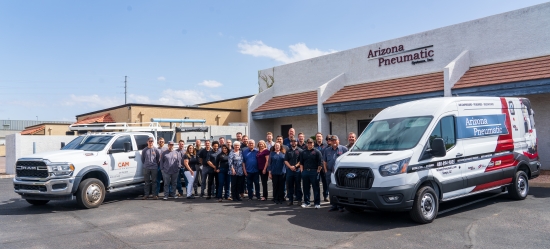
Arizona Pneumatic Systems worked with Cardinal Glass to deliver clean, dry compressed air.
Right-Sizing the Refrigerated Compressed Air Dryers
To dry the compressed air, Arizona Pneumatic Systems recommended two cycling refrigerated compressed air dryers capable of 400 scfm and 800 scfm.
“I have them all piped together. They line up nicely,” Kelly said. “The cycling refrigerated compressed air dryers are redundant and the air compressors are redundant. We cycle them to exercise them and make sure they're good to go.”
“Refrigerated compressed air dryers are rated for the three 100s: ambient and inlet temperature and inlet pressure (psi),” Robertson said. “Moisture in compressed air systems is common in Arizona and Nevada. Once I explain it in the simplest terms, clients quickly realize the source of their moisture issue.”
Since Kelly improved his compressed air system in 2018, it’s run without incident.

Two properly-sized refrigerated compressed air dryers keep moisture out of the compressed air stream.
A Drainage Concern Leads to Oily Soil
The problem of the refrigerated compressed air dryer draining directly to the soil was not immediately obvious to Kelly, but once the environmental concerns were made clear he helped with remediation. The runoff contained oil, which slowly built up in the soil.
“At first, I thought, ‘Well, it's only water; run it into the dirt.’ Then days turned into years, and we had oil-saturated soil. A new Plant Manager said, ‘This doesn't look right. We're draining this right to the earth. That's not okay.’ So we changed it. We removed the dirt and it went to hazmat. We backfilled the hole. Now, our refrigerated compressed air dryers all use oil-water separators connected to a French drain, completely clean.”
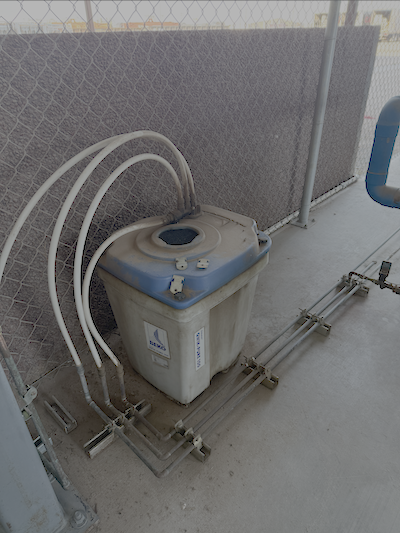
Compressed air condensate now drains into oil-water separators.
Adding a Second Production Line to Meet Demand
In 2024, the plant added a second production line able to produce two-and-a-half times more product than the first line. Thanks to the second line, Kelly needed more compressed air flow than he got from the 30 hp air compressor. He upgraded to a 50 hp rotary screw air compressor with an output of 235 cfm. It’s set for 100 psi. When pressure drops below 95 psi, a second 50 hp air compressor starts up, but that rarely happens.
Robertson helped with the second production line. “This process included identifying the specific compressed air flow and pressure requirements of each piece of process equipment, pinpointing any inappropriate uses of compressed air and implementing an annual leak inspection program,” Robertson said. “These steps were crucial in reducing demand and right-sizing the original system. Datalogging kilowatt usage further validated the accuracy of our system calculations and the impact of these improvements on the demand profile. As the Cardinal Glass compressed air system was developed, decisions regarding capital equipment were based on objective data, taking into account potential growth and the need for system redundancy.”
Since the compressed air system’s replacements and expansion, all plant equipment has been well maintained. Pneumatic failures are a thing of the past. With the compressed air system stable, Kelly – now the Plant Manager – has been able to turn his attention to preventative maintenance. He enrolled in the Platinum Trust Complete Package coverage program with Arizona Pneumatic Systems so his technicians can focus on something besides keeping the compressed air system running.
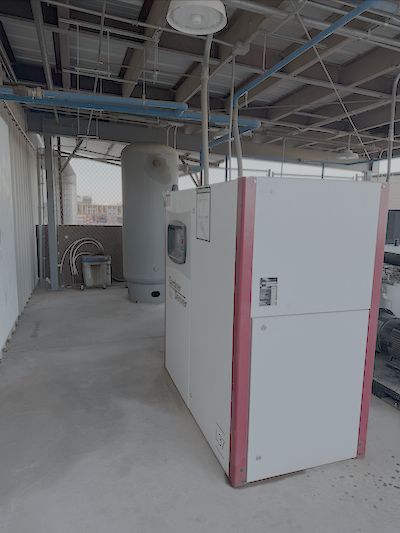
The plant’s compressed air needs are met by a single 50 hp rotary screw air compressor.
About Arizona Pneumatic Systems
Arizona Pneumatic Systems, established in 1977 by Jeannette and Gordon Gunning, has become a leading compressed air distributor in Arizona and Nevada. Starting from its headquarters in Tempe, AZ, the company has expanded its footprint to include 14,000 square feet of facilities in Arizona and an additional 4,500 square feet in Las Vegas, NV. For more, visit https://arizonapneumatic.com.
To read similar Compressed Air Treatment articles, visit https://www.airbestpractices.com/system-assessments/air-treatment-n2
Visit our Webinar Archives to listen to expert presentations on Compressed Air Treatment at https://www.airbestpractices.com/webinars.