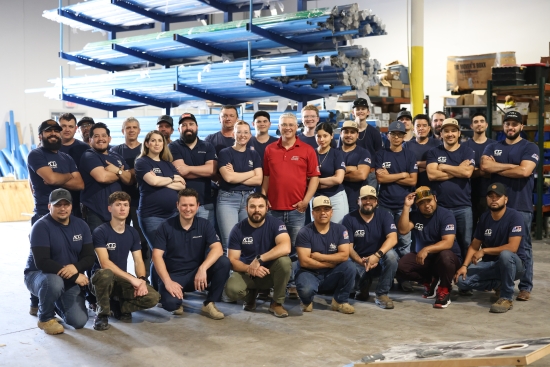
The employees at ADG Concepts of Saginaw, TX
A frozen food processor in North Texas had more problems with its compressed air system than it realized. All it knew for certain was that adding additional air compressors wasn’t helping.
ADG Concepts is based in Saginaw, TX, and describes itself as a compressed air, industrial vacuum, and nitrogen solutions company. It operates like an engineering firm crossed with an installer, solving and fixing industrial utility problems for industrial clients.
ADG Concepts had a five-year history with this plant, having been brought in originally by an equipment salesperson to do installation work. Since then, it had been brought in many times for repairs. Each time there was a problem, plant management saw adding equipment as the solution. After years of attempting to educate its client, the company was finally hired to perform a compressed air system audit.
The audit of the existing system and the design of the new system were a collaborative effort between the plant’s engineers, the Quincy Compressor equipment salesperson, an auditor with the Draw Group and the ADG team.
“They got to a point where every time they added a new piece of equipment, it did not eliminate their rental, nor did it eliminate the water problems, the leaks and everything else they were experiencing. The system had issues that adding more equipment simply could not fix,” said Ivan Suslaev, President, ADG Concepts. “On top of the issues with the existing system, the plant was planning an expansion and buying new production equipment that required a lot more compressed air than the old production equipment provided. All their efforts at upsizing their compressed air system weren’t getting any more air into production.”

Ivan Suslaev, President, ADG Concepts
This plant has two main production facilities on the same campus, one older and one newer. The work described here was done in the older facility. Six air compressors in three locations fed this facility’s compressed air system: four older air compressors in one location (all air-cooled, fixed-speed, 100 horsepower [hp] rotary screw air compressors, running partially loaded), a newer variable-speed drive (VSD) 200 hp rotary screw air compressor in a second location, plus an air-cooled, fixed-speed 75 hp rotary screw rental air compressor, which was located far from the production facility and lost much of its pressure due to undersized compressed air piping. All totaled, the plant should have gotten 2,855 cfm if all the air compressors were fully functional. The company estimated the plant wasted \$41,500 yearly in energy costs. The rental cost was \$51,840 per year, and had been in place for over a year.
The plant uses compressed air for a variety of purposes, including shipping and receiving, running automated valves in the spice mixing room and combining ingredients in the bakery. Four electric industrial blowers powered the plant’s air knives.
Water in the compressed air piping contributed to a variety of production problems. Shutdowns occurred routinely due to water interfering with the solenoid valves and actuators. Maintenance needed to perform frequent repairs to keep production machinery operational.
“A Schedule 80 stainless steel pipe for the plant’s freezer was installed coming off the bottom of the header. Because of the improper installation and moisture in the compressed air system, it kept filling with water and freezing,” Suslaev explained. “For as long as they had it, it never worked.”
An Interstitial Ceiling Hides Compressed Air Piping, But Also Hides Problems
The compressed air piping system was made from a variety of materials, including copper and stainless steel, but primarily black iron. Water in the compressed air system caused rust in the black iron piping, reducing airflow substantially. Half or more of much of the black iron piping was filled with rust. Oil seeped through most of the compressed air piping joints.
The plant has an interstitial ceiling, creating a space for compressed air piping, electrical lines, high-pressure water piping and process chemical piping that was kept separate from the food production area below in order to maintain cleanliness. The interstitial ranged in height from 18 to 48 inches. The building had been purchased from a different food processing company 30 years prior, and the plant simply added or modified piping over time, depending on its needs. The plant had no idea how many feet of compressed air piping were in the interstitial.
The company’s first task was to create a detailed map of the existing compressed air system. That took roughly a month, with Suslaev and his crew crawling every foot of the interstitial.
“Every possible inefficiency known to man, and then some new ones, we found in the interstitial,” Suslaev said.
Most of the interstitial piping was not labeled. When temperatures dropped in North Texas, pipes in the interstitial often froze and burst. When that happened, plant management would send a technician up to cut out the damage and run new lines. This had gone on for 30 years, and the resulting system was a maze.
The company was surprised to find completely open pipes measuring one-half to three-quarters inches in the interstitial. Perhaps after a freeze, the wrong pipe was cut, Suslaev guessed. Multiple compressed air pipes blew openly.
The company’s solution wasn’t to repair or modify the existing compressed air piping system, but to create an entirely new system that delivered compressed air to the needed drops with the shortest amount of piping. It built this alongside the existing system so there would be no downtime. The new compressed air piping system took a different route from the older one, and unneeded drops were eliminated. Construction of the replacement compressed air piping system took six months. The company installed 2,650 feet of new Prevost aluminum compressed air piping, about half the length of the previous system. When it was ready, the company redirected compressed air from the older piping to the newly installed piping.
The compressed air piping includes six-inch headers from AIRnet aluminum piping connected to a 3,000-gallon dry storage tank, and a four-inch header running north to south. The company used pipe calculators from AIRnet, Prevost and the Department of Energy to verify it chose the right sizes. It opted to upsize piping slightly to leave room for future growth.
Creating a New Home for Plant Air Compressors
The compressed air piping system wasn’t the only thing that needed an overhaul; the control rooms and the air compressors did, as well. The compressed air system included two control rooms that fed into the same distribution piping. Due to the lack of a control system, the two control rooms fought each other.
The control rooms included controls for the compressed air system and other plant systems, including systems for ammonia, cold water and ambient heating and cooling. Three air compressors drew air next to five anhydrous ammonia compressors. In the event of a leak, this created the potential for contaminants to enter the compressed air system. Two old and poorly maintained refrigerated compressed air dryers were in this control room, as well. They couldn’t keep up with the amount of compressed air fed into them, but there was no room for another refrigerated compressed air dryer. They allowed water into the compressed air piping, which is why pipes froze during cold snaps.
Even though space was at a premium, the company was able to demolish the second compressed air room and create one dedicated space for the compressed air system. The company removed the process tanks that were there and demolished the old structure. It then poured concrete and built a new structure, one that only held compressed air equipment.
When the project was complete, this facility had just three air compressors: a new 200 hp fixed-speed and a 175 hp VSD, plus an existing 200 hp VSD used for redundancy, all located in a single air compressor room.
“One of the big wins we were able to accomplish with the new compressed air system was moving all of the compressed air equipment into its own dedicated building,” says Jason Simon, Project Manager. “Not only did that give a better environment for the compressed air system, it also provides a better environment for all of the other systems it used to share a space with.”

Jason Simon, Project Manager, ADG Concepts
“In the two previous air compressor rooms, there was no way to get an adequate ambient air flow to keep the air compressors cool. This is one reason why we built the new air compressor room the way that we did,” Suslaev said. “The new air compressors are air-cooled. I’m proud of the way we designed the building. On one side of the building, we added louvres all across the bottom. We added hot air exhaust fans on top of the opposite side. We sloped the roof so the fans would draw cool air coming in across the air compressors and out the top. We ducted the air compressors on the opposite side of the building. Because it was a metal building, we insulated it for sound attenuation and to reduce the heat load. You can walk into that building in the middle of summer, and the breeze created by pulling air across the equipment actually makes the room feel comfortable.”
The new compressed air system includes two large desiccant compressed air dryers, filtration and mist eliminators. The company didn’t feel refrigerated compressed air dryers would provide a low enough dew point for the new production equipment, so it opted to go with a heated blower purge desiccant compressed air dryer with a 1.7% purge rate.
The company says the new compressed air system will satisfy the plant’s compressed air demand and reduce energy use by 35-45% during production runtime. At current demand, it should lower energy costs by \$73,061 yearly.
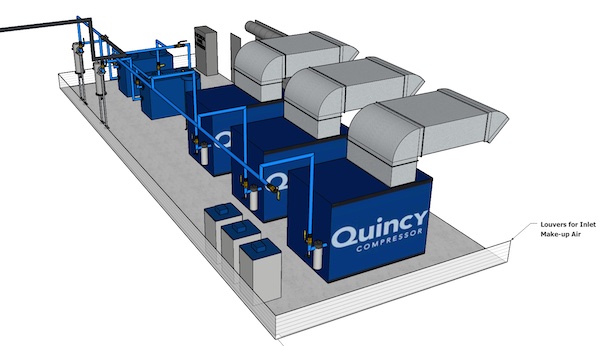
The plans for the new air compressor room included louvres and a sloped roof for better airflow.
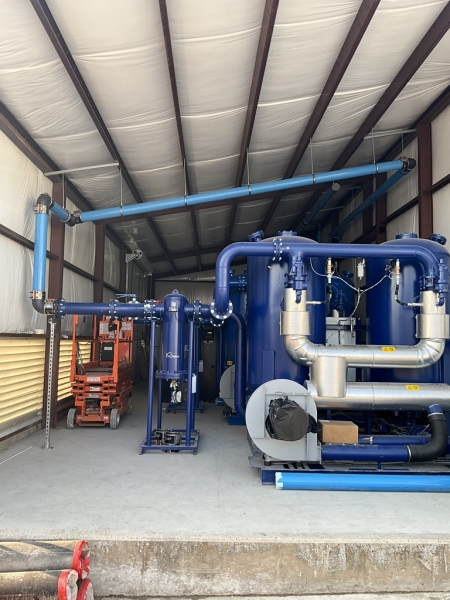
The new air compressor room gives the plant’s air compressors and desiccant compressed air dryers a single home separate from other equipment.
Installing a Compressed Air System Without Interrupting Operations
When the compressed air room was complete, the company brought the new compressed air system online while the old one was still working, and connected drops one at a time. The process took a month and a half.
“We worked around their schedule,” said Simon. “Whenever they had a cleaning or preventative maintenance on their process equipment, they let us know the dates and the rooms that would be available. We never shut them down.”
Once the plant was switched to the new compressed air system, the company sent its technicians back into the interstitial, but this time to cut out and remove the old compressed air piping. Leaving it in would make future maintenance or expansion a challenge, so the company removed the old piping when it was no longer needed. At the end of the project, the rental air compressor was no longer needed, either.
The company eliminated the industrial blowers and connected the air knives to the compressed air system. The air knives’ output was in direct contact with food, and so it needed to meet a certain level of purity. Connecting the air knives to the already sanitary compressed air system made the most sense.
With the rebuilt compressed air system now more efficient, the company’s last step was to ensure it stayed that way in the future. It met with plant management to explain what should happen in the future.
“We educated the customer on the new system and gave them the compressed air system drawing once the project was complete,” Suslaev said. “We explained, ‘Anytime you have somebody come in after this and make modifications to the compressed air system, please make sure you get updated as-built drawings. You have a fluid system. You constantly upgrade equipment. Here's the CAD file. If you need help updating it, we can help.’” The plant has its own maintenance team, plus a contract with Quincy Compressors to provide routine maintenance to the air compressors.
Calculating energy savings for the project is difficult, as the plant upgraded its process equipment at the same time this work took place. However, the company was able to meet the increased production needs with fewer air compressors and provide a scalable system to accommodate future growth.
About ADG Concepts
ADG Concepts partners with industrial customers to develop customized solutions that exceed expectations and deliver a high level of quality. The company strives not only to solve problems but also to build lasting relationships. For more, visit https://www.adgconcepts.com.
To read similar Piping System Assessment articles, visit https://www.airbestpractices.com/system-assessments/piping-storage.
Visit our Webinar Archives to listen to expert presentations on Piping System Assessments at https://www.airbestpractices.com/webinars.