
With a first principles approach, small investments lead to big savings
Energy efficiency and decarbonization in industrial processes are becoming increasingly important priorities for businesses seeking to reduce operational costs, meet sustainability goals and maintain a competitive edge. Compressed air systems are essential in many industrial applications. However, these systems are known for high energy consumption.
Focusing on first principles and taking a holistic view of system performance can offer significant potential for cost savings. This article explores the importance of understanding the key system parameters driving the overall efficiency of positive displacement air compressor systems. We will also review two case studies to illustrate how low-tech, low-cost system improvements can lead to significant energy savings and performance improvements.
First Principles and Key Parameters
Table 1 highlights four key parameters that directly impact the efficiency, performance and, ultimately, operating cost of a positive displacement compressed air system.
| Parameter | Description |
| Volumetric Flow | Total volumetric flow is dependent on the actual volumetric rate of flow required by the process, typically known in North America as actual cubic feet per minute (ACFM). |
| Isentropic Efficiency | The a measure of the efficiency of the air compression relative to ideal conditions; usually found on Compressed Air and Gas Institute (CAGI) performance worksheets. |
| Pressure Ratio | Pressure ratio, often known as pressure head or pressure lift refers to the ratio of the output generation pressure to the incoming inlet air pressure ratio. |
| Air Density | Positive displacement compressors are volumetric systems that compress a specific volume of air per unit of time, irrespective of the properties of the incoming air. However, the pressure developed in the system is determined by the mass of air that is delivered which is directly related to the air density. Air density, in turn, is impacted by the ambient inlet pressure, temperature and moisture content. |
Table 1.
Factors 1, 3 and 4 can be optimized without any upgrade to the air compressors in the system, however all of these factors should be considered when optimizing for energy efficient performance.
Optimizing the system volumetric flow will focus on decreasing actual air demand from the process requirements in the system, which will directly reduce the actual power required in a linear fashion. A 10% reduction in air demand will result in a 10% reduction in energy consumption. Common examples for reducing volumetric flow include identifying and repairing leaks, reducing un-necessary air use such as unregulated blow-off guns and eliminating, where possible, the use of compressed air completely such as implementing electric blowers in place of compressed air for drying applications. In addition, when we discuss reducing system generation pressure later on, we will highlight how reducing the system pressure also reduces the unregulated demand in the system. This further reduces the volumetric flow and power requirements in a linear manner.
Optimizing isentropic efficiency is only possible when selecting new air compressors. Isentropic efficiency is the ratio of actual energy consumption required to ideal, zero-loss isentropic energy, and is a measure of how close the actual compression process comes to an idealized zero-loss compression process. An air compressor with higher isentropic efficiency will reduce the required input power across all flows and pressure ranges relative to a compressor with the same capacity but with a lower isentropic efficiency. This measure is comparable across pressure and flow levels and is a clearer indication of actual efficiency than the specific power (kW/100 acfm) values.
Optimizing the pressure ratio, pressure lift or head by reducing output or generation pressure relative to inlet pressure can deliver significant energy savings. Typically, this can be accomplished through improved controls and reducing the pressure drop within piping systems, as well as increasing the system volume to reduce the impact of short-term peak flow events. As will be discussed in the case studies, increasing system volume reduces the impact of pressure gradients in the system. This allows the system to avoid low pressure events related to peak flow events, which can then allow for lower overall system control pressures. Finally, it is important to consider the location and design of the inlet air ducting. Contamination of inlet air filters from dirt and dust, as well as poorly designed inlet air ducting causes pressure drops which lowers the actual inlet air pressure and increases the pressure lift the air compressor has to deliver. As discussed earlier, there is a bonus energy efficiency gain that comes from reducing the outlet generation pressure since this also reduces losses from unregulated demand in the system. Any output, including leaks, that uses compressed air at system pressure will consume less at lower system pressure.
Since positive displacement machines are volumetric flow devices in principle, they produce a certain volume of flow regardless of the actual mass content per unit volume or density of the ambient air. However, pressure in the system is related through the ideal gas law to the mass of air being delivered to the system. Optimizing inlet air density means focusing on cooler and dryer inlet air and also reducing pressure drops at the inlet. Since the majority of input power to an air compressor is lost as heat, compressor rooms are typically warm. This measure is often implemented by routing the air inlet for the air compressors or the air compressor room outdoors to obtain cooler and ideally lower humidity air (ensure the air inlet for the air compressors is not located close to high humidity areas such as evaporative cooling towers). High ambient humidity results in more water vapor being entrained in the air flow which, when removed in the air treatment process, also reduces outlet pressure since part of the pressure is exerted by the water vapor.
The Role of System Volume
One of the most critical, yet often overlooked, factors in optimizing compressed air systems is the role of system volume, which refers to the total volume of the entire compressed air system, including receiver tanks and piping.
The relationship between pressure, system, volume and time can be derived from Boyle’s law as shown in Figure 1. When the consumption of air flow by the process increases faster than the air compressors supply air to the system, the system pressure can drop quickly and trigger other air compressors in the system to start running causing unnecessary energy consumption. Figure 1 shows by increasing the system volume (usually by adding receivers or piping), the rate of change in system pressure over time can be permanently reduced or dampened, leading to a more stable operation.
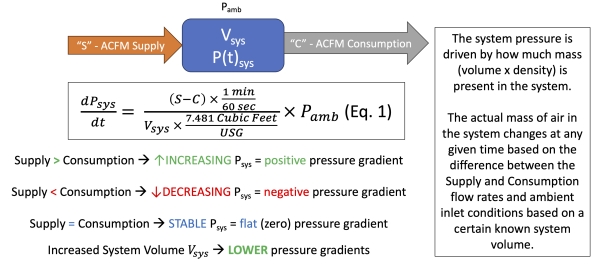
We will look at the impact of system volume on improving the energy performance of compressed air systems in the following two case studies.
Case Study 1: Energy Reduction Through Additional System Volume
A facility used a 240-horsepower (hp), variable speed drive (VSD) air compressor and a 150-hp, fixed-speed, rotary screw compressor for 17 hours per day. The system experienced ongoing intermittent low-pressure events related to short-term peak air flow demand, which led to both air compressors operating when the capacity of the VSD was actually sufficient to satisfy system flow requirements. For much of the time, the 150-hp, fixed-speed machine shows intermittent and inefficient unloading behavior with the VSD air compressor running at the lower and less efficient range of its capacity. Essentially, both machines are trying to control the pressure in the system.
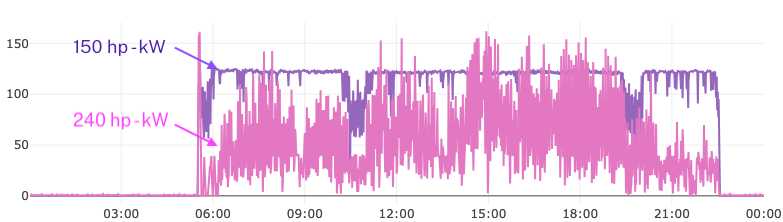
Through modeling of the system, adding an additional 800 USG of volume to the system was found to deliver a more stable pressure response. This allowed the 240-hp, VSD air compressor to handle 95% of the system demand within an appropriate pressure band, even during peak flow periods, without the need for the 150-hp air compressor to engage as often. As a result, the modeling showed a 5.3% reduction in energy use, a 5.6% reduction in demand and a 6.5% improvement in specific power. Annual cost savings were almost $38,000 (not including maintenance and equipment life savings from lower operating hours for the 150-hp machine). Conservatively estimating $7,000 for the purchase and installation of the 800 USG receiver would make the payback time less than three months.
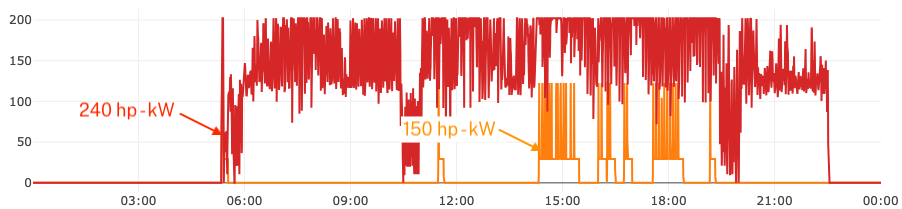
The addition of volume also improved pressure control, eliminating low-pressure events, and suggesting average generation pressure could be lowered for further gains.
Case Study 2: Significant Cost Savings with Increased System Volume
The second case study involved a system with two rotary screw air compressors, one 300-hp and one 200-hp, both with inlet valve modulation control. The system started with a total volume of 900 USG, which included a 600 gallon receiver tank. During peak flow events (labelled “A” below), system pressure would drop causing the 200-hp air compressor to engage unnecessarily. Both air compressors would then continue to operate in modulation mode, leading to inefficient operation and increased energy costs.
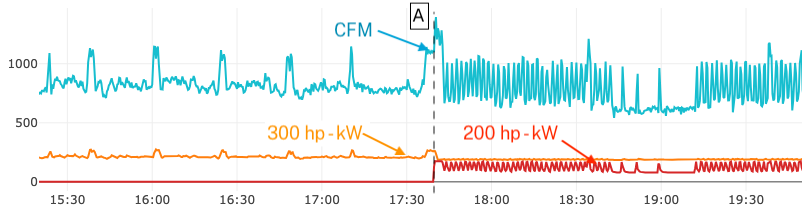
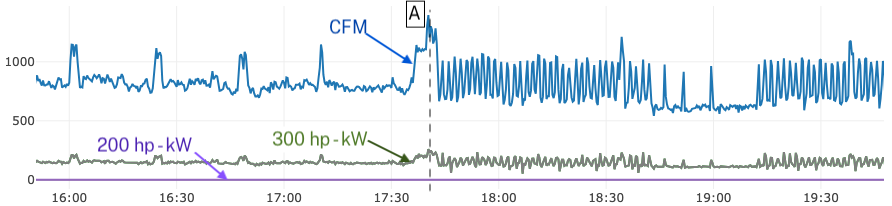
By increasing the system volume to 3,000 USG, modeling indicates the 300-hp air compressor would be able to handle the system’s demand during peak events without driving the pressure below the load point for the 200-hp air compressor. The modeling indicates a potential 46.3% reduction in energy use since the 200-hp air compressor is now completely off most of the time, which would save the facility $160,000 annually. Additionally, there would be a 48% reduction in demand and a 45.8% improvement in specific power. Getting 3,000 USG of volume in the system would probably cost less than $30,000 installed, again offering a payback time of less than three months.
The increased system volume reduced the intermittent low pressure events observed in the base case data, allowing for a 6.1% reduction in system pressure, further contributing to the overall efficiency of the system. Wear and tear on the air compressors would be significantly reduced, leading to lower maintenance costs and extended equipment life.
Conclusion
Optimizing compressed air systems through the management of key parameters including the pressure ratio, actual volumetric flow use, inlet air density and system volume will drive improvements in energy efficiency, cost savings and system reliability. By focusing on the fundamental principles that drive system performance, compressed air users can often achieve significant gains without the need for costly equipment upgrades.
About the Author
Andrew Smith-Carrier is a Mechanical Engineer who has been working in industrial energy efficiency with a focus on compressed air for over 15 years, currently through SMARTCAir.
About SMARTCAir
SMARTCAir is a Simulation, Modeling and Reporting Tool focused on the application of a first principles approach to the timely, cost-effective and independent analysis of compressed air systems. For more information, visit https://smartcair.com.
To read similar Air Compressor articles, visit https://www.airbestpractices.com/technology/air-compressors.
Visit our Webinar Archives to listen to expert presentations on Compressed Air Systems at https://www.airbestpractices.com/webinars.
