In modern manufacturing, efficiency is no longer a luxury – it's a necessity. Aluminum plants, with their complex machinery and high energy demands, are always seeking ways to optimize performance and reduce operational costs. One such opportunity presented itself in a continuous casting house of a major aluminum production plant in Turkey, where a seemingly routine application of compressed air was silently consuming significant energy and money.
This plant operated eight continuous casting lines producing high-quality aluminum coils for downstream processes. As with any high-speed manufacturing line, it included critical control points designed to ensure product quality. Compressed air was used in one of these stages to remove scrap aluminum pieces from the coil path. What initially seemed like a minor use of compressed air soon revealed itself as a major source of inefficiency.
This article explores how a focused engineering intervention driven by data and a clear understanding of process requirements led to a transformative change. By switching from traditional compressed air systems to low-pressure industrial blowers the plant not only maintained product quality, but also achieved a dramatic reduction in energy use saving nearly \$455,000 annually (all amounts converted to USD).
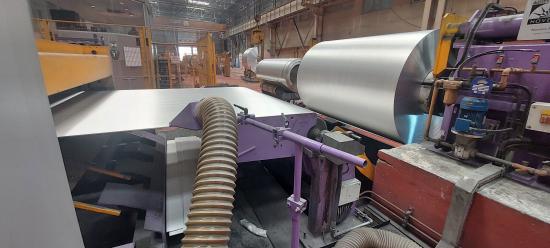
The continuous casting house of a major aluminum production plant in Turkey.
Understanding the Process: Where and Why Blowoff Is Needed
In a continuous casting line, every element plays a vital role in shaping the final product, and even small inefficiencies can have far-reaching consequences. After molten aluminum passes through twin-roll casting, it solidifies into a thin, wide strip. To ensure the coil edges meet surface quality standards, side cutters are employed immediately after the casting section. These cutters trim off the rough edges, generating small aluminum scraps.
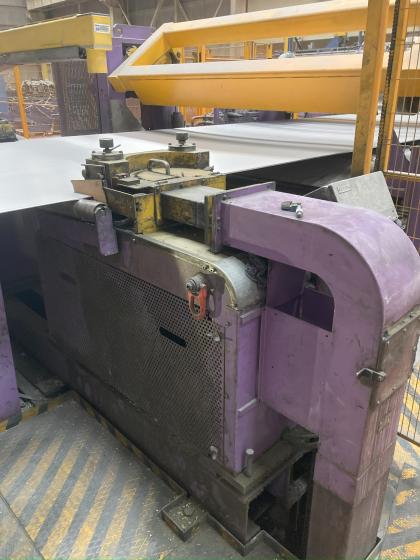
This edge trimmer removes excess material from the sides of aluminum sheets to ensure a uniform width and clean edges.
Further down the line, just before the coiler that rolls the finished strip, are deflector rolls. Deflector rolls guide the aluminum strip into the coiler, ensuring alignment and tension control. However, there's a critical risk here: If any small aluminum pieces from the side cutting operation aren’t properly removed, they can travel with the strip and become embedded in the coil. This contamination becomes a serious issue during cold rolling, where surface quality is paramount. To avoid damaging the machinery or the aluminum strip, the cold rolling line slows down or even halts when contamination occurs, causing costly production interruptions.
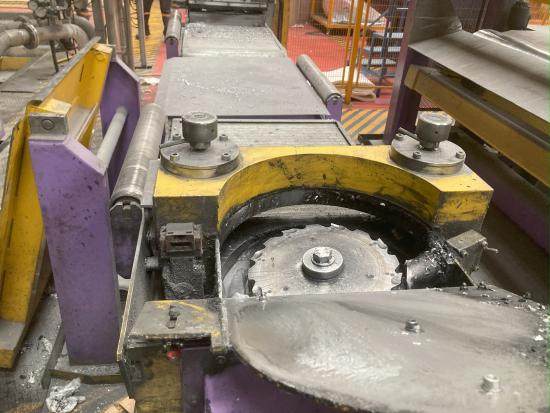
If the trimmed aluminum scraps aren’t blown away, they’ll get caught and wrapped into the foil during rolling.
To prevent this, the plant used compressed air to blow away the cut pieces of aluminum before they reached the deflector rolls. Air jets are essential for protecting the product and downstream equipment. However, the solution came at a cost: A surprisingly high volume of compressed air was being used to perform a task that only required low-pressure air.
This mismatch between process need and energy input opened the door to a deeper investigation and a smarter solution.
High Compressed Air Demand for a Simple Task
At first glance, using compressed air to blow away aluminum scraps seemed like a standard, even modest, application. However, a closer look revealed a significant inefficiency hidden in plain sight.
Measurements taken at the deflector roll stations showed each continuous casting line consumed approximately 412 cfm (700 cubic meters per hour) of compressed air for this cleaning task. With eight lines operating simultaneously, the total compressed air demand reached a staggering 3,296 cfm (5,600 m³/h ) – a volume far greater than expected for what was essentially a simple blowing operation.
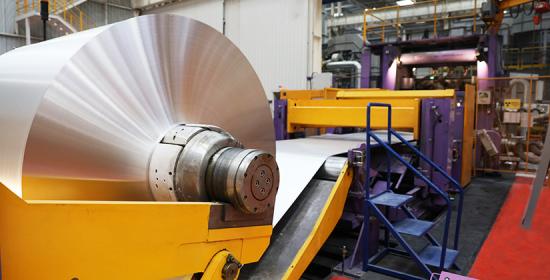
Deflector rolls ensure accurate foil alignment, maintain proper tension and guide the aluminum strip smoothly before final coiling.
The plant’s compressed air was supplied by three centralized 335 horsepower rotary screw air compressors, each capable of producing 1,350 cfm. These machines were operating at 102 psi (7 bar), far more than was required to move lightweight aluminum pieces. Yet, because the compressed air system was already in place and functional, it had gone unchallenged for years.
According to standard calculations provided by leading air compressor manufacturers, generating 3,296 cfm (5,600 m³/h) of compressed air at 102 psi (7 bar) with 70% efficiency would require roughly 825 kW (kilowatts) of power per hour. This substantial energy consumption was a serious ongoing cost for a task that didn’t even require compressed air, just high volume and consistent flow.
The problem was clear: Compressed air was being used where it wasn't needed. The next step was to find an alternative that could deliver the same functionality with lower energy input. That’s where the innovation began.
The Solution: Replacing Compressed Air with Industrial Blowers
Once it was clear compressed air was being used for a low-pressure task, the focus shifted to finding a more efficient solution, one that delivered the same airflow with less energy use.
The plant’s engineering team identified industrial blower technology as a strong alternative. Unlike air compressors, industrial blowers are designed to move large volumes of air at low pressure, making them ideal for applications like removing lightweight aluminum scraps. Among several options on the market, a belt-driven, single-stage centrifugal blower emerged as the best fit.
This industrial blower is capable of delivering 700 cfm (1,189 m³/h) of airflow at 0.7 psi (45 millibars) using 4 kW of power. Even when factoring in 66% system efficiency, this translated to an effective output of around 462 cfm (785 m³/h) per unit, which is more than enough to replace the 412 cfm (700 m³/h) of compressed air previously required for each casting line.
By installing one industrial blower per line, the plant eliminated the need for compressed air in this application. The total industrial blower energy requirement dropped to 32 kW for all eight lines, compared to the previous 825 kW drawn by the air compressors.
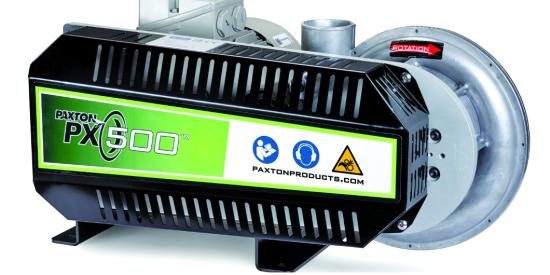
SolvAir PX500 centrifugal blower.
This simple switch not only ensured continued functionality on the production line, but also unlocked enormous energy savings. It showed how matching the right tool to the task yields results far beyond expectations.
Energy Savings and Financial Impact
The switch from a compressed air to an industrial blower system in the continuous casting lines brought immediate and measurable improvements in energy efficiency and cost savings.
Before the change, the eight casting lines consumed around 825 kW per hour to operate the compressed air system for aluminum scrap removal. After replacing this system with industrial blowers, total energy consumption dropped to 32 kW per hour. That’s a reduction of 793 kW every hour the lines ran.
With an industrial electricity rate of \$0.072 per kWh, the plant had been spending nearly \$57 per hour on this single application. Post-upgrade, the cost dropped to less than \$2 per hour. Spread over 8,000 operating hours per year, this resulted in an annual savings of over \$455,000.
This change also enhanced the efficiency of subsequent operations in the cold rolling mills. In cold rolling, the process speed can drop to half if aluminum particles remain on the surface after casting. With cleaner, well-prepared rolled aluminum thanks to the improved industrial blower system, cold rolling can now run at nearly double speed, significantly boosting productivity.
The switch to industrial blowers also helped reduce strain on the plant’s central compressed air system, freeing up capacity for other critical applications and improving system reliability. Additionally, industrial blower systems typically require less maintenance and experience fewer leaks than compressed air lines, offering long-term operational benefits.
This project demonstrated that even seemingly minor adjustments – when backed by data and thoughtful engineering – can drive significant improvements in sustainability and bottom-line performance.
Conclusion: Rethinking Air Use in Industry
Compressed air is a convenient and versatile utility embedded in industrial operations. However, in the case of this aluminum continuous casting plant, it wasn’t the best or most efficient solution.
What started as a routine observation led to a transformative change. A critical look at one specific application revealed an opportunity for energy savings. By shifting from high-pressure compressed air to low-pressure, high-volume industrial blowers, the plant not only preserved product quality and process reliability, but also unlocked over \$455,000 in annual savings.
This experience offers a powerful lesson: In energy-intensive industries, it pays to challenge assumptions. Every piece of equipment and utility used on the production floor should be continually re-evaluated against today’s technology and efficiency standards. For tasks that don’t require compressed air but only need airflow or motion, alternatives like industrial blower systems can be game-changers.
Sustainability doesn't always require massive investments or complex systems. Sometimes, sustainability begins with a simple question: Is there a smarter way to do this?
This is a reminder to engineers, plant managers, and decision-makers alike: Compressed air should be treated like any other valuable resource, and not wasted when it isn’t needed.
About the Author

Alper Alten is the Founder and Engineering Consultant for AAPM Project Management and Consulting in Turkey. He’s a Mechanical Engineer who graduated from the Technical University of Berlin with extensive experience in industrial projects across Germany and the United States. He has held senior roles as a Project Manager and Maintenance Manager in industrial operations in Turkey.
About AAPM Project Management and Consulting
The company provides consultancy services for national and international clients, implementing and managing projects. For more information, visit https://www.aapm.com.tr.
To read articles on Industrial Blowers, please visit https://www.blowervacuumbestpractices.com/technology/industrial-blowers.
For expert presentations, visit our Webinar Archive Section dedicated to Industrial Blowers at https://www.blowervacuumbestpractices.com/magazine/webinars.