Four Case Studies
Whatever kind of plant you operate, you likely have varying needs for air at different pressure levels and flow rates to support multiple industrial processes. What businesses really care about is getting air into the pipe reliably and, in most cases, at the lowest possible total cost to the business. As blower, vacuum pump and compressed air technologies have evolved, so too have the business models surrounding these products. Historically, companies used capital dollars to acquire the blowers, vacuum pumps and air compressors required by their plants and then established a maintenance strategy.
Today, business models around getting air in the pipe have evolved such that plants no longer need to use budgeted capital dollars to meet their air needs. They can rent the assets they need or enter into long-term supply contracts to receive air as if it were a subscription service or a paid utility like electricity, natural gas or water. Long-term supply contracts are often referred to as “air-over-the-fence.” Each of these approaches has its own pros and cons. This article aims to explore those business approaches to getting air in the pipe reliably and explore some of the pros and cons associated with each method.
Purchase the Required Blower and Compressed Air Assets
Companies purchase the blower, vacuum pump or compressed air assets they need and establish a preventative maintenance plan, either using in-house personnel or third parties.
|
Pros
|
Cons
|
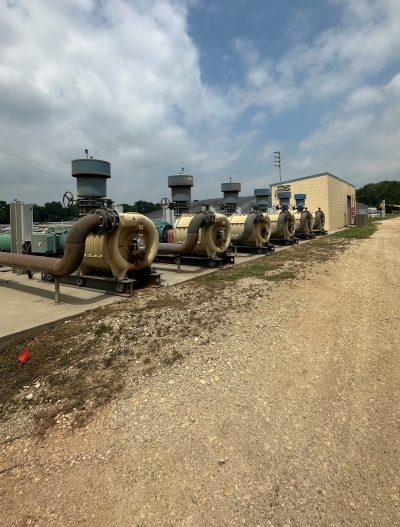
These multi-stage centrifugal blowers are permanently installed and owned by a water treatment plant in Texas.
Renting Required Blower and Compressed Air Assets
Rental companies invest in the same type of blower and compressed air assets that companies purchase. Reputable rental companies have these assets tested, staged and ready for immediate shipment 24/7. Rental is most often used to supplement a purchased asset strategy where the air provided by a rental asset is needed for a short period of time. In some cases, plants rely entirely on rented assets to meet their air needs.
|
Pros
|
Cons
|
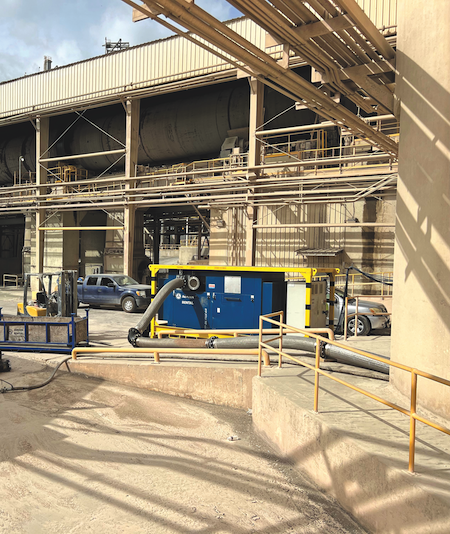
A cement plant in Texas relied on a rented industrial blower to replace a rented diesel air compressor while awaiting permanently installed units.
Air-Over-the-Fence (AOF) for Air Subscriptions
With AOF, third-party companies own and maintain their own assets to deliver air to industrial plants on a subscription basis (a flat rate per month) or a pay-per-use basis (typically a minimum base charge plus a per cfm usage charge). Air in the pipe availability is typically guaranteed with liquidated damages if the specified air cannot be provided. Although these liquidated damages are not based on the cost of lost production in the plant, they are steep enough to motivate the AOF provider to respond with urgency if their equipment is not operable. Liquidated damages are typically not immediate; most AOF providers are afforded a timeframe within which they must remedy any issues – typically, 24 hours.
|
Pros
|
Cons
|
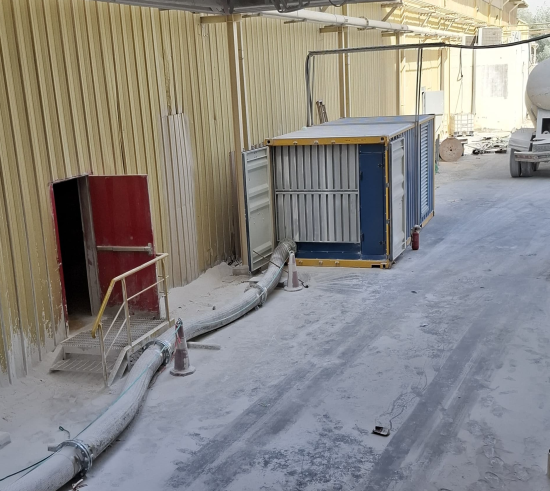
A gypsum plant in Saudi Arabia used a rental air compressor while waiting on purchased air compressors that would be permanently installed.
Looking Beyond the Price Tag for Blowers and Air Compressors
If purchasing blowers or air compressors is likely the cheapest option, why would businesses consider rentals or AOF?
Availability of capital dollars. Many companies prioritize their capital investments based on those projects that carry the largest ROI. Capital projects to add production equipment or debottleneck processes lead to increased plant throughput and a direct top-line revenue impact. These projects are ranked as a much better way to invest available resources, leaving funds for rentals or AOF to be considered batch costs that are accounted for in the company’s gross margins. With only so much money available to be invested in a business, prioritizing projects with a tangible ROI may be a better use of company funds than spending on critical infrastructure assets.
Rental as a supplement. Most plants that rent do so for a short term to get through a transition period with their purchased assets. Renting can allow for a faster production ramp-up or provide air during a planned or unplanned outage with a purchased asset.
Headcount and focus. Some companies view a long-term rental or AOF strategy as a means of minimizing the number of employees needed to maintain the assets, allowing employees to focus on production equipment directly related to achieving production goals and improving plant throughput. These companies value having their employees develop expertise and maintain their focus on those assets most directly related to their products while outsourcing commodity infrastructure needs like the air flow provided by blowers, vacuum pumps and air compressors.
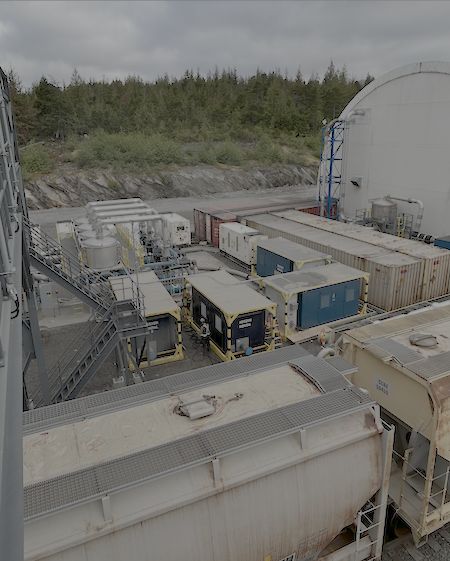
These vacuum blowers were rented while permanently installed vacuum blowers were on order.
Case Study: Auto Manufacturer Makes a Badly Timed Decision
An automotive manufacturing plant in the Midwest transitioned from owning and maintaining assets to a 15-year AOF contract. This plant employed several thousand people at its peak and operated with a high cost of downtime. It preferred to completely outsource its air needs to an AOF supplier.
The scope of the AOF contract included a dedicated compressed air building, all electrical switchgear infrastructure designed with n+1 redundancy (including automatic power transfer with independent power feeds from separate 11 kV substations), liquidated damages for inability to meet the contracted compressed air guarantee, efficiency guarantees on measured compressed air delivered vs electricity consumed and air quality guarantees around dewpoint and oil carryover. The contract required a guaranteed compressed air flow of over 32,000 scfm at a dewpoint of -40° F (-40°C) and at class 0 quality. The AOF supplier designed the facility to include centrifugal air compressors and heated blower purge desiccant compressed air dryers with n+1 redundancy at the peak contractual guarantee point.
Approximately two years into the 15-year agreement, the plant’s production needs changed drastically due to changes in technology that allowed it to produce products using far less compressed air. Its compressed air needs dropped from a daily average of 30,000 scfm to only 8,000 scfm. The plant attempted to renegotiate the AOF supply contract, but, given the rigid nature of the contract and the large capital investment the AOF supplier made to build the facility, the AOF supplier politely declined to consider a renegotiated price. The plant was stuck with the contract for the remaining 13 years with no ability to reduce costs. What the plant paid to the AOF supplier over that 13-year period was estimated to be about six times the cost of purchasing and maintaining the assets needed to maintain the reduced production needs.
The takeaway: Rigid AOF contracts are not advisable if business conditions may change through the life of the contract.
Case Study: Water Services Provider Switches from Rentals to AOF
A water services provider in the Southeast relied on approximately 25,000 scfm of air at 10-12 psi (0.7-0.8 barg) for its diffused aeration system. However, the facility was understaffed and overwhelmed with maintenance demands across its various process components. The facility frequently experienced major failures with its seven permanently installed tri-lobe aeration blowers, often resorting to cannibalizing parts from one machine to keep another operational. Eventually, it became impossible to maintain enough functioning aeration blowers to support the required production levels.
To address the shortfall, rental aeration blowers were brought in. After observing the reliability of the aeration blowers and responsiveness of the rental provider, the facility decided to remove its permanently installed aeration blowers and replace the full 35,000 scfm capacity with seven 5,000 scfm rental aeration blowers.
As time passed and the facility realized the benefits of improved reliability and reduced maintenance time spent on the aeration blower system, it decided this strategy of an outsourced aeration blower system aligned with its long-term needs. It sought opportunities to reduce its costs. This led it to explore AOF. Implementing a five-year AOF contract took about two years from idea to implementation due to protracted contract negotiations and long equipment sourcing and installation lead times from the AOF supplier.
In the end, the facility not only reduced its monthly third-party vendor spending but also gained a liquidated damage-backed delivery guarantee. In addition, it was able to realize energy savings as the AOF supplier provided rotary screw aeration blower technology instead of the tri-lobe aeration blowers offered by the rental company. The new aeration blower system is projected to save the facility over $1 million during the five-year contract.
The takeaway: An AOF provider will do the same work that a reputable rental company will do, but at a lower price and with contractual performance guarantees for companies with long-term stability in their process needs and a willingness to enter into a rigid contract.
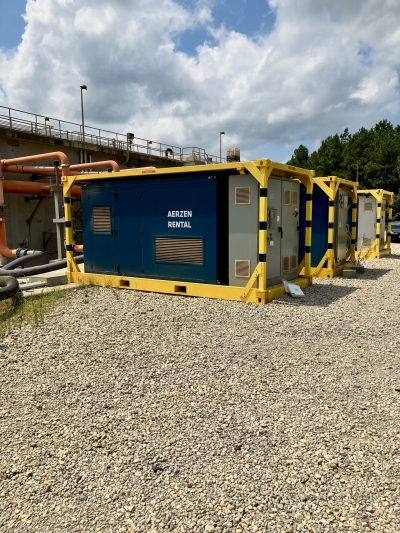
Due to protracted negotiations, a water services provider in the Southeast used these rental air compressors for two years while negotiating an AOF contract.
Case Study: Building Materials Plant Pays for Artificial Load
A building materials plant in the Southwest transitioned its compressed air system to an AOF system with five 400 hp oil-flooded air compressors, plus desiccant compressed air dryers able to deliver 7500 scfm of compressed air at -40°F (-40°C) dewpoint. The commercial terms had the plant paying for compressed air usage through a continuous measurement of air compressor energy consumption. The underlying premise was that the energy consumption of an air compressor is directly related to the volume of compressed air it produces when loaded.
An independent study of the supply and demand side of the compressed air within the plant found several AOF air compressors with compressed air filters near fully plugged and with little to no compressed air actually delivered, yet pulling full load current. Because the plant was paying for usage based on current draw, it paid for artificial air compressor load. After changing the compressed air filters, one of the five units was able to be turned off. This saved the plant $23,000 per month in energy and removed the usage expense paid to the AOF supplier.
The takeaway: Budgeting for the use of an independent auditor is a best practice to ensure conflicts of interest are avoided with AOF providers.

These rental air compressors were used temporarily while permanently installed air compressors were on order.
Case Study: Insulation Products Plant Rents Blowers as Needed
An insulation products plant in the Southeast suffered from a lack of reliability and high maintenance costs due to frequent major component failures in its purchased industrial blower assets. Its business also experienced a period of considerable volatility around product demand, causing it to be protective of capital expenditures even when needing to maintain product delivery schedule targets. To supplement its immediate needs, the plant rented two variable frequency drive (VFD) blowers capable of operating between 700 and 1800 scfm, while controlling to maintain a header pressure of 15 psi. Over the years, it added blowers when demand was high, eventually reaching a peak of six rental blower units. It scaled back to as few as two blowers when demand was low.
The takeaway: Rental blowers and air compressors can be a viable avenue to provide air needs to a plant when the production needs are unpredictable and there is a desire to protect capital expenditures while avoiding long-term contractual commitments.
Conclusion
This author happens to have a career’s worth of experience in the blower, vacuum and compressed air spaces but this article could just as easily have been written about chilled water, steam, nitrogen or any of the other industrial utilities that are provided by assets a plant purchases with capital dollars to support its needs.
There is no single right approach to putting the necessary volume and pressure of air in the pipe to meet production needs. There is a place for purchasing assets, there is a place for renting assets and there is a place for an AOF contract. Just as the business models around these assets change, so do the needs of an industrial plant. What may have worked for the last 10 years may not work for the next 10. Only the plants themselves can evaluate the pros and cons of each option while weighing the goals and financial metrics of the organization to determine what is best for their businesses going forward.
About the Author

Matt Piedmonte is the Vice President and General Manager of Aerzen Rental Solutions in the Americas.
About Aerzen Rental Solutions
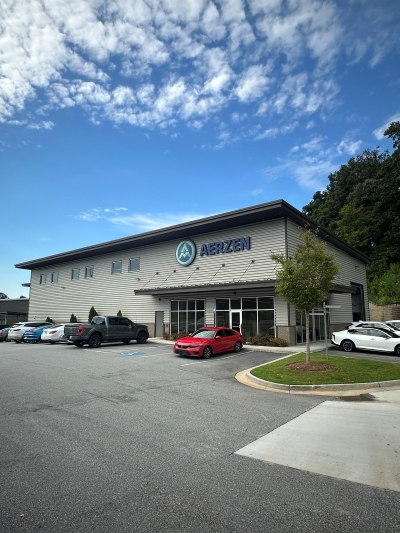
Aerzen Rental Solutions’ U.S. headquarters in Atlanta, GA.
Aerzen Rental Solutions was founded in 2018 and specializes in temporary blower and air compressor solutions under 50 psig. With locations in Phoenix, AZ and Atlanta, GA, it’s positioned to deliver rental solutions within one day to any location in the continental United States. Its rental blower and air compressor solutions use technology developed and advanced over 160 years by Aerzener Maschinenfabrik GmbH, based in Aerzen, Germany. It also specializes in Rental Retrievable Diffused Aeration Grids, which were developed in partnership with affiliate company Aquarius Technologies, based in Saukville, WI. For more information, visit https://www.aerzen.com/us/rental-solutions/about-us.
To read similar articles on Industrial Blower Technology, please visit
https://www.airbestpractices.com/technology/blowers.
Visit our Webinar Archives to listen to expert presentations on Industrial Blower Technology at https://www.airbestpractices.com/webinars.