
The advantages of two-stage rotary screw air compressors are well-known and were the subject of an excellent article in Compressed Air Best Practices® Magazine (“The Pros and Cons of Single-Stage and Two-Stage Air Compressors,” July 29, 2020). However, because two-stage rotary screw air compressors at that time were only available in large horsepower options (100 hp and above), the advantages of two-stage rotary screw air compressors were often ignored because large horsepower two-stage rotary screw air compressors were much more expensive than single-stage, as well as the fact that most air compressors sold are lower horsepower.
Recently, low horsepower two-stage rotary screw air compressors have been introduced into the market (30 hp and above) with pricing much closer to their single-stage counterparts, which makes revisiting this issue worthwhile. Adding to the importance is the implementation of the U.S. Department of Energy’s Title 10, Part 431, Subpart U rules, which require testing of rotary screw air compressors to meet isentropic efficiency standards. As will be shown here, two-stage rotary screw air compressors will certainly meet or exceed future isentropic efficiency requirements.
Industrial manufacturing environments demand high-performance compressed air systems that balance operational efficiency, reliability and energy consumption. Two-stage rotary screw air compressors are a transformative technology, offering substantial advantages over traditional single-stage air compressors, particularly in energy savings and operational performance.
Much of the discussion in this article is theoretical since low-horsepower two-stage air compressors are new to the U.S. market. The calculations used here are based on well-accepted CAGI formulas.
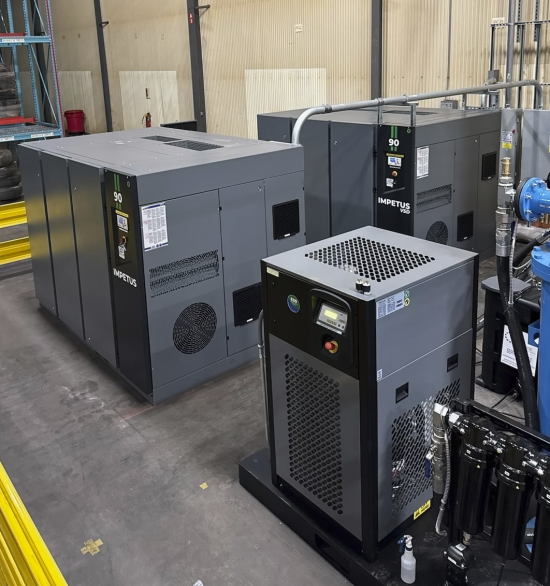
Understanding Two-Stage Air Compression Technology
Two-stage rotary screw air compressors differ fundamentally from single-stage models by implementing a more efficiently designed air compression process. In these systems, air undergoes compression in two distinct stages, with an intercooler between the first and second stages. This allows for more effective and controlled compressed air production.
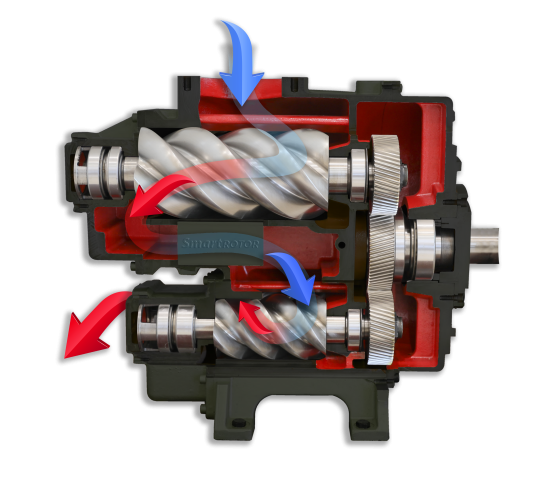
The first stage compresses air to an intermediate pressure level, after which the air passes through an intercooler (usually an oil shower) that reduces the air temperature. Then, the partially compressed air enters the second stage, where it undergoes final compression to the desired pressure. This methodical approach provides several critical advantages for industrial applications.
Energy Efficiency Gains
Two-stage rotary screw compressors demonstrate remarkable energy efficiency compared to their single-stage counterparts. By distributing the air compression workload across two stages, these systems can achieve energy savings ranging from 15% to 25%, translating to significant cost reductions for industrial operations.
The three examples shown in Tables 1, 2 and 3 compare a direct drive single-stage air compressor, a single-stage variable speed air compressor and a two-stage variable speed air compressor. I created a sample load profile for all three, assuming the factory is working 4,000 hours first shift, 1,500 hours second shift and 750 hours third shift. The load profile for the direct drive single-stage air compressor in Table 1 is derived from the Compressed Air Challenge power curve for fixed-speed machines. (See “Optimizing the Specific Power of Part Loaded Systems,” Compressed Air Best Practices® Magazine, June 4, 2012.)
|
Load |
Cfm |
Hrs |
%Load |
% Power |
|
1 |
200 |
4000 |
88% |
97% |
|
2 |
160 |
1500 |
70% |
91% |
|
3 |
110 |
750 |
48% |
80% |
Table 1. Using this load profile, I calculated the total kWh annual usage at about 229.000 kilowatt hours for a direct drive single-stage air compressor.
Table 2 shows a load profile for a single-stage variable speed drive (VSD) rotary screw air compressor. This profile takes isentropic efficiency into account. Based on CAGI data performance publications, approximately 15% more power is required for a typical single-stage VSD rotary screw air compressor to produce the same result as a two-stage VSD rotary screw air compressor.
|
Load |
Cfm |
Hrs |
%Load |
% Power |
|
1 |
200 |
4000 |
92% |
92% |
|
2 |
160 |
1500 |
74% |
74% |
|
3 |
110 |
750 |
51% |
51% |
Table 2. Using this load profile, I calculated the total kWh annual usage at 216.000 kWh for a single-stage VSD rotary screw air compressor.
Table 3 uses the same load profile for a two-stage rotary screw air compressor, with the major difference being the specific power since the rotary screw air compressor is variable speed and the relationship between the %Load and the %Power is linear.
|
Load |
Cfm |
Hrs |
%Load |
% Power |
|
1 |
200 |
4000 |
83% |
83% |
|
2 |
160 |
1500 |
66% |
66% |
|
3 |
110 |
750 |
46% |
46% |
Table 3. In the case of a two-stage rotary screw air compressor, I calculated the total kWh annual usage at 188.500 kilowatt hour.
Using the national average of 15.5 cents per kWh, that’s a savings of approximately $6,000 a year over a single-stage fixed-speed rotary screw air compressor, or $4,200 a year savings over a single-stage VSD rotary screw air compressor. (Electrical costs are much higher in the northeastern U.S. and somewhat lower in the south. Even at 10 cents per kWh, that’s a savings of almost $4,000 per year. And remember, airend warranties are for 10 years.) In just one or two years, an owner will, in most cases, recover the cost differential between a single-stage and a two-stage rotary screw air compressor.
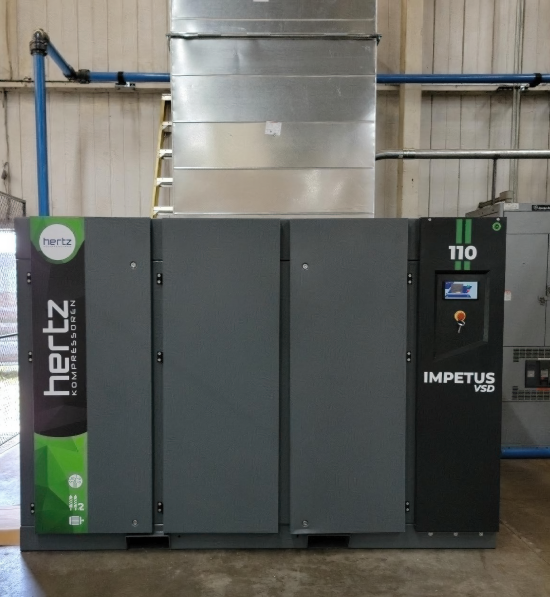
Heat Reduction and Two-Stage Rotary Screw Air Compressors
Heat is the enemy of air compression. The intercooler between compression stages plays a pivotal role in heat reduction and energy optimization. By systematically reducing air temperature during compression, these systems minimize the energy required to achieve target pressures. This temperature management directly correlates to reduced electrical input and enhanced overall system efficiency. Intermediate cooling during the air compression process ensures more stable and consistent compressed air quality. This characteristic is crucial in industrial environments where precision and reliability are paramount, such as pharmaceutical manufacturing, automotive production and precision engineering.
Reduction of Thrust Load
The two-stage rotary screw air compressor design inherently reduces mechanical stress on compression components. By dividing the air compression process, these systems experience lower temperature and pressure extremes, resulting in decreased component wear, extended equipment lifespan, reduced maintenance requirements and lower long-term operational costs. Thrust load can significantly impact the life of an airend in a rotary screw air compressor. The higher thrust loads of single-stage rotary screw air compressors can lead to increased friction and wear on the air compressor's internal components, such as the rotors and bearings. This can reduce the overall lifespan of the airend. Excessive thrust load can cause higher temperatures within the air compressor, which can degrade the lubricating oil and damage seals and other components. Finally, higher thrust loads can reduce the efficiency of the air compression process, leading to higher energy consumption and increased operational costs.
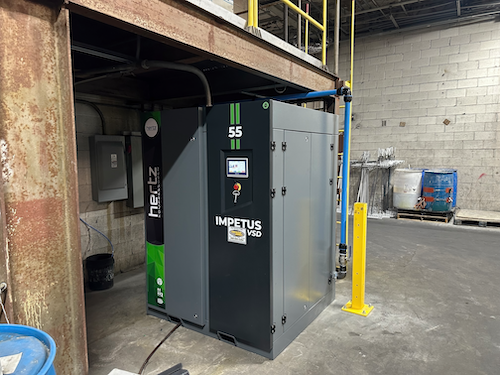
In a single-stage rotary screw air compressor, one stage is responsible for raising the compression from atmospheric to the desired pressure. The following is the formula to calculate the air compression ratio on a single-stage air compressor. (The compression ratio is the relationship between the discharge pressure compared to the inlet pressure. Rotor thrust loads are directly proportional to the air compression ratio.)
125 psia/14.7 psia = 8.5, the compression ratio for a single-stage air compressor with 125 psia as its desired output pressure.
In a two-stage air compressor, the first stage raises the compression to, say, 35 psia resulting in a compression ratio of 2.38. The second stage raises the compression from 35 psia to the desired 125 psia, resulting in a compression ratio of 3.57. Each airend on a two-stage machine is subjected to less than half the compression ratio of a single-stage airend.
35 psia/14.7 psia = 2.38, the compression ratio in the first stage, which raises the air pressure to 35 psia.
125 psia/35 psia = 3.57, the compression ratio in the second stage, which raises the air pressure from 35 psia to 125 psia.
The magnitude and direction of thrust loads directly impact bearing life expectancy, rotor wear patterns, maintenance intervals and overall reliability.
Finally, increased thrust load may necessitate more frequent maintenance and inspections to ensure the air compressor continues to operate effectively and safely.
Isentropic Efficiency
All manufactured rotary screw air compressors are imperfect and inefficient: The friction between the rotors and casing generates heat, there are air leaks between the rotors and housing, there is oil injection into the compressed air and there is constant pressure on seals and bearings – all working together to make an inefficient system. In ideal isentropic air compression, the process would be perfectly reversible with no friction or heat transfer. Entropy would remain constant throughout air compression (no heat would be generated during the air compression process) resulting in the theoretical minimum work performed to achieve a given pressure ratio.
However, no air compressor can achieve 100% isentropic efficiency.
The isentropic efficiency of single-stage rotary screw air compressors, as reported by CAGI data, typically falls between 65% and 75%. Since isentropic efficiency is the ratio of ideal work to actual work, this range suggests these air compressors consume roughly 33% to 54% more power than the theoretical minimum for the given air pressure output.
Using the same CAGI data source, we find two-stage air compressors achieve significantly higher isentropic efficiencies than single-stage air compressors, typically from 80-88%. Using the same formula showing the ratio of ideal work to actual work, two-stage machines require only 14-25% more power to produce the air pressure needed. Two-stage rotary screws run cooler, create less friction and have lower thrust loads, all resulting in higher isentropic efficiency and energy savings.
Conclusion
Two-stage rotary screw air compressors represent an excellent solution for industrial compressed air requirements. By prioritizing energy efficiency, reliability and performance, these systems offer a compelling technological advancement that addresses the complex demands of modern manufacturing environments.
Industrial engineers and facility managers seeking to optimize operational efficiency should strongly consider the benefits of two-stage rotary screw air compression technology. Now that two-stage variable speed air compressors are available at 30 hp and up, two-stage rotary screw air compressors should be the only choice for efficiency and energy savings.

About the Author
Ed Maxwell, CEO, Eastern States Associates, has spent over 50 years selling industrial air compressors in the northeastern U.S.
About Eastern States Associates
Eastern States Associates, headquartered in Palmer, MA, has been selling air compressors in the northeast U.S. for 70 years. Its sales team is located from Maryland to Massachusetts. The company is the exclusive northeastern representative for Hertz-Kompressoren USA, Inc. For more information, visit https://www.easternstates.com.
