Industrial Utility Efficiency

Air Compressors

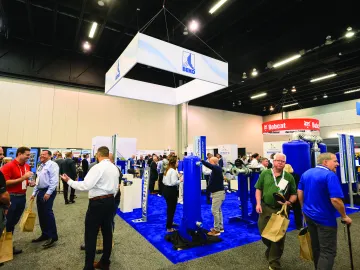
From October 29-31, 2024, professionals who operate, maintain and design industrial compressed air, vacuum, blower, nitrogen generation, process cooling and HVAC systems gathered at the Cobb Galleria Centre in Atlanta, GA, for the 6th annual Best Practices 2024 EXPO & Conference. The event featured two tracks of conference presentations and panels.

The ITER Project Builds on Sauer Helium Compressors

A spectacular vision is gradually becoming reality in Cadarache in the south of France. Modeled on the sun, the ITER (International Thermonuclear Experimental Reactor) fusion system uses nuclear fusion to generate energy in order to secure humanity’s supply of electricity. One of the biggest challenges is the high temperature inside the reactor. Technology by Sauer Compressors is a key factor in cooling the reactor. The manufacturer has supplied the world’s largest system for helium recovery.

Oil-Free Turbo Air Compressors from Finland

Compressed Air Best Practices interviewed Timo Pulkki (CEO), Hannu Heinonen (President, Tamturbo Inc.) and Mike Batchelor (Director of Sales Americas) from Tamturbo. Since the 1960’s, the Tampere region in Finland has been a birthplace of several air compressor innovations – many of which involved Kimmo Laine, a co-founder of Tamturbo. Mr. Laine was a leader in R&D in the air compressor business for many years since the 1960s. This included bringing a high-speed turbo air compressor to market later at Tamturbo. Working together in the 1980’s in a division of Tamrock, called Tamrotor-where Hannu Heinonen also worked, Mr. Laine met a gentleman named Jaakko Säiläkivi.

Compressor Room Advantages with Oil-Free Centrifugal Air Compressors

Today’s industrial manufacturing environment is extremely competitive, requiring companies to constantly search for cost saving opportunities and better efficiencies. In many cases, manufacturers find that centrifugal air compressors are a successful method for reducing the overall plant costs involved in supplying compressed air.

Compressed Air Purification Fundamentals-the Compressor’s Job

The air we breathe and the air compressors ingest is a mixture of gases, aerosols, biological material, and particulates. It’s a real mess! Particulate, for instance, is very harmful to humans, because lungs are complex oxygen separators, not filters. They tend to load up with particulate, this is harmful over time. There isn’t a sufficient “pre-filter” to prevent all harmful particulate from entering the lungs. However, humans prefer water in the air, gas, aerosol, and to a certain level, liquid form. A de-humidifier would not typically be a healthy addition to our built environments.

Applying Centrifugal Air Compressors for Variable Loads

There are many choices of compressor technology and types of controls that can be used for variable demands. Some examples are rotary screw compressors with inlet valve control: variable speed drives: load/unload control; or centrifugal compressors with variable inlet guide vanes. However, in many cases, the efficiency of the overall compression process can be reduced significantly during lower flow demands, leading to more power per unit of air flow being delivered. It is very important to evaluate different available options and see how a plant can run most efficiently.

Centrifugal Air Compressor Controls and Sizing Basics

Larger air compressors, typically over 500 hp, in refineries, pulp and paper plants, chemical and other processing plants often have high-speed, multi-stage air compressors called “centrifugal” air compressors. As seen from a total system perspective, they are not much different than screw air compressors. They compress air to plant pressure from atmospheric conditions, and deliver it to the dryer. These types of air compressors have no internal wearing parts, besides bearings and seals, and are very reliable and efficient, at their best efficiency point. 

Overhauling an Air Compressor: Cost Control, Rigorous Testing and Quality Parts

Knowing when to overhaul a unit is important, and there are certain signs indicating a unit needs attention. Performing routine fluid checks, taking oil samples and routinely checking for bearing vibration can unveil indicators suggesting an upcoming failure. Oil contamination with metal fragments usually indicates parts are wearing. It’s also important to take notice of airend temperature increases. If internal air compressor temperatures go up, it’s a good indicator the cooler may be failing.

Sizing VFD Compressors for Multiple Air Compressor Systems

It is becoming a “best practice” to install a variable frequency drive (VFD) air compressor whenever one is replacing an old air compressor.  As a result, real systems have fixed-speed and VFD air compressors, mixed.  I have observed several VFD compressor sizing methods.  In my last article, I referred to a common method: size one VFD compressor for the whole system.  This can work.  However, if it doesn’t meet a higher peak demand, one or more of the old compressors will be started, and a mixed system results.   Another method is to replace a compressor with the same size, but with a VFD.  If the compressor that was replaced is large, a big VFD is installed.  If small, a small one.

Sizing VFD Air Compressors for Single-Compressor Systems

As an end user, have you ever heard the message to put in the biggest VFD air compressor, and the system will always be reliable and efficient.  Why do an audit?  Just add up the compressors on site and put one VFD for that size or larger.  Why have the complexity of multiple compressors, storage, sequencing, etc?  Even better, put in two of them, one for the whole system, and one for back-up.  If you could wave a wand, wouldn’t that be what every system should look like?  Perfect peace and efficiency, with 100% confidence of reliability.

Analysis of Current Air Compressors and Dryers in a System Assessment

A complete compressed air system assessment should provide detailed information on both the supply and demand sides of the system. The supply-side refers to the equipment supplying compressed air – the air compressor, dryers, filters, piping and storage tanks.  The purpose of this article is to illustrate what information we believe a factory should receive from a supply-side system assessment and more importantly – what information a plant should always know about their compressed air system.