By Rod Smith, Compressed Air Best Practices® Magazine
BSA LifeStructures is a full service architectural and engineering firm specializing in healthcare, higher education and technology facilities. We employ close to 260 associates and are established in two locations; Indianapolis and Chicago. Our strongest focus is on hospitals and university facilities.
By Chris Duffell and Mark White, Parker domnick hunter
The most abundant contaminant in any compressed air system is water. This can be in either liquid or vapour form. Atmospheric air is already very wet, and becomes saturated when compressed. This water vapour will condense when the temperature drops, after the compressor, and will damage air receivers, pipework and equipment. For this reason coalescing filters and then dryers are used to remove the bulk of this water.
By Jay Francis, Americas Sales Manager, Strategic Accounts & Rental Group, SPX FLOW
Hazardous breathing conditions exist in routine industrial operations, such as hospitals, abrasive blasting, paint spraying, industrial cleaning, and arc welding. In these and other operations that introduce contaminants into the workplace, supplied-air respirators are frequently used for worker protection.
A good-size hospital with 200 beds and ten operating rooms can have a medical air system, a laboratory air system, and pneumatic air systems. The medical air systems must all follow the NFPA 99 guidelines. We follow these guidelines, from the beginning, when we assess the demand for air in a hospital.
Compressed Air Best Practices® interviewed Mark Allen (Director of Marketing) of BeaconMedæs.
In the U.S. as an example, the NFPA has taken the view that if your compressor draws in good clean ambient air, the air stays clean through the compressor, is then dried and filtered, when you deliver it to the patient it will be entirely satisfactory. After all, when you went into the hospital that’s what you were breathing and when you leave you will breathe it again!
Sitting on his desk the day Brian began his new job as Plant Engineer for Carbo Ceramics’ McIntyre, GA facility was a proposal to purchase a new 150 HP air compressor as a backup machine. The facility already had six of these machines and, yes, all six ran almost continuously.
By: Alan S. Bandes Vice President, UE Systems, Inc.
The secret to success is to understand the nature of what type of leak produces a detectible ultrasound and what does not, along with the techniques that can be used for effective leak identification.
Industrial plants are major consumers of water. Water is used in many processes. Sustainability projects focus on reducing the consumption of water and the energy-costs associated with cooling water so it may be effectively used.
This aluminum mill spends \$369,000 annually in energy costs to operate their compressed air system. This system assessment recommends actions reducing annual energy costs by \$120,000 and improving productivity and quality by delivering clean, dry compressed air.
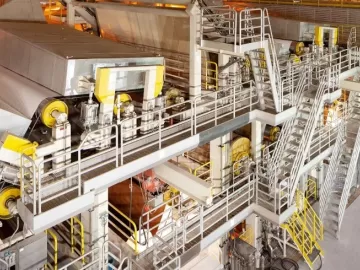
This major mill complex upgraded their compressed air system and thereby eliminated \$500,000 in annual rental compressor costs, reduced annual cooling-water costs by \$500,000, and reduced electrical energy costs by \$135,000 per year.