End Uses

By Nasr Alkadi, Ph.D., CEM, CSRM, Strategic Energy Management Consultant and Coach, CLEAResult

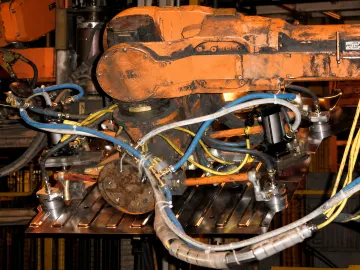
This article focuses on a project to replace vacuum cups with spring-return magnetic pickups for handling ferrous metal parts at an automobile assembly plant in Missouri. The application is most familiar in automotive stamping and body shop operations, but the lesson applies to any plant using vacuum cups to grab steel blanks, panels, brackets or formed parts. The original equipment in this case study used vacuum cups served by venturi devices.

Compressed Air Demand-Side Demons at a PET Bottle-Blowing Plant

By Pete Rhoten, Air Engineering LLC. and Greg Fitzpatrick, Compressed Air Technologies, Inc.

Sometime in mid-2015, I received a call from a project engineer at a major plastics firm. He had a troubling issue with one of his PET bottle plants. The bottom line was this: They could not run all five high production blow-molding machines at one time—even though they were able to do so 18 months previously.

Study Proves Potential Energy Savings of AODD Pump Controls

By Compressed Air Best Practices® Magazine

Air-operated double diaphragm (AODD) pumps are common to many manufacturing facilities. As estimated by veteran compressed air auditor Hank van Ormer of Air Power USA, approximately 85 to 90 percent of plants in the United States have AODD pumps. They are used for all kinds of liquid transfer applications, like those found in chemical manufacturing, wastewater removal, and pumping viscous food products.

Meat Processing Plant Drops Compressed Air Costs 60%

By Ron Marshall for the Compressed Air Challenge®

One of the statements made in the Compressed Air Challenge’s Fundamentals of Compressed Air Systems seminar is that improvements can always be made to every compressed air system, including new ones. The statement definitely applies to a Canadian pork processing facility built a few years ago. This article is based on a compressed air audit performed two years into the life of a brand new plant. The audit found numerous problems and made recommendations that helped reduce plant compressed air operating costs by 60 percent.

What is In-Process Air Gauging?

By Chris Koehn, Air Gaging, LLC.

In recent years, we have seen an upward trend of higher production manufacturers wanting to integrate their air gauging quality checks from a stand-alone, outside-of-machine device where the operator is performing a manual check to an automated in-process gauge. There are several reasons for this trend, including higher quality standards, tighter tolerances, as well as running a leaner operation. The benefits are 100 percent inspection of the required geometric callout, as well as handshaking between measuring device and machine to make each piece better than the prior one. It also removes any bad parts.

Steel Forging Facility Maximizes Investment in Compressed Air System

By Tim Stearns, Senior Energy Consultant, Efficiency Smart®

When a company is considering making an investment of more than a million dollars in system upgrades, it is crucial for them to review all options to get the best return. By exploring energy efficiency impacts throughout the entire compressed air system, vendors can propose projects resulting in both a larger sale for them and increased financial benefits for their customers, while still meeting capital expenditure guidelines. This “best of both worlds” scenario was evident when a foundry in the Midwest was evaluating options for replacing its steam system used to drive the plant’s forging hammers.

Steel Mill Energy Audits Include Air Compressor Performance Testing

By Eric Lee, Senior Engineer, EnSave Inc.

EnSave, an energy auditing company based in Richmond, Vermont, recently performed compressed air audits at two facilities of a leading U.S. steel manufacturer. Both plants are mills that melt, cast, and roll steel to produce a variety of products, including: rebar, merchant bar, steel flats, rounds, fence posts, channel bar, steel channels, steel angles, structural angles and structural channels. These products are used in a diverse group of markets, including: construction, energy, transportation and agriculture. Compressed air is provided at 100 psig in both plants for a variety of applications — from optical sensor cooling to pneumatic cylinders for stacking finished products.

CAPS Inc. Audit Turns Off 100 hp in Air Compressors

By Don Dyck, President, Compressed Air Performance Specialists

Compressed Air Performance Specialists (CAPS Inc.) is a compressed air consultancy located in Calgary, Alberta. In its most recent compressed air project, the company reduced a 200-hp, multi-compressor system down to a single, 100-hp variable speed drive (VSD) air compressor utilizing 75 hp of compressor energy (kWh), resulting in $70,000 in annual energy savings.

Managing Dust Collectors in Cement Production

By Hank van Ormer, Air Power USA

Cement production facilities have a significant number of dust collectors. Many have continuing problems with short bag life and low-pressure problems at the further points from the central air system. They often run on timers. When they try to run on demand control, they often get extreme short cycling, which causes even more bag problems. Most have gauges at the entry, on at least half of the dust collectors, and the compressed air feed lines are always the same size as the connector opening. This article reviews where these problems come from and provides some troubleshooting ideas.

Evaluating Operational Costs of Sandblasting Operations

By Scott van Ormer, Air Power USA

As you walk past the “sandblasting cabinet” back in the corner of the plant running alone and without the need for monitoring, does the thought of operational costs enter your mind? When it does, are you happy knowing the cabinet is automatic and does not need a full-time operator? Then, did you say to yourself, I wonder how much that abrasive media costs? How long does it last? Is this a more cost competitive alternative? Is there something that might last longer?

Hidden Compressed Air Opportunities in Chemical Plants

Compressed Air Best Practices® Magazine interviewed Chris Beals, President of Air System Management, Inc.

Chemical plants, due to their size and complexity, pose many challenges to the efficient and reliable operation of a compressed air system. There are so many places for hidden opportunities to be found in these large industrial complexes. We are normally dealing with several large centrifugal and rotary screw air compressors scattered across the complex. We encounter sites with well over thirty (30) desiccant air dryers of different types. Compressed air leaks can be found almost at will across the vast lengths of compressed air piping. Add to this the fact they are outdoor installations exposing all compressed air system components to the extremes of summer and winter. As you can imagine, it is a big task to simply understand the system.

Meat Processing Plant Eliminates 1000 SCFM of Compressed Air Flow

By Don van Ormer, Air Power USA

This food & beverage plant is a large (500,000 sq ft) meat processing plant with twenty packaging lines and nine palletizers. The compressed air system is supplied from three separate rooms with seven individual lubricant-cooled, single and two-stage rotary screw compressors. The plant has four blower purge desiccant dryers designed to deliver a - 40°F pressure dewpoint.

Proper Compressed Air for IS Glass Container Machines

By Hank van Ormer, Air Power USA

Proper compressed air supply to the IS Machine, in glass container manufacturing, is critical. Each process requires carefully controlled pressure, air quality (dryers), and flow as necessary for optimum production with minimum scrap. Most IS machine operations, which Air Power has reviewed over the years, offer significant energy savings opportunities with low capital costs. The final results also enhance quality and productivity.

Three Compressed Air Demand-Reduction Projects at a Glass Plant

By Don van Ormer, Air Power USA

This was a complete supply and demand-side system assessment. The supply-side audit involved shutting off old air compressors and purchasing newer more efficient air compressors and dryers. The demand-side audit involved finding ways to improve the piping and reduce compressed air consumption. Annual plant electric costs for compressed air production, as operating today, are $3,050,625 per year. If the electric costs of $27,811 associated with operating ancillary equipment such as dryers are included the total electric costs for operating the air system are $3,078,436 per year.

Precise Air Gauging in Metal Fabrication and Machining Centers

By Chris Koehn, President, Stotz USA

Air gauging relies on a law of physics that states flow and pressure are directly proportionate to clearance and react inversely to each other. As clearance increases, air flow also increases and air pressure decreases portionately. As clearance decreases, air flow also decreases and air pressure increases.

Reviewing Compressed Air Demand at a Food Processor

By James G. McAuley P.E.

This article reviews portions of an audit report of a compressed air system in a food industry factory located in the U.S. Although the audit explored different supply-side options the client should consider to improve dynamic efficiency, we will focus on the demand side of the system for this article.

5 Compressed Air Demand-Reduction Projects at the Brewery

By Don van Ormer, Air Power USA

This brewery is a relatively large operation with nine production lines plus a keg line. There are five bottle lines and four can lines. Operations in the plant include palletizing de-palletizing, filling, packaging operations, and brewing. Annual plant electric costs for compressed air production, as operating today, are $693,161 per year. If the electric costs of $43,016 per year associated with operating ancillary equipment such as the blower purge dryers are included, the total electric costs for operating the air system are $736,177 per year. These estimates are based upon a blended electric rate of $0.06 /kWh.

Pneumatic Conveying Energy Assessment Saves $321,000

By Don van Ormer, Air Power USA

The plant air system consists of eight, single-stage, lubricated, Sullair rotary screw compressors. All units are in good working order. Units 2, 3, 4 and 7 are water-cooled and units 6, 8, 9, 10 and 11 are air-cooled. The main plant air system has two primary compressed air dryers, a Thompson Gordon model TG 2000 refrigerated dryer, and a Sullair model SAR 1350 heatless desiccant dryer. Both units are working according to their design. The TG 2000 uses approximately 11.2 kW and is a non-cycling type unit, and the SAR 1350 uses approximately 200 cfm of purge air to regenerate the wet tower.

Optimize a Compressed Air System with Highly Fluctuating Air Demand

Dr. Ing. Nicola Piccardo Product Manager Centrifugal Compressors Europe, Middle East and Africa Ingersoll Rand

When an air system requires large quantities of air (ca. >100 m3/min) and air demand highly fluctuates during the day, it is common belief among end-users that large variable speed screw compressors can deliver significant savings opportunities by precisely matching the compressed airflow to the system’s demand. Where the daily flow demand has a variability of up to 90% of the maximum air demand, the study compares the energy consumption of six alternative solutions in terms of number of installed compressors, compressor sizes and types of compression technologies (i.e., oil free centrifugal and oil free rotary).

Factory Reduces Compressed Air Energy Costs by 61%

By Don van Ormer, Air Power USA

This factory, located in the U.S. northeast, spent an estimated $120,000 annually on energy to operate the compressed air system. The group of projects recommended below reduced these energy costs by $73,700 or 61% of current use. These estimates are based upon a blended electric rate of $0.114/kWh.

Blow Molding Equipment: Review and Process Steps to Minimize Energy Usage

By Donald Miller, Vice President, Technical Services, Plastic Technologies, Inc.

Stretch blow molding equipment requires a significant amount of energy—both compressed air and electrical—to produce bottles. Creating an effective and efficient process, as well as monitoring and maintaining optimal process settings, can result in significant energy cost reduction. These efforts will also help produce containers that meet all of the required quality standards.

Meat Packager Reduces Compressed Air Demand

By Don van Ormer, Air Power USA

This meat processing and packaging factory spent an estimated $203,640 annually on energy to operate the compressed air system at their Midwestern facility. Based on the air system operating 8,760 hours per year, the group of projects recommended below could reduce these energy costs by an estimated $107,522 or 47% of current use. In addition, these projects will decrease compressor maintenance costs. Estimated costs for completing the recommended projects total $21,900. This figure represents a simple payback period of 2 months.

ASME EA-4-2010 - Energy Assessment for Compressed Air Systems. What’s it all about?

By Joe Ghislain for the Compressed Air Challenge®

Over the years, analyzing compressed air system operation and efficiency has gone under various names and taken many different shapes and forms. You may know these as; Assessments, Audits, Studies, and Surveys, but in all cases the compressed systems are analyzed using techniques, such as metering and measuring, to assess the system’s performance and identify opportunities for improvement. The problem is that the results of these activities have varied widely; leaving the end-user to try and determine what is usable, credible and implementable. This has led to a lot of “no actions“, resulting in assessments, audits, studies, and surveys being put on the shelf to collect dust.

Plastic Injection Molder Saves $53,000

By Hank Van Ormer, Air Power USA

This facility is part of a corporation producing molded plastic products. There are many injection and extrusion molding processes. The factory was spending $94,934 annually on energy to operate their compressed air system. This system assessment detailed seven (7) project areas where yearly energy savings totaling $53,191 could be found with a minimal investment of $4,170.

Success Stories at BC Hydro

By Ron Marshall for the Compressed Air Challenge®

BC Hydro is a sponsor of Compressed Air Challenge and one of two Canadian utilities represented on the Board of Directors. BC Hydro’s Power Smart Compressed Air Optimization program helps customers assess how their air system is working, helps with project implementation costs and provides for onsite training of plant personnel. The following profiles tell how two of their customers discovered excellent savings through the application of low cost measures.

PET Bottle Blowing Efficiency

Compressed Air Best Practices® Interviewed Dean Smith, iZ Systems.

The PET industry is in a state of flux right now. A number of new bottle blowing facilities are being brought on-line. They are in the “discovery” phase right now as they realize how challenging the required compressed air systems are to manage – from an energy efficiency standpoint. The average high-volume stretch blow molder (SBM) working with PET usually has 2,000 to 4,000 horsepower of installed air compressors with the related energy costs running between $1 to $4 million per year. This typically represents 35-40% of the facilities’ total energy bill.